
Book Review: “The Veiled Prophet” — The Pageantry of Reaction
By Lucas Spiro
Veiled power in St. Louis –How a secret society turned class war into ritual and never let go.
The Veiled Prophet: Secret Societies, White Supremacy, and the Struggle for St. Louis by Devin Thomas O’Shea. Haymarket Books, 472 pages, $27.
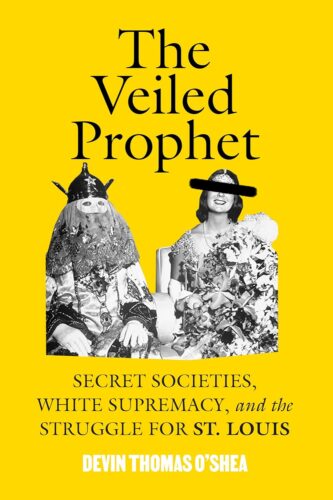 Someone once remarked that all great historical facts appear twice: first as tragedy, then as farce. He might have added a third iteration: their reappearance in a world fit for a Thomas Pynchon plot. Here’s a sampling of the dramatis personae in Devin Thomas O’Shea’s The Veiled Prophet: secret societies, Klan terrorism, robber barons, communists, exiled revolutionaries, railroads, Mardi Gras krewes, Agent Orange, Confederates, Freemasons, Arabian fairy tales, Reconstruction, uprisings of every hue, urban renewal schemes, real estate cartels, the Pentagon, street theater, Boeing, Monsanto, McDonnell Douglas, and Al-Qaeda. Its characters have names like Alonzo Slayback, Mr. Cockerill, “Ole Pap” Price, “Ole” Mac, and Otto Menger. This brisk inventory only hints at the dense political chicanery on display. Originally conceived as a Pynchonesque novel, a path later preempted by Jonathan Franzen’s The Twenty-Seventh City, The Veiled Prophet is a riotous history lesson: a century-spanning x-ray of the underbelly of St. Louis.
At its core, The Veiled Prophet traces how reactionary power consolidated in response to perceived labor domination. In 1877, amid the upheaval of the Great Railroad Strike, St. Louis stood as a vital rail and river hub, central to westward expansion. Like much of the Midwest, it had a large German immigrant population, including many Forty-Eighters—veterans of the failed revolutions of 1848, among them committed socialists and communists. Then the fourth-largest city in the United States, St. Louis saw a level of worker militancy that alarmed its ruling class and threatened its aspirations for metropolitan, even national, power. Strike leaders seized businesses and organized the distribution of essential goods, prompting later observers to invoke the shorthand of a “St. Louis soviet.” As O’Shea makes clear, the city’s elite understood the need to crush union power. Faced with “the threat of a united multiracial working class,” he writes, the bigwigs founded the costumed Veiled Prophet Society to “reknit the tear in the bourgeois social fabric between Northern and Southern whiteness.” In effect, they staged a Mardi Gras spectacle of white elite power to mask the violent suppression of the underclass.
The Society fused Klan iconography with Orientalist fantasy, borrowing from distorted visions of Asian and Islamic cultures to cloak its intimidation in an air of mysticism. Its inaugural “Prophet” was the city’s police chief. The threatening message—to union militants, Black residents, and immigrant communities—was unmistakable. Alonzo Slayback, a Lost Cause Confederate, led the effort after failed bids to push Missouri into secession and to establish a colony in Mexico. The idea for the Society followed a sojourn in New Orleans, where Alonzo’s brother Charles ran a successful business. There, inspired by Mardi Gras pageantry—particularly the Mystick Krewe of Comus—Slayback devised the Veiled Prophet as a ritualized assertion of the authority of capital and the social pecking order it sustained.
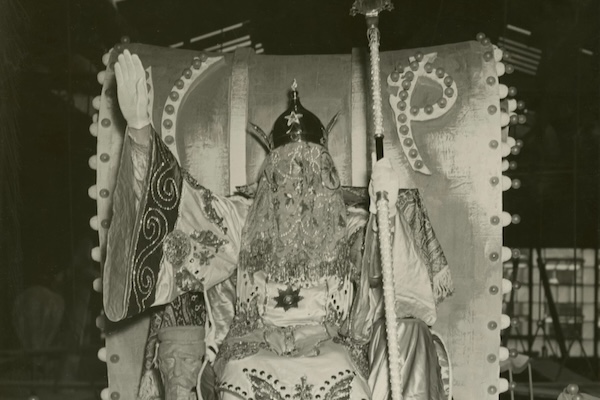
A 1935 image of the Veiled Prophet. Part of the caption: “His mysterious majesty, the Veiled Prophet; who will pay his 57th annual visit to St. Louis, October 8th and 9th.” Photo: Ruth Cunliff Russell/Missouri History Museum
Drawing on a wide range of historical scholarship and period journalism, O’Shea traces the Society’s origins through to the early years of the Black Lives Matter movement in nearby Ferguson. The result is a sweeping tableau of rebellion and retrenchment: a familiar Marxist dialectic in which reaction repeatedly outlasts those who produce—and bear—the costs of immense wealth. The Veiled Prophet Society does not merely display power through ritual; it adapts, preserving its influence as the city is reshaped by suburbanization, privatization, and the enclosure of public life, processes that hollow out the urban core and fracture working-class communities. Meanwhile, factions within the ruling class compete for dominance, even as their shared conservatism equips them to recognize, and respond to, the dynamics of class conflict more coherently than their opponents. What emerges is both a psychology and a playbook of an entrenched elite resistant to the transformations implied by organized labor.
There are, inevitably, more granular histories that could deepen O’Shea’s account as it moves briskly across eras of development—or, as he provocatively frames it, anti-development. Still, the book’s breadth is its strength. Any thread can be followed outward, revealing the durable structures of bipartisan conservatism that continue to shape St. Louis and the nation. In this sense, The Veiled Prophet performs a demystifying function, stripping away the ornamental language and conspiratorial fog that so often obscure the workings of power in a capitalist society. What remains is less spectral than solidly material: not hidden hands, but familiar figures grabbing for power—police, businessmen, politicians—operating in plain view even as they labor to preserve the illusion of invisibility.
Lucas Spiro is a writer living in Dublin.
Tagged: Agent Orange, Arabian fairy tales, Confederates, Devin Thomas O'Shea, Freemasons, Haymarket Books, Klan terrorism, Mardi Gras krewes, Reconstruction, St. Louis, Veiled Prophet, Veiled Prophet Society, communists, exiled revolutionaries, railroads, robber barons
3 Comments
Leave a Comment

That’s some mighty fine insight.
First time tragedy, second time farce is from Marx’s 18 Brumaire of Louis Bonaparte—not hard to track down.
Those with St. Louis roots will roll their eyes at this book. The Veiled Prophet has for a long time (back to my mother’s day) been nothing more than a debutante ball for the daughters of people who are into that sort of thing.
Everyone knows the Marx quote. A little ironic distance was a stylistic choice to keep in line with the comparison to the Pynchon for the sake of a bit of levity. Quoting it in total sincerity felt too cliched for the average Arts Fuse reader.
The author is from St. Louis so I’d take it up with him but his book traces what turned into what many think was nothing more than a debutante ball back to when it was maybe more than just a debutante ball. Was your mom around in the 1880s?