Classical Music Concert: Fire and Friction at Boston Modern Orchestra Project’s Night of Premieres
By Aaron Keebaugh
A fierce new cello concerto and adventurous premieres showcase the orchestra’s flair for the elemental.
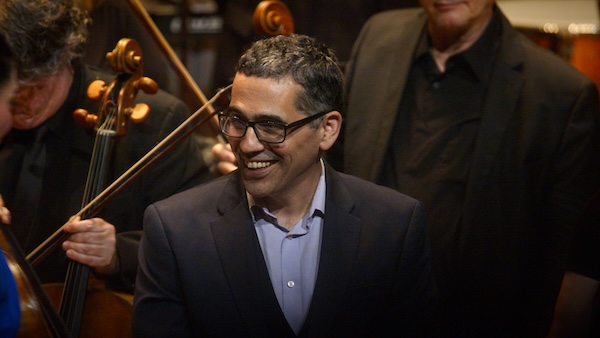
Composer Avner Dorman at the BMOP premiere of Inner Fire, his concerto for cello and orchestra. Photo: Dave Jamrog
The music of contemporary American composer Avner Dorman routinely wrestles with the complicated emotions generated by internal strife. But Inner Fire, his new concerto for cello and orchestra, makes that psychological turmoil feel especially immediate and arresting. Heard in its world premiere by cellist Kristina Reiko Cooper and the Boston Modern Orchestra Project last weekend, the substantial score fulfills its title: it begins with glowing embers that gradually erupt into a bright blaze over the course of its half-hour span. Conductor Gil Rose allowed the music’s accumulating kinetic energy to surge with natural vigor.
Composed expressly for Cooper, Inner Fire is less a homage to fire than an exploration of its capacity for destruction, transformation, and renewal. Its five movements, played without pause, crackle with a rigorous, live-wire tension as soloist and orchestra vie for dominance. Moments of repose surface along the way, but this is music driven more by conflict than cooperation.
The opening “Invocation” unfolds with Cooper alone, her cello tracing wistful phrases over gently pulsing basses. As this invitation to grapple develops, the orchestra grows increasingly agitated, until winds and strings can barely contain their force. “Ignition” presses forward with even greater urgency, its exchanges between cello and orchestra tearing at the air. Cooper shapes the cadenzas into long, arching lines that briefly ease the tension—but only momentarily. “Wildfire” drives relentlessly toward sonic extremity. The lone respite comes with “Hearth,” a brief interlude of warmth and calm before the flames reignite in the concluding “Inner Fire.”
At its peak, Inner Fire recalls the expressive sweep of Bloch’s Schelomo and Shostakovich’s cello concertos, though with fewer harmonic barbs. Even so, Dorman’s voice remains distinct, bending tradition to his own ends. It stands among his most compelling recent works, and Cooper, Rose, and BMOP delivered it with electrifying commitment.
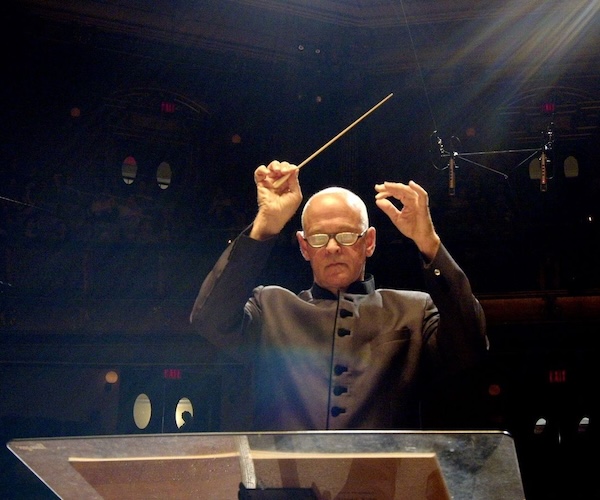
Gil Rose conducting the BMOP. Photo: Dave Jamrog
A comparable sense of drama and surprise animated John Aylward’s History of the World, also heard in its world premiere. Drawing on the legacies of Michelangelo and Galileo, the piece dramatizes the tension between artistic vision and scientific inquiry. Moving between shadow and radiance, it evokes enduring conflicts between ancient mystery and modern discovery.
This idea unfolds across two movements inspired by biblical figures: David and Adam and Eve. Each begins in a kind of sonic primordial soup, with brass and percussion rumbling through loose, unsettled textures. Gradually, sharper lines emerge, flashing like lightning. The harmonies they leave behind hover in prismatic suspension. The effect is elemental—gestures collide and overlap, often resisting clear resolution.
Yet the score is not all turbulence. In the second movement, single tones accumulate into luminous harmonies. Strings ripple gently, and brass coalesce into delicate, shimmering sonorities. Rose led a finely detailed performance that illuminated the work’s shifting textures.
The second half of the program featured New England premieres of Paul Moravec’s Miami Variations and Bernard Rogers’s seldom-heard Symphony No. 5, “Africa.”
Moravec’s piece, written for the University of Miami’s 2025 centennial, brims with energy and color. It paints a portrait of a city alive with cultural and ideological diversity. Rhythms pulse throughout, woodwinds propel playful thematic fragments, and brass interjections slip into jazzy inflections. Beneath it all, the strings sustain a unifying thread, suggesting constant motion. BMOP rendered the work as a vivid, kinetic urban panorama.
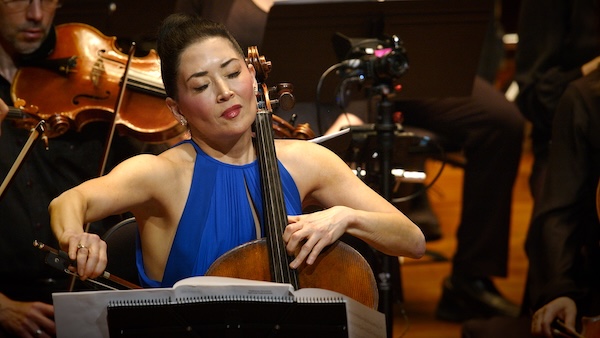
Cellist Kristina Reiko Cooper and the Boston Modern Orchestra Project performing Inner Fire. Photo: Dave Jamrog
The ensemble brought similar care to Rogers’s Fifth Symphony. Like the other works on the program, it avoids literal depiction, instead evoking suggestive and elusive imagery.
Though Rogers composed widely, he is best remembered as a teacher—his students at Eastman included Peter Mennin, Dominick Argento, and David Diamond. That legacy has overshadowed music that is often strikingly immediate and sensuous, drawing on sources ranging from the Bible to modern poetry and Japanese prints.
BMOP’s ongoing effort to revisit his symphonies is therefore especially welcome. The performance of the Fifth made a strong case for the project: completed in 1959, its two movements are packed with driving rhythms and vivid contrasts, offering an evocative, if impressionistic, portrait of Africa.
The opening unfolds in shadow, with little warmth, but its palette gradually brightens, even as the music maintains a certain distance and air of mystery. In the second movement, percussion propels the action forward, and the music resists settling into equilibrium. Rose and the orchestra played with assurance and clarity, making a persuasive argument for a composer whose work still has much to offer. Kudos to BMOP for this revival—and for those yet to come.
Aaron Keebaugh has been a classical music critic in Boston since 2012. His work has been featured in the Musical Times, Corymbus, Boston Classical Review, Early Music America, and BBC Radio 3. A musicologist, he teaches at North Shore Community College in both Danvers and Lynn.
Tagged: Avner Dorman, Boston Modern Orchestra Project, Gil Rose and the Boston Modern Orchestra Project