Poetry Review: Nicole Yurcaba’s “Hutsulka” — Lost in Translation, Living in War
By Olga Livshin
A compelling exploration of diasporic grief and the limits of a poetic response to war.
Hutsulka by Nicole Yurcaba. River Paw Press, 42 pages, $17.99
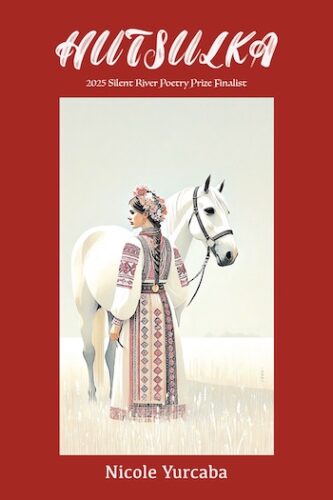
Nicole Yurcaba’s 2026 chapbook Hutsulka opens with a stark articulation of linguistic and cultural dislocation: “You don’t know / what it is like spending your life lost in translation.” She continues, “how one language wrestles / a second or third face-down into mud.” The title refers to the feminine form of Hutsul, an ethnic group from the Carpathians of western Ukraine and northern Romania, and one of Yurcaba’s identities. Another recurring presence is the Lemko people, a Carpathian minority spread across Ukraine, Slovakia, and Poland. A finalist for the 2025 Silent River Poetry Prize, the chapbook appears from River Paw Press, a publisher with a sustained commitment to Ukrainian literature; its catalog includes the anthology Sunflowers: Ukrainian Poetry on War, Resistance, Hope and Peace (2022).
Yurcaba is deeply invested in her heritage while remaining attuned to its contradictions. She writes as an outsider in both Ukraine and the United States, marked by “the way your tongue roughs up / my unpronounceable name / clean-cut in my own nearly extinct language.” This estrangement is compounded by a grief unavailable to those around her: the ongoing violence in Ukraine, particularly in the regions where her parents once lived and where her extended family remains. The poems register both a longing to alter that reality and a helplessness in the face of it, returning again and again to the refrain “war in my homeland.”
The question of poetic intervention hovers throughout. As Ukrainian-American poet and translator Olena Jennings wrote in 2022, “There are situations we watch from a distance, unsure how to intervene…. I write this text. … I translate. I attempt to bring the language to a new soil.” Hutsulka stages a similar search for response, but rather than mediating between cultures, it focuses on the widening gap between Ukrainians and others. The speaker compulsively tracks the news even as she moves through the motions of daily life—work, bars, relationships: “I’m eating Taco Bell & checking / casualty counts.” Although she is thousands of miles away from Ukraine, her pain is here, teeming just below the surface, surfacing in gestures of uneasy self-comfort: “I cope with the silence / by taking another bite of processed taco.” This tension between distant catastrophe and ordinary routine will feel familiar not only to diasporic readers but also to Americans absorbing a relentless political news cycle while carrying on with daily life.
Yurcaba renders diasporic wartime existence as profoundly isolating. Many of the speaker’s interlocutors are men who offer the promise of intimacy or understanding but ultimately fail to engage the reality of ongoing violence. Wartime language carries a different weight for someone with familial ties to a place under siege, and the speaker finds herself “invisible, unnoticeable.” Her body registers trauma that intimacy cannot adequately translate or share. The poems also critique the dynamics of gender and cultural authority: American men, positioned within dominant structures, often show little interest in understanding her experience. Some presume to explain Ukraine back to her—“Tell me again,” she challenges, “how you want to fight / Zabuzhko’s sentences into philosophies / bound by proper punctuation”—a pointed reference to Oksana Zabuzhko’s formally expansive work. (Zabuzhko, the seminal female Ukrainian fiction writer and scholar, uses stream-of-consciousness narration.)
Relationships unravel in parallel with the exhaustion and attrition of war. “What I can offer isn’t enough / to keep you,” the speaker admits, even as she gestures toward shared intellectual and cultural life: “long afternoons discussing Socrates / & Skovoroda’s writings, a photo of books / received through the mail.” Yet Hutsulka itself offers that richness in abundance, ranging from imagined dialogues with Kafka to evocations of Lemko and Hutsul memory, dress, and landscape. The result is a compelling and urgent collection, resonant for readers within the Ukrainian diaspora, those seeking to understand it, and anyone navigating the pressures of an increasingly fractured present.
Olga Livshin’s poetry appears in AGNI, Poetry, The Southern Review, and others. She is the author of A Life Replaced (Poets & Traitors Press, 2019) and co-translator of Today is a Different War by the Ukrainian poet Lyudmyla Khersonska (Arrowsmith Press, 2023).