Book Review: Rivalry as Collaboration — Dylan, the Beatles, and the Sound of Influence
By Michael Londra
Jim Windolf’s joint portrait argues that competition between icons did not divide them—it reshaped modern music.
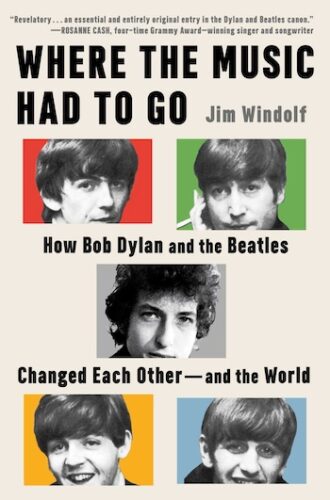
Where the Music Had to Go: How Bob Dylan and the Beatles Changed Each Other—and The World by Jim Windolf. Scribner, 400 pp, $30
Is rivalry good for art? Béla Bartók opined competition was “for horses, not artists.” History tells a different story. Plutarch, for example, describes how young gun Sophocles defeated the old dog Aeschylus—the “father of tragedy”—winning first prize at the Athenian theatrical festival honoring the god Dionysus. Sophocles needed to innovate in order to one-up Aeschylus. Reportedly, according to Aristotle, the dude introduced an unprecedented third speaking actor on stage. In other words, Ancient Greece’s obsession with turning everything into the Olympics helped forge a formidable intellectual legacy. The same holds for the Elizabethans. Shakespeare primarily dueled for recognition with four playwrights affiliated with Cambridge, known as the “University Wits”—Christopher Marlowe, Thomas Nashe, Robert Greene, and Thomas Kyd—and developed into England’s national poet.
We might call them the Bard’s Fab Four. This is because Jim Windolf’s Where the Music Had to Go chronicles a similarly competitive milieu consisting of an individual talent versus a highly popular quartet. Thousands of titles parse these luminaries individually—this is the first attempt to write a joint biography. Critics have mostly agreed that there is no “there” there—not enough common experience to merit a book-length analysis. That is, aside from the notorious encounter, demythologized here by Windolf, at Manhattan’s Delmonico Hotel in 1964, when Dylan meets John, Paul, George, and Ringo for the first time; and where, in turn, he “introduces” them to marijuana.
Indeed, despite occasionally overplaying his hand, New York Times features editor Windolf debunks a number of false beliefs with a page-turning account of “the long and eventful relationship between Bob Dylan and the Beatles.” Structuring his narrative chronologically, the meat of the book focuses on the sixties. Subsequent decades are telescoped into the final two chapters. Windolf synthesizes diverse sources “scattered piecemeal across biographies, out-of-print memoirs, and long-buried articles” and has come up with numerous interesting anecdotes, such as an Isle of Wight tennis match between Dylan, Lennon, Harrison, and Ringo.
Windolf settles into his best storytelling mode when noting revealing parallels and coincidences along the road to stardom and beyond. For example, he delves into the Beatles’ Liverpool apprenticeship and Dylan’s formative years in Hibbing, Minnesota. Coming of age in communities saddled with economic hardship, it was his subjects’ love of midcentury American pop culture—as well as loathing for bourgeois conformity—that transformed snot-nosed Cold War kids on either side of the Atlantic into virulent “disciples of Little Richard,” inexorably “moving toward each other.” But while it’s true Little Richard was a “key influence on Dylan and the Beatles,” Windolf does not seize the opportunity to explore the more seminal influence of folk-blues pioneer Huddie “Lead Belly” Ledbetter (1888–1949). Eulogized in Dylan’s 2016 Nobel speech, Lead Belly’s voice “changed my life… I’d been walking in darkness, and all of a sudden the darkness was illuminated.” George Harrison was equally pointed—as quoted in 2015 by Roger Catlin for Smithsonian magazine: “No Lead Belly, no Beatles.”
Portraiture rather than musicology is Windolf’s strength. This is evident in his depiction of Dylan’s epiphany when he finally “gets” the Beatles. Previously dismissing them as “bubblegum,” Dylan finds himself the prisoner of his car radio on a 1964 road trip. Besieged by “I Wanna Hold Your Hand,” Windolf tells us Dylan stops at a café and eagerly feeds quarters into a jukebox to hear “She Loves You” again and again. Meanwhile, in Paris, the Beatles groove to Dylan’s first albums, unwinding after nightly concerts. Harrison recalled: “We recognized some vital energy, a voice crying out somewhere, toiling in the darkness.”

New York Times features editor Jim Windolf. Photo: Susan Rushing
The Beatles goad Bob to plug in a Stratocaster, but Lennon pivots in the opposite direction. Windolf misses the point when he characterizes 1965’s “You’ve Got to Hide Your Love Away” as John’s “most Dylan-esque creation.” He attempts to connect Lennon’s lyrics to Dylan: “The first two lines… show that he was not bothering to conceal his new influence: ‘head in hand’ echoes ‘my head in my hand’ on ‘Honey, Just Allow Me One More Chance’ from The Freewheelin’ Bob Dylan; ‘face to the wall’ is a close match for ‘facing the wall’ in ‘I Don’t Believe You (She Acts Like We Never Have Met),’ a favorite track of John’s.”
For me, Lennon is borrowing Bob’s vibe. He is not alluding to Dylan’s lyrics, but repurposing the other songwriter’s rhetorical stance—Bob’s approach to the form. Lennon pours his own content into Dylan’s vessel. Critics admit “You’ve Got to Hide Your Love Away” addresses closeted Beatles manager Brian Epstein, expressing what it might mean to be gay in a homophobic world. Dylan is too cynical to embrace this empathic sensibility, at least not until 1975’s Blood on the Tracks. Windolf is correct, though, in underlining that “You’ve Got to Hide Your Love Away” has “no bridge.” Namely, it lacks a key change in the song’s eight “middle” bars. The Beatles appropriated this technique from Tin Pan Alley. In “Hide Your Love Away,” Lennon dropped it. Conversely, for the first time, under the Lennon-McCartney spell, Dylan inserts one on “Ballad of a Thin Man” from Highway 61 Revisited.
Dylan was defensive about fruitful cross-pollination, deeming Lennon a plagiarist. Windolf’s best section probes Dylan’s kerfuffle with Lennon over this issue, after John records “Norwegian Wood.” At this point, Bob “felt things had gone too far.” Windolf thinks so too, arguing that John’s composition is “a very Bob Dylan song.” This is debatable. For one, the tune’s lead instrument is a sitar. In response, Bob pens “Fourth Time Around,” aping “Norwegian Wood” note for note, the title derisively pointing to the number of times Lennon had “filched from the Dylan songbook.”
Months later, the gloves come off. Staying at the May Fair Hotel in London, Dylan has the Beatles over to his suite, “listening to music, drinking, and smoking joints until the early hours.” Pre-release acetates of Revolver and advance tapes of Blonde on Blonde are spun. “Fourth Time Around” is “unveiled,” and “John felt ill at ease to hear his own melody coming back at him.” Instead of admitting any guilt, Paul and John openly laugh at Lennon’s sarcastic comeback: “That ought to be in Northern Songs,” referring to the Beatles’ music publishing company. Bob has been denied his big gotcha triumph. Strong enough to stare down booing audiences scandalized by his new electric repertoire, being made fun of to his face seemed to wound him more. Still vexed and nursing a grudge for nearly two weeks, Dylan confronted John again. While being filmed in the back of a limo, Dylan ambushes Lennon about what he sees as his bald imitations. According to Windolf, Bob comes on like a “prosecutor out of an old courtroom drama.” Lennon isn’t intimidated, and uses humor to defuse the tension. Suddenly Dylan doubles over, nauseous from partying. Scene over.
Where the Music Had to Go is not definitive, but it is enlightening. Windolf proves that rivalries can be synonymous with collaboration. (Shakespeare even united with Christopher Marlowe on Henry VI.) After all, art boils down to what Dylan called “everybody’s song.” Apropos of that sentiment, the track following “Fourth Time Around” on Blonde on Blonde is “Obviously Five Believers.” Windolf perhaps overlooks that. Does anyone else see this as revelatory? The tune is “obviously” an olive branch to the Beatles. It is a more poetic evocation of comradeship than “Roll on John,” the hackneyed 2013 Dylan tribute to Lennon quoted at the end of this biography. Dylan and the Beatles can be seen as “five believers,” proselytizing for the salvation of rock ’n’ roll. After Bob got “Fourth Time Around”off his chest, the penultimate stanza of this song may be about Dylan mending fences — it could be an homage to the Beatles as his musical BFFs: “Five believers / All dressed like men / Tell your mama not to worry because / Yes, they’re just my friends.”
Michael Londra—poet, fiction writer, critic—recently introduced the Poets Confront AI and Surveillance Capitalism event at Poets House, available on YouTube. He also talks New York writers in the YouTube indie doc Only the Dead Know Brooklyn (dir. Barbara Glasser, 2022). “Time is the Fire,” the prologue to his soon-completed novel of Delmore Schwartz and Lou Reed appears in DarkWinter Literary Magazine. His poetry was translated into Chinese by scholar-poet Yongbo Ma. Two of his Asian Review of Books contributions were named Highlights of the Year for 2024 and 2025, one of which was translated into Vietnamese. “Life in a State of Sparkle—The Writings of David Shapiro” from The Arts Fuse was selected for the Best American Poetry blog. He can also be found or is forthcoming in Lana Turner: A Journal of Poetry & Opinion, Restless Messengers, The Fortnightly Review, spoKe, Cha: An Asian Literary Journal, and The Blue Mountain Review, among others. He added six essays and the introduction to New Studies in Delmore Schwartz, coming next year. Born in New York City, he lives in Manhattan.
Tagged: "Where the Music Had to Go: How Bob Dylan and the Beatles Changed Each Other—and The World", Bob-Dylan, Jim Windolf