Book Review: Throwing Some Shade on Shade — A Case for Sunlight
By David Mehegan
A science writer challenges the orthodoxy on sun exposure, arguing for its benefits while downplaying its risks.
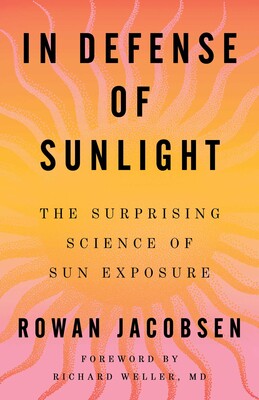
In Defense of Sunlight: The Surprising Science of Sun Exposure by Rowan Jacobsen. Scribner. 268 pp. Cloth. Illustrated. $29
Growing up with fair skin on the Irish Riviera, as Massachusetts South Shore towns were once called, I envied kids who tanned practically as soon as they put on swimsuits and shorts when school was out. Me, I never could get a tan and felt unattractive because of it. Remember the Coppertone slogan? “Don’t be a paleface!” Which I was. How I envied the golden girls and boys! The solution, everyone knew, was to go ahead and get sunburned (but not horribly), and when the damaged skin peeled away, voilà—at least some tan, which, alas, would fade over the next fall and winter. Doomed to be a paleface!
Today I think of that with dread. Bad enough to suppose that any skin color is correlated with beauty and that changing it is possible or desirable. But to fry your flesh? That seems to be insane given what we now know about the effects of UV rays, especially the UVB type and its role in skin cancers, particularly malignant melanoma. The much more common basal cell and squamous cell skin cancers are rarely fatal. Nevertheless, nowadays we’re taught to treat them all as dangerous and to follow the Australian “slip, slop, slap” sun policy, drummed there into the heads of kids and their parents: slip on a shirt, slop on sunscreen, slap on a hat.
While it was nuts in the past to embrace sunburns in hopes of social success, it’s also true that today’s common anti-skin cancer recommendations would suggest to any reasonable person that sunshine is a deadly poison. It’s like the recent warning that there’s no safe amount of alcohol. None! Consider, for instance, this anti-skin cancer regimen from the current website of Memorial Sloan Kettering Cancer Center:
“Wear protective clothing such as long-sleeve shirts, wide-brimmed hats, and sunglasses.
“Protect yourself from sun rays by wearing broad-spectrum sunscreen. Broad spectrum means it blocks both types of UV rays (UVA and UVB).
“Apply sunscreen with an SPF of 30 or higher 30 minutes before going outside. Do this even on cloudy days and in the winter.
“Apply a thick layer of sunscreen, about 2 tablespoons, on your face and body.
“Reapply sunscreen every 2 hours and after swimming, toweling, or sweating.
“Stay out of the sun from 10 a.m. to 4 p.m. when rays are the strongest.
“Get into the shade whenever possible.
“Do not use indoor tanning machines.”[1]
OK, right, avoid those stupid tanning beds and clinics. Don’t roast your skin on the beach, boats, or golf course for hours at a time, especially at midday. But apply a thick layer of sunscreen, SPF 30 or higher, every two hours, even in the winter? Stay out of the sun between 10 and 4? Get into the shade whenever possible? Come on, we’re being told to get in a cave and stay there.
Now comes science writer Rowan Jacobsen, who argues that while severe sunburns—especially in childhood—are indeed a significant risk factor for skin cancer later in life, the broader claim that all sunlight is harmful and should be avoided is both incorrect and unsupported by science. In fact, he argues that we need sunlight for good health, both physical and emotional, and that human beings could not have evolved successfully in a sunlit world if sunshine per se were a killer.
Jacobsen points out that melanoma diagnoses continued to rise even after people began slipping, slopping, and slapping, citing eminent dermatologist Bernard Ackerman, who told the New York Times that “the field is replete with nonsense.” Ackerman maintained that “the evidence that sunscreen could prevent melanoma was weak, and that the epidemic was being driven mostly by overdiagnosis. ‘There has been a mania for taking off these moles that are of no consequence. … We’re talking about billions and billions of dollars being spent, based on hype.’”
The curious fact is that while diagnoses of melanoma have skyrocketed in recent decades, the mortality rates have not. This is because, Jacobsen writes, what most of the skin screenings found are “what are known as in situ or ‘stage 0’ melanomas. These are small lesions that are confined to the surface of the skin and haven’t yet shown signs of spreading.” And improvements in treatment have reduced the mortality of invasive cases.

Science writer Rowan Jacobsen Photo: courtesy of the Knight Science Journalism Program
Citing a wide range of studies—most notably a landmark study of Swedish women—Jacobsen argues that sunlight exposure is essential to health. Its benefits extend beyond the production of bone-supporting vitamin D to include improved cardiovascular health, reduced risks of stroke, diabetes, and high blood pressure, as well as better sleep and stronger immune function. He places particular emphasis on its role in emotional well-being and the prevention of depression.
In Defense of Sunlight is extensively footnoted, drawing on a wide range of scientific studies. It includes a glossy, tipped-in section explaining the science of light—its nature, its wavelengths, and their effects on living organisms—along with a glossary and an excellent index. The result is an impressive primer on both historical and current knowledge. Jacobsen also writes with clarity and ease, making the material readily digestible.
His recommendations come down to a few things: sunshine early and late in the day is better and safer. Wear sunscreen (but avoid SPF above 30) if you must be out midday. He expresses his guidance in seven words: “Get sun. Not too much. Go outside.” Above all, pace my boyhood days, don’t try to get a tan by cooking your skin. But do get as much sunshine as you safely can.
A caveat: Jacobsen makes no effort to hide his biased premise. This guy loves sunshine. “I live in Vermont,” he writes in his introduction. “Gorgeous summers, brutal winters. Over the years, I started to notice what a profound effect the different season had on me. Basically, winter sucked. This was not simple SAD (seasonal affective disorder) … in which people feel low during the winter months. I didn’t feel depressed in winter. I felt as if my cells didn’t work.”
“In summer, my senses were sharper. My thinking was sharper, I ate less but did more. My skin felt snappier, especially once it got a little color. I was way happier. Small things seemed deeply pleasing.” His joy in the rays is mentioned throughout. It’s as if he must be right about sunshine because it makes him feel so great. But what exactly is a snappy feeling in the skin? The author photograph shows a wide-smiling fellow with a touch of gray and, no surprise, golden skin color. One might be forgiven, in reading this book, for inferring that sunshine is a magic elixir for whatever ails you.
Not that one expects such a book to argue against itself, of course, yet it is noticeable that Jacobsen cites no contemporary research contrary to his claims. Of course, surely not everybody of substance in the dermatology and cancer fields agrees with him about the magic properties of sunlight. I don’t know about Dana-Farber, but it appears that Memorial Sloan Kettering might beg to differ
David Mehegan is the former Book Editor of the Boston Globe. He can be reached at [email protected]. He won’t be on the beach.
[1] https://www.mskcc.org/cancer-care/types/melanoma/risk-factors-prevention