Theater Review: “The Zionists” — A Bold Debate, Blunted
By Bill Marx
S. Asher Gelman’s script opens as a rare, bracing political drama before collapsing into conventional family melodrama.
The Zionists: A Family Storm by S. Asher Gelman. Directed by Chloe Treat. Staged by Barrington Stage Company at the Boyd-Quinson Stage, 36 Linden Street, Pittsfield, through July 3.
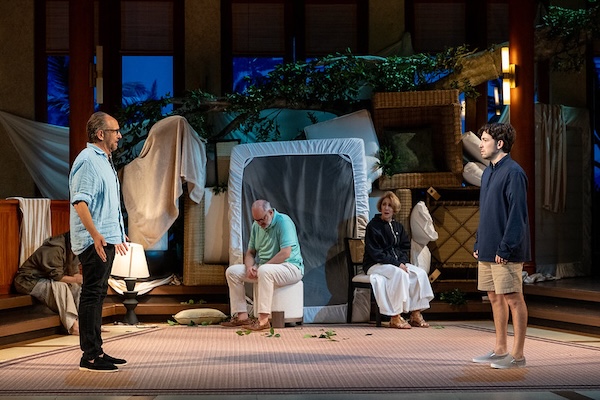
(L-R) Gregg Weiner, Adam Grupper, Joanna Glushak, and Coby Getzug in Barrington Stage Company’s production of S. Asher Gelman’s The Zionists: A Family Storm. Photo: Daniel Rader
Pick your contemporary crisis, any that comes to mind: the erosion of American democracy, widening income inequality, the authoritarian muscle-flexing of an empowered oligarchy, the rewriting of history by our government, the scapegoating and imprisonment of immigrants, the savage conflict between Russia and Ukraine, mass killings and widespread civilian deaths in Sudan, or the Israel-Gaza war, which has prompted global accusations of genocide, the depth and breadth of the eradication of human life depending on this country’s military resources. The strategy of Boston-area theaters has been to sidestep these moral and economic crises by maintaining a blithe spirit — business as usual, avoid anything that might seem “too political,” and wait for normalcy to return. The problem (and the opportunity for those willing to seize it) is that the good old days may not be coming back.
Well-deserved kudos to a playwright willing to take on — and to a theater company willing to stage — a drama that tackles what many believe is a tragic, ongoing assault on universal human rights that is causing lasting damage to international norms, diplomatic credibility, and the fragile architecture of global accountability. So far as I can tell, New England theaters have shied away from the Israel-Gaza conflict. Aside from an anachronistic revival of the one-person show Golda and a production of Palestine, a one-woman show written and performed by Najla Said, Edward Said’s daughter, Boston-area theater spaces have avoided the subject. In the Berkshires, by contrast, Barrington Stage is presenting S. Asher Gelman’s admirable but flawed The Zionists: A Family Storm, which revolves around a fervent debate — Israel’s rampant militarism versus its claims to moral legitimacy — among the members of a wealthy, politically influential, and internally strained American family.
Set in November 2024, the story presents the Rosenberg clan vacationing at a ritzy Caribbean resort. Parents Ruth and Mitchell are attempting to stage an uneasy, likely futile attempt at reconciliation among their adult children. The gathering quickly curdles: long-standing tensions calcify into ideological trench warfare, ignited most visibly by Aaron—a gay recovering addict—who has siphoned family money into “Sons of Abraham,” which is backing pro-Palestinian groups, including Columbia University protesters. His older brother David, the family’s financial steward, counters with a zealous pro-Zionist stance; compounding his anger — his pregnant wife, a Columbia professor, has received death threats. Sister Bex and her partner Dana have returned from Israel with their daughter, convinced the country is unlivable—a fear that has led to a blunt withdrawal of empathy for Palestinians. Aaron’s husband, Zephyr, who is Black and teaches kindergarten, draws explicit parallels between Gaza and the history of racial violence in the United States. As accusations ricochet, the parents’ authority falters: Ruth clings to an impassioned but all-too-familiar defense of a Jewish homeland, while Mitchell retreats to bewilderment, asking whether a family incapable of civil discourse underlines the fact that any political resolution may be impossible. Gelman lets that question hang, as he does whether the Rosenbergs should consider themselves to be “good people.”
The play’s first act deftly dovetails political disagreement with personal fractures among the Rosenbergs. Its heated exchanges dare to confront urgent questions: Is Israel committing genocide? Is Zionism claiming a right to act militarily without ethical or legal constraint—including the killing of women and children—in the name of security? Gelman taps into an increasingly ugly strategy: some defenders of Israel classify any criticism of Zionism in this current form as inherently antisemitic. Does advocating for Palestinians—including calling for a separate state or defining Israel as an apartheid state—constitute antisemitism? Are the country’s actions in Gaza—and now in Lebanon, where more than 1.5 million people have been displaced by the IDF—proportionate responses to Arab aggression? The exigency of this question has become sharper as attention shifts to Iran and Lebanon, pushing Gaza into the margins, even as a recent UN commission report concludes that Israeli forces “have deliberately targeted Palestinian children resulting in genocide, crimes against humanity and war crimes in the Gaza Strip and war crimes in the West Bank.” Interspersed flashbacks efficiently sketch the characters’ concerns leading up to the vacation confrontations, as Gelman maintains a broadly sympathetic balance among these intersecting arguments.
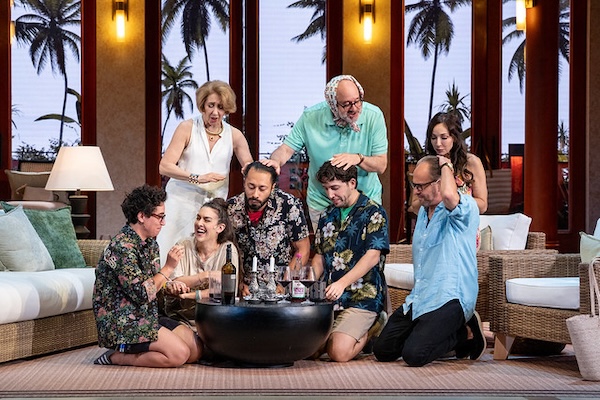
(L-R back) Joanna Glushak, Adam Grupper, Yvette Gonzalez-Nacer (L-R front) Shira Alon, Dani Stoller, William DeMeritt, Coby Getzug, Gregg Weiner. The cast of Barrington Stage Company’s production of The Zionists: A Family Storm. Photo: Daniel Rader
The script’s problems surface early. In the opening scenes, the parents are played too broadly, undercutting the playwright’s later efforts to endow them with second-act gravitas. The central storm metaphor—a massive hurricane bearing down on the resort—is rendered with all the subtlety of gale-force winds. Meanwhile, the extent of the Rosenbergs’ political and financial influence remains frustratingly vague. We’re told that if Aaron hadn’t spoken to The New York Times about his pro-Palestinian organization, Ruth might have been appointed ambassador to Israel, where she could have advanced the cause of peace. But what were the chances that, as a member of the Biden administration, she could have made any real difference—especially given her tendency to speak in maternal bromides?
Despite the lack of clarity here and elsewhere, the first act sustains an effective fusion of the personal and the political. As family members spar over questions of war and peace, morality and barbarism, the drama establishes a vital connection to the wider world. It is rare for an American play to function as a genuine forum for the give-and-take of contentious public debate.
Unfortunately, in the second act Gelman abandons the first act’s meritorious balance, narrowing rather than deepening the conflicts he has set in motion. The Zionists becomes yet another drama that stews in revelations of family secrets and long-simmering resentments; the life-and-death questions that once connected the play to the wider world give way to internecine grievances—charges of mistreatment, complaints of being misread or sidelined by siblings.
That backtracking feels especially disappointing because the earlier argument invited greater risk. With greater courage, The Zionists might have pushed further—probing not only the unintended consequences of Aaron’s advocacy for the Palestinian cause, but also the Rosenbergs’ own financial investments in Israel: where that money goes, what it enables, and whether such efforts might do as much harm as good. The title itself forecloses the possibility of Palestinian perspectives, though that absence may reflect the limits of what American theaters are willing to stage. Even so, the script’s near-total silence around the United States’ blank-check support for Israeli militarism—and the family’s implication in it—represents a missed opportunity. Wouldn’t these forces also shape the family’s fracture, informing not just their private resentments but the slippery moral terrain they inhabit?
In the end, Gelman turns to the threat of nature as a unifying device, arriving at a prayerful vision of cohesion forged less through reckoning than through fear—and one that feels dramatically and intellectually unearned.
Aside from occasional dips into sitcom rhythm to accommodate Gelman’s dollops of humor, director Chloe Treat capably marshals a large cast. The performances are solid, grounded in personal rather than polemical stakes, though often a bit one-note. After the opening, moments of ease all but vanish; each character seems to bide their time before detonating, and the relentless volatility becomes tiresome once the conflicts shrink to a series of domestic grievances. Dani Stoller captures Bex’s wavering emotional loyalties with precision; Coby Getzug lends Aaron a credible moral anguish. Cast as mediators, Joanna Glushak and Adam Grupper, as the parents, come off as tepid. By the second half, no performance breaks through the action’s accumulating internecine warfare. Even so, it is reassuring to see a production of a new play that insists on engaging the political and ethical horrors of the present moment, one that acknowledges that “a hard rain” is falling.
Bill Marx is the editor-in-chief of The Arts Fuse. For over four decades, he has written about arts and culture for print, broadcast, and online. He has regularly reviewed theater for National Public Radio Station WBUR and The Boston Globe. He created and edited WBUR Online Arts, a cultural webzine that in 2004 won an Online Journalism Award for Specialty Journalism. In 2007 he created The Arts Fuse, an online magazine dedicated to covering arts and culture in Boston and throughout New England.
Tagged: "The Zionists: A Family Storm", Adam Grupper, Barrington Stage Company, Chloe Treat, Coby Getzug, Dani Stoller, Gaza, Gregg Weiner, Israel, Joanna Glushak, S. Asher Gelman, Shira Alon, William DeMeritt