
Jazz Concert Review: The Bill Frisell Trio — This Old Cowpoke was not in the Mood
By Jon Garelick
When a favorite artist disappoints, is the fault in our stars or in ourselves?
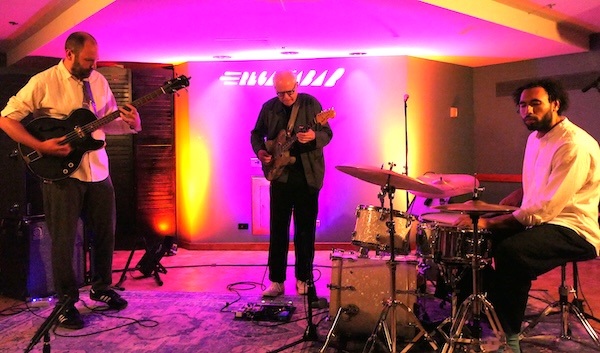
The Bill Frisell Trio at the Regattabar. Photo: Paul Robicheau
Somewhere in the middle of the Bill Frisell Trio’s take on “I’m an Old Cowhand” (Johnny Mercer, 1936) in their sold-out show at the Regattabar Thursday night — maybe after the third or fourth chorus —I thought, “I don’t like this song. I didn’t even like it when Sonny did it.”
I was guessing the selection was a tribute to Sonny Rollins, who died on May 25. But it wasn’t out of keeping with a set that included “Moon River” (Mercer, Henry Mancini, 1960), “People” (Jule Styne, Bob Merrill, 1963), “La-La (Means I Love You)” (Thom Bell, William Hart, 1967), and “These Days” (Jackson Browne, 1967). Or with the general Americana tilt of Frisell’s book, going back at least as far as Have a Little Faith (1992, Nonesuch), which ranged from Charles Ives and Aaron Copland to John Hiatt, Bob Dylan, and Madonna.
If you look up the history of “I’m an Old Cowhand (From the Rio Grande),” you’ll see that, more than a corny old cowboy song, it was actually a parody of Hollywood’s singing cowboys, whose satirical lyrics include, “I know every trail in the Lone Star State/’Cause I ride the range in a Ford V-8.” Irony! The first recorded version was made in 1936 by city slickers the Jimmy Dorsey Orchestra with singer Bing Crosby (born in Tacoma, Wash., raised in Spokane, in a state Frisell long called home), following a different version in Crosby’s own self-mocking singing-cowboy film, Rhythm on the Range. This was well in advance of Gene Autry’s version (from the 1941 movie Back in the Saddle, sung with Mary Lee) but the same year as the release of the Autry film The Singing Cowboy. Believe it or not, Crosby and the Dorsey band swing like hell, and Bing even offers his own broad crooner parody of the verse in the out-chorus.
“I’m an Old Cowhand” has been covered a zillion times, by everyone from Autry’s fellow singing cowboy Roy Rogers to Bobby Darin, the Mills Brothers, Clark Terry, Joshua Redman, and John Scofield. Redman takes the Rollins template — a “pianoless” trio, on 2007’s Back East, the title an explicit acknowledgment of Sonny’s 1957 sax-bass-drums Way Out West, where “Cowhand” was the lead track. Redman gets into the melody from an oblique angle, then plays the tune with incisive swing before taking off into state-of-the-art improvisation. The invention here is as hip and witty as it is straight-faced and “serious,” so that when the theme comes back it’s as real music. Scofield, meanwhile, offers one chorus of the tune, on solo ukelele, as a coda to his Country for Old Men (Impluse!, 2016), replete with a production effect of vinyl surface noise — elegiac and sweet. And when I went back to Sonny’s version, you know what? It was pretty damned good, even with the corny joke of the opening clip-clopping hooves of Shelly Manne’s drumsticks. Driving walking-bass swing, with Rollins at the height of his powers as a young improviser (age 27).
So why was I so cranky about Frisell’s “Cowhand”? By this point, the band was 20 minutes into the set. They had started with “Moon River,” coming at it from Frisell’s rubato intro of short, hesitant guitar phrases and a couple of pinging harmonics before Luke Bergman’s electric bass joined him in some counterlines with Tim Angulo’s scraping drumsticks, and then Frisell playing the unmistakable ascending fifth of the lyric’s first two syllables. The tune was full of Frisell’s delicate effects, his contrasting call-and-response with himself from his crystalline upper register to the twangy bottom. And there was one fast little recurring descending figure that seemed like a triggered effect, though I couldn’t see Frisell’s picking hand (or his feet, for that matter). It was all very rubato, until the band settled into 3/4 time, with Frisell comping Bergman’s bass solo, and then a reprise of that opening interval again. The rest of the melody was hard to discern, but when the little descending effect followed a phrase of guitar octaves, it was moonlight on water. Nice.
From there, it was a slow drift into Frisell’s “Claude Utley,” a tune I had not known (from 2022’s Four, on Blue Note). The tune’s intricate simplicity was fetching — an upward interval alternating with a rapidly ascending six-note pattern with a two-note tag. The tune wandered hither and yon before ending with a backwards guitar effect and a light snare roll.
By now, I was getting a little antsy, what with all the lovely impressionism, and was grateful when the loping alternating major and minor sixths of Monk’s “Misterioso” came into view. And here Angulo, who’d been providing key accents and color all night, got to stretch out with a solo that was succinct as it was exhilarating. Beginning by mimicking the rhythm of the melody, he built his patterns with acute attention to timbre — from rims and floor tom, adding in bass drum and hi-hat, and, finally, the declarative rattle of snare.
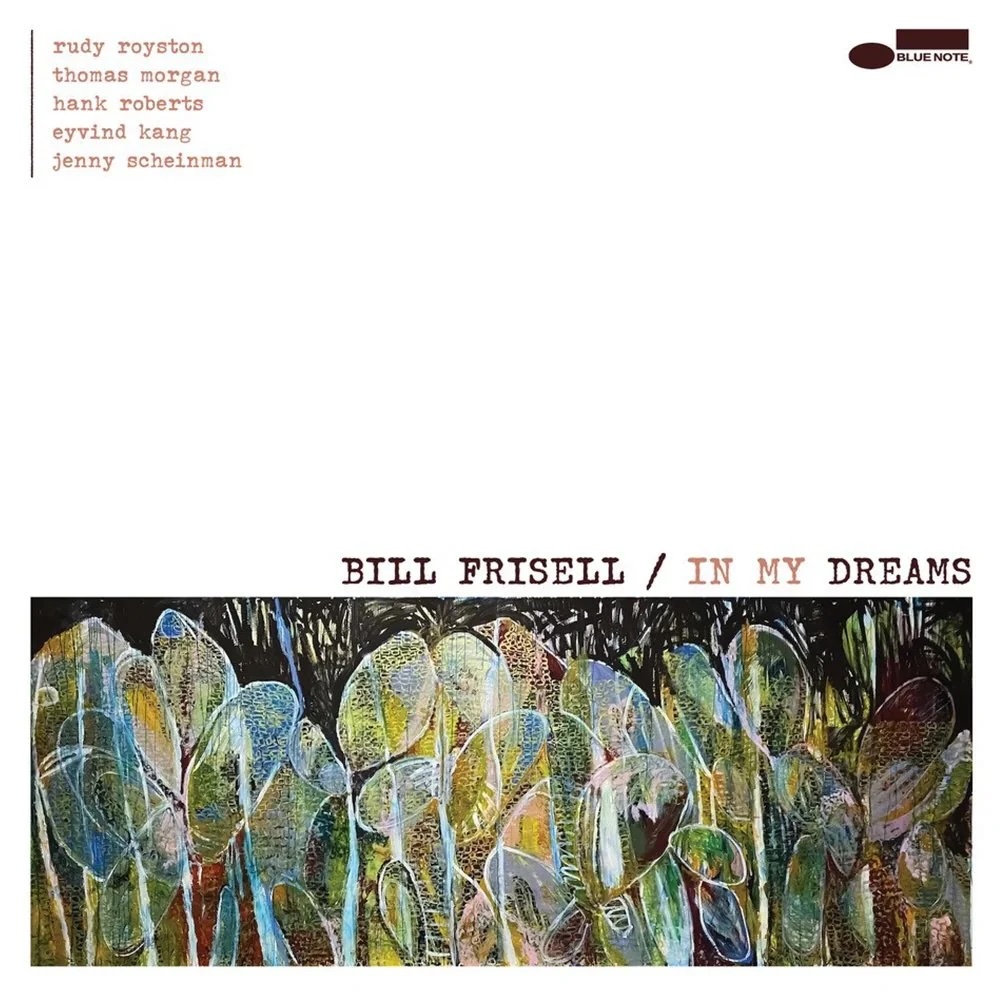
When Frisell segued to another rubato solo intro, he teased with a dark, noirish chord sequence over Angulo’s mallets. Nonetheless, I wrote in my notebook, “I’m ready for bed.” Still, the piece woke me up with its long-phrased 6/8 and the melody returning, with its suggestions of David Lynch. Appropriately enough, it turned out to be “In My Dreams,” better heard on Frisell’s new Blue Note release of the same name.
Then came Billy Strayhorn’s “Isfahan” (also on the new album), Frisell spelling out adjacent harmonies in the melody, with a nice hard hit from Argulo marking a cadence and then, lo and behold, suggesting dotted-rhythm swing with his cymbals. But it was not to be, the performance dissolving Strayhorn’s beautiful reverie from his and Ellington’s Far East Suite (now with a different layer of meaning, given the war with Iran).
And then, the dreaded “I’m an Old Cowhand,” Frisell in a throaty lower register with Argulo clopping (less overtly than Manne) those hoofbeats on his rims, eliciting some laughs from the audience. But it was nice to hear Frisell at last blowing over a walking bass. Here he delivered his chordal variations with some rhythmic spine, reinforced by some nice drum breaks with a tart repeated guitar note. They ended it with a vaudeville tag phrase, getting more chuckles. “La La (Means I Love You)” was lovely if brief, conjuring versions by the Jackson 5 and the Delfonics.
Finally came “People,” another immediately recognizable two-syllable interval that got another appreciative laugh. There was more nice lower-register twang from Frisell, more noirish chords, and pinging harmonics. But given Frisell’s social awareness (“Hard Times” has been a live feature and is on the new album), this performance didn’t underline the phrase “people who need people” or the rising phrase of “are the luckiest people.”
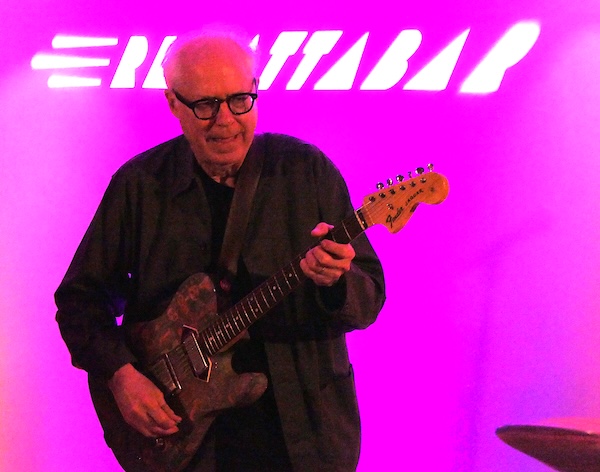
Bill Frisell at the Regattabar. Photo: Paul Robicheau
An encore mixed “Old Man River” with “These Days” (a song Frisell has not recorded) over a shuffle with brushes, some stardust notes sprinkled over the more heavily articulated melody line, and a coda with rich, organ-like tones.
What can I say? All around me people had been smiling and nodding with the music. The standing ovations were a foregone conclusion. Not only has Frisell regularly made my annual top ten list of recordings, but there have been live performances that are indelible: a show at the Regattabar with a breathtaking Greg Tardy clarinet feature; another show, just as good, with Petra Haden singing; a show at Jazz at Lincoln Center’s Appel Room with Greg Osby and Craig Taborn; an organ trio show at the Somerville Theatre.
At the Lincoln Center Jazz show, I wrote about Frisell’s ability to conjure drama by taking it “low and slow.” And at the Somerville Theatre, I waited for an endless vamp to deliver on the promise of a coming storm. “Would the rain never come?” I asked. And then it broke, full of color and a replenishing shower of invention. At the Regattabar on Thursday, that moment never came, most of the music passing like water through my fingers.
Frisell will continue to be one of my essential artists. (In My Dreams is already vying for this year’s Top 10.) I’m sorry I couldn’t come back for one of the two Friday-night shows at the Regattabar. Maybe the music would have been different, or I would have been in a better mood to receive it.
Jon Garelick is a former arts editor at The Boston Phoenix and a retired staff member of The Boston Globe’s Opinion page. He can be reached at [email protected].
2 Comments
Leave a Comment
I kind of felt the same way, long ago, hearing the David S. Ware quartet play Barbara Streisand’s “Memories.” They weren’t going for hip irony. It was just the wrong song for the wrong band in every way.
Nope, Frisell is not one of my essential jazz artists, and I was disappointed by a terrible Village Vanguard shambles that he led in August 2024 with 2 drummers. For some reason only he would know. Popular, and does some good things (duets with Thomas Morgan), but variable and, in my view, missable. I can think of 100s of different jazz players I’d rather hear live than Frisell.