
Jazz Concert Review: The Write Stuff – Kurt Rosenwinkel Quintet at the Regattabar
By Jon Garelick
This was not genre-pushing experimentation. Kurt Rosenwinkel’s tunes stayed well within recognizable patterns of chords and rhythms, but the inventive craft alerted the ear at every turn.
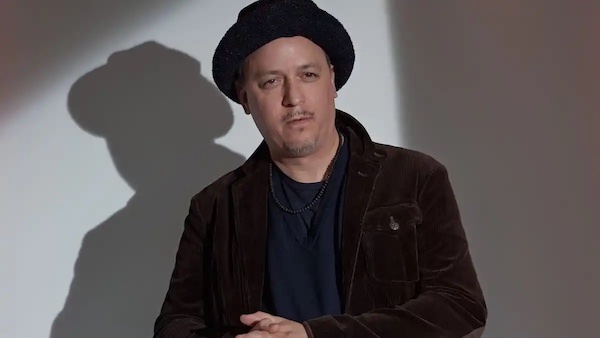
Guitar hero extraordinaire Kurt Rosenwinkel. Photo: Aleks Koncar
It’s rare that all the elements of a live show come into alignment: the band, the playing, the tunes. At the Regattabar all of that was there in the first of two sold-out shows by the Kurt Rosenwinkel Quintet on May 29. There was no languor. Even the club’s variable sound system seemed to be cooperating.
This was a show had been rescheduled from a snow date last winter. Maybe as a result of that, both shows were sold out. But, also, this is Kurt Rosenwinkel — guitar hero extraordinaire, and, at 55, approaching the elder statesman category in a generation that follows previous modern masters like Pat Metheny, Bill Frisell, and John Scofield. And the crowd showed it: groups of grizzled white guys in beards and t-shirts, Berklee-undergrad guitar students (no doubt), a smattering of older couples. This was not date night.
The last time I’d seen Rosenwinkel, it was in a trio that leaned heavily on standards. This quintet show was all originals, beginning with a suite by Rosenwinkel, “Chico and Harriett: Love Beyond the World.” It began with a ballad tempo prelude, Rosenwinkel taking the lead with his big rounded tone, joined by tenor saxophonist Aidan McKeon on the second chorus. Then a brisk second section in 6/8, with pianist Joe Block taking a bravura solo with a lot of hard bop in the left hand, and then a downshifting tempo, with Rosenwinkel taking his first showpiece solo, shaping one lambent phrase after another around the form, and an equally well-shaped tenor solo by McKeon that had me uttering “yeah!” on the turnaround.
This was not genre-pushing experimentation. Rosenwinkel’s tunes stayed well within recognizable patterns of chords and rhythms, but an infusion of inventive craft alerted the ear at every turn. Phrase lengths, the shift in feel from one section to another, the surprising patterns within each form – everything worked to create “hummable” tunes that were full of variety, often animated by some small structural detail. On the Afro-Latin-inflected “B Major/Community” (the second tune, after the suite) it was the funny little descending figure of a two-note pattern that was a surprise the first time around and then, with familiarity, became a kind of pop hook. Here you could see the enthusiasm of the band as they smiled at one another (bassist Alex Claffy having moved to electric) while McKeon navigated the turns with smooth aplomb.
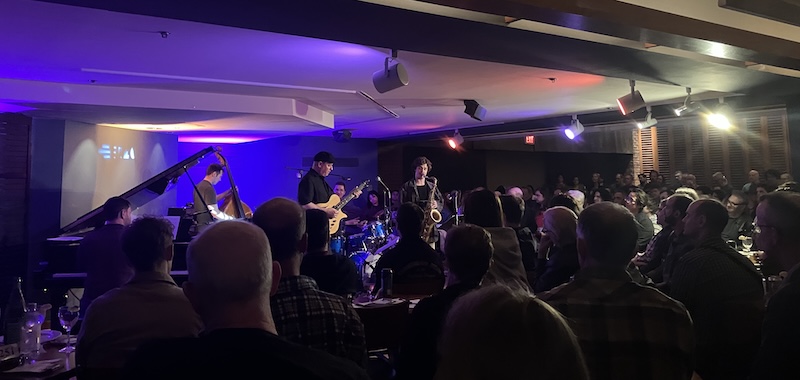
The Kurt Rosenwinkel Quintet at Regattabar. Photo: Jon Garelick
I’m not wild about the synth-ier effect Rosenwinkel deploys sometimes (PTSD from Pat Metheny’s dreaded synth guitar, perhaps), except that on a tune like “Filters” it gives him a horn-like timbre that carries the tune perfectly. Besides, there — and everywhere else — you could see what draws the guitar geeks to these shows: the superb touch in his pianissimo intro to “Gesture Lester” (for Rosenwinkel’s father, not Pres) as he “comped” chords against his single-note phrases, the fluid speed of his fretting fingers on “Blue Line” (from 2003’s Heartcore), and the way every phrase contributes to overall melodic shape, along with the dips and curves of those tasty compositions.
This is a band that is of a single mind with Rosenwinkel — the ear for detail informed by a sense of the whole, whether it was Block’s hard bop references on “Chico and Harriett” or his odd little flamenco aside on “Gesture Lester,” Claffy’s fluid alternating of electric and acoustic basses, drummer Jimmy Macbride’s succinct intro and solo on “Filters,” and McKeon’s perfectly placed upper-register held note on Rosenwinkel’s lovely bossa nova, “Ouro Preto.” When McKeon and Rosenwinkel traded 8’s on the up-tempo “Filters,” it was no pro-forma jazz move, but an elevation of the tune into another realm.
Somewhere Thelonious Monk supposedly said that he made his tunes so hard because it was a way to seduce his band into rehearsing. Rosenwinkel has honed his writing chops working on Brahms and Chopin projects (“Chico and Harriett” and “New B Major/Community” were commissions), and he reportedly credited Schoenberg’s procedures with influencing his breakthrough album, Heartcore. On the surface, Rosenwinkel’s tunes don’t sound “hard,” but their freshness and ease is clearly hard won. A boon for the players, and the listeners.
Jon Garelick, a former arts editor at The Boston Phoenix and retired staff member of The Boston Globe Opinion page, can be reached at [email protected].
1 Comment
Leave a Comment
Thanks Jon! This show deserved a write up. I don’t remember being so satisfied with a jazz performance. The sound, playing, improvising, compositions. All were equally important and completely engrossing. And sharing the room with others who obviously dug it equally was so gratifying.