Book Review: “Rothko in Florence” — Against the Solace of Transcendence
By Margherita Artoni
This ambitious catalogue is strongest when it treats Mark Rothko’s paintings as shifting perceptual structures—and weakest when it resolves them into metaphysical comfort.
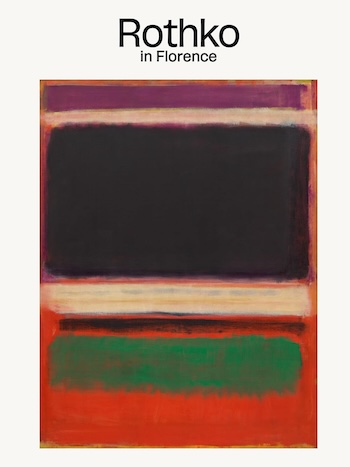
Rothko in Florence, Marsilio Arte, 224 pages $40.
Today, Mark Rothko is less encountered than already interpreted. His work circulates within a stable critical vocabulary that risks neutralizing the perceptual instability it once produced. What was once a challenge to vision has become an expected form of seriousness—contemplation as cultural default.
Rothko a Firenze arrives with the institutional authority that now routinely frames major presentations of Rothko. He appears as a pre-stabilized experience of seriousness: what once demanded sustained looking now registers as a sanctioned form of depth, consumable precisely because it appears to exceed consumption.
Installed at Palazzo Strozzi, the exhibition and its catalogue are most compelling when they resist the museum’s habitual conversion of Rothko into spiritual atmosphere and return him to perception as an unstable field. At their best, they treat the paintings as constructed situations in which seeing is actively reorganized. At their weakest, they revert to metaphysical generality where formal description would be more precise.
The installation reinforces this tension. Rooms are paced with deliberate intervals; walls are held in muted tones that avoid theatrical contrast; transitions are structured so that no single painting dominates upon entry. Light is diffused rather than directed, producing a gradual adjustment of vision in which color appears to shift before the body stabilizes its distance.
The exhibition brings together more than one hundred works spanning Rothko’s trajectory from early figurative experiments to mature abstraction. Chronology reveals a logic of reduction in which representation dissolves under pressure rather than simply disappearing. What remains is a condition of instability: color carries structure without pictorial support, meaning persists without figuration, and form operates without descriptive anchoring.
Early works such as No. 3 / No. 13 (1949) retain traces of figurative logic, functioning as residual tensions within a field already in flux. Pictorial space organizes itself less around narrative coherence than around unstable relations between figure and field, recognition and dissolution. What appears as image shifts into structure.
The mythological and surrealist phases mark successive reductions, each stripping away another layer of descriptive stability. Color assumes structural responsibility, replacing representation as the primary carrier of meaning.
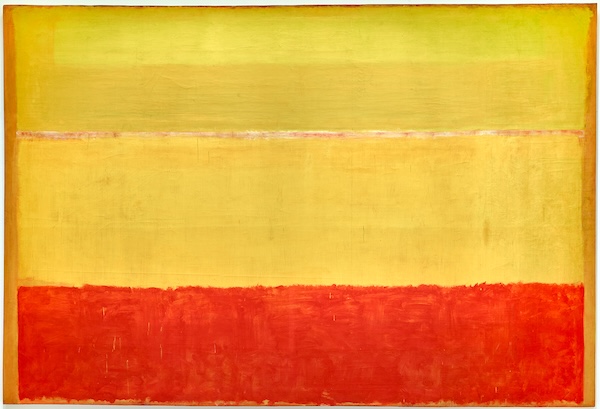
Mark Rothko, Untitled (Titulurik gabea) (1952–53). Photo: Guggenheim Bilbao
In the mature work, this logic becomes explicit. In Untitled (1952–53), the edge becomes a zone of perceptual instability where chromatic intensity accumulates at the point of formal dissolution. The rectangle functions as a controlled failure of containment. Apparent simplicity emerges from extreme calibration, with color fields tuned to the threshold at which form destabilizes into vibration.
Here the catalogue gains force when it aligns with Dore Ashton’s account of Rothko as a maker of emotional structures rather than optical fields. Meaning arises from relations—interval, adjacency, tension. The paintings operate as unstable configurations held in continuous perceptual negotiation. Looking becomes a process of sustained adjustment rather than recognition.
This reading also clarifies the limits of Clement Greenberg’s formalism. Flatness, optical purity, and medium specificity cannot account for Rothko’s pictorial logic. The surface operates as a threshold in which depth is continuously staged and withdrawn. Stability becomes a managed instability of perception.
A more productive framework emerges through phenomenology, particularly Maurice Merleau-Ponty. Vision becomes embodied exposure. Rothko constructs perceptual environments in which scale, distance, and duration are continually recalibrated through bodily presence. At close range, surfaces resist consolidation; edges loosen and color refuses closure. At distance, forms briefly cohere before dissolving again. Across time, perception drifts. The painting reorganizes the conditions of viewing.
It is precisely here that the catalogue falters, reproducing the mythology it ought to hold in suspension. Terms such as “ritual,” “silence,” and “transcendence” function as interpretive closure, stabilizing works whose force lies in instability. Spiritual vocabulary replaces description at the moment when description is most necessary.
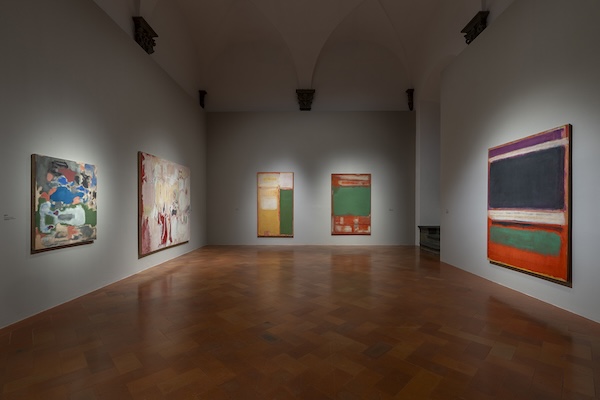
Rothko in Florence, exhibition views, Palazzo Strozzi, Museo di San Marco, Biblioteca Medicea Laurenziana, Firenze, 2026. Photo: Ela Bialkowska, OKNO Studio
More broadly, Rothko’s institutional success depends on a structural paradox: the conversion of perceptual difficulty into a generalized affect of depth. The more consistently his work is framed as transcendence, the more it becomes culturally neutral—available as a ready-made experience of seriousness that no longer requires resistance. What is lost is friction.
This dynamic extends beyond Florence. Across major museums, mid-century abstraction is increasingly curated as managed intensity. Rothko returns as a resolved experience of contemplation, while lighting, spacing, pacing, and narrative framing assume interpretive functions once demanded of the viewer.
The Palazzo Strozzi installation makes this condition visible rather than concealing it. Lighting is restrained, allowing works to emerge gradually. Smaller paintings function as thresholds of perceptual adjustment, while larger canvases impose a scale that cannot be absorbed at once. Duration becomes a structural requirement of seeing rather than a curatorial suggestion.
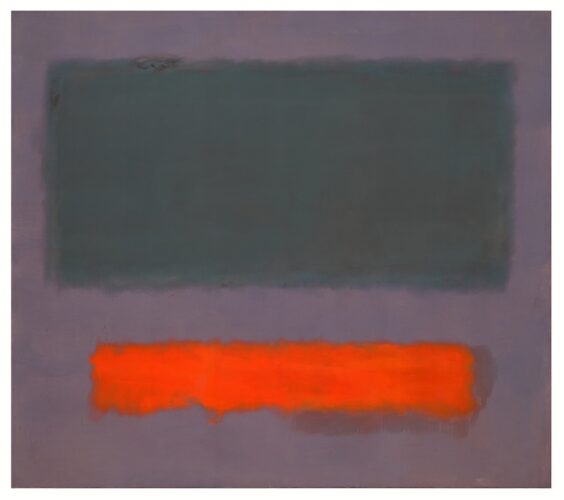
Mark Rothko, Gray, Orange, Maroon No. 8 (1960)
Later works such as Gray, Orange, Maroon No. 8 (1960) intensify this condition. Chromatic articulation reaches a threshold at which perception is absorbed into space. The painting sustains a controlled suspension of perceptual certainty, holding meaning in continuous deferral.
Rothko produces the conditions under which transcendence becomes a misreading. His paintings stress experience, holding perception in calibrated instability without permitting symbolic resolution. What appears as metaphysical depth is instead the exhaustion of stable perceptual hierarchies.
Yet this constructed slowness also exposes an institutional tension the catalogue only partially acknowledges. Rothko’s work demands duration and perceptual vulnerability, yet circulates within exhibition economies shaped by speed, reproducibility, and consumption. Slowness risks becoming a curatorial style—an aesthetic layer rather than a form of resistance.
Rothko a Firenze, exhibition views, Palazzo Strozzi, Museo di San Marco, Biblioteca Medicea Laurenziana, Firenze, 2026. Photo: Ela Bialkowska, OKNO Studio
No interpretive framework exhausts the instability these paintings sustain. What remains is prolonged attention beyond comfort—an attentional state produced by the work itself. Looking becomes a condition of exposure.
In this sense, Rothko a Firenze is most compelling where it resists closure, and least convincing where it reinstates it through the vocabulary of transcendence. Its central insight is structural: Rothko is not an image of depth but a configuration that prevents depth from stabilizing into certainty. The exhibition ultimately stages the institutional management of transcendence. Rothko remains difficult because meaning fails to settle under the pressure of looking
Margherita Artoni is a contemporary art critic and curator working between Italy and the United States. She began her career collaborating with Flash Art and currently writes for Segno, Juliet, Artribune, Exibart, Inside Art, ArteIN, part of cult(ure), The Arts Fuse, and Whitehot Magazine.
She has directed galleries in Turin — including NEOCHROME and EDGE Art Space — and in New York at TEAM Gallery. Her curatorial work has included exhibition programs with international artists such as Rashid Johnson, Theaster Gates, Ali Banisadr, Angel Otero, Tim Rollins & K.O.S., Laura Owens, and Mika Tajima.