
Theater Review: “The Maids” and “Kenrex” — A Tale of Two Theatrical Experiments
By Tim Jackson
The Maids uses video and fantasy with purpose, while Kenrex turns a grim murder story into empty showmanship.
Two recent New York productions, transfers from London—The Maids and Kenrex—approach identity and criminality from opposite directions. One transforms a play about a notorious crime into a feverish ritual of fantasy and role-playing; the other, a one-man show, reconstructs a real act of violence through the ingenious use of contemporary documentary techniques.
The Maids at Saint Ann’s Warehouse in Brooklyn
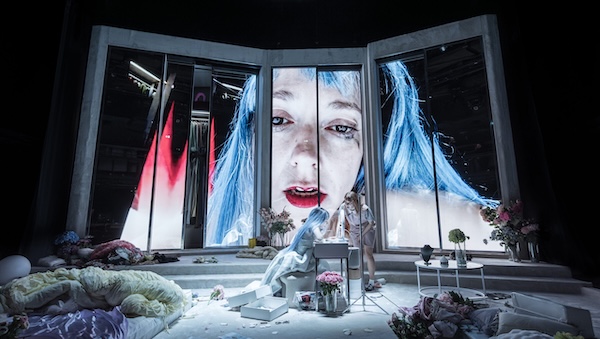
A scene from The Maids St. Ann’s Warehouse in Brooklyn. Photo: courtesy of the artist
For decades, I’ve been journeying to St. Ann’s Warehouse in Brooklyn for productions that are unique and compelling. My introduction came in 1984, when Elizabeth LeCompte’s Wooster Group mounted L.S.D. (…Just the High Points…), which featured a panel reading from Timothy Leary’s writing and other 1960s countercultural texts mashed together with a “play” about the Salem witch hunt envisioned, with a few other prerecorded elements, as a day in the life of the House Un-American Activities Committee. A repurposed Hamlet in 2005 blended live performance with a projection of the historic 1964 Broadway revival, starring Richard Burton, of Shakespeare’s tragedy, marketed as a “Theatrofilm,” recorded for TV with 17 cameras by way of a process called “Electronovision.” The Town Hall Affair in 2015 was a stunning reenactment of Chris Hegedus and D.A. Pennebaker’s documentary Town Bloody Hall, which chronicled a raucous 1971 debate on women’s liberation. These days, the theater continues to bring productions to its medium-sized space that experiment with theatrical form.
Currently, St. Ann’s Warehouse is hosting an update of Jean Genet’s 1947 play The Maids, written and directed by Kip Williams, the young Australian director who transformed The Picture of Dorian Gray into a dazzling one-woman vehicle for Sarah Snook. Williams calls his method, which blends live theater with video technology, “cinetheatre.” This approach may sound gimmicky, but it serves a thematic purpose. The production of Dorian Gray, according to Williams, had a “theatrical form [that] would express what Wilde expresses in the novel, which is that a human is a being with myriad lives and myriad sensations.” As Wilde expressed it in history, man is a “multiform creature.”
Using cell phones, video projections, and rapid costume changes—all in sight of the audience—Snook embodied both the vanity of Wilde’s world, in which life is “a grand act of theater,” as the writer claimed, and our contemporary obsession with self-performance, social media, selfies, and reality TV.
If Wilde saw identity as a performance, Genet, writing nearly sixty years earlier, raised the stakes, recasting performance as a ritual of domination, fantasy, and self-invention that could become untethered from reality. The Maids was inspired by the notorious case of Christine and Léa Papin, two live-in servants who brutally murdered their employer in 1933. In France, the crime became a symbol of class struggle and social alienation. It inspired numerous adaptations, including Claude Chabrol’s La Cérémonie in 1995. The story was ideally suited to Genet, a lifelong rebel and openly gay man who distrusted conventional institutions; he spent years in reformatories and prisons, which fed a fascination with those who survive on the fringes of society. In his writings, he often elevated thieves, vagabonds, and criminals into a kind of secular sainthood. At its best, his vision of the fertile conflict between domination and submission, authority and rebellion, becomes a form of poetry.
Genet insisted that The Maids be performed in a heightened, stylized manner, with actors avoiding psychological realism and embracing overt theatricality. The characters do not merely speak and behave self-consciously; they are trapped in the performances demanded by their social roles. Madame acts out bourgeois privilege, while Claire and Solange perform servitude, resentment, and desire. Their language, gestures, and fantasies are part of a cultural hall of mirrors: identity is not a fixed reality but a role that is endlessly rehearsed and renewed.
As the play begins, a diaphanous curtain encloses the three-quarter stage. The maids, Solange (Phia Saban) and Claire (Lydia Wilson), are playacting a battle between maid and mistress. We learn that they are not only household servants but sisters. Their world of bitter fantasy seethes with deep resentment at their servile lot. The pair continually gaze into their cell phones, using apps such as FaceApp and Snapchat to project visual caricatures of glamour onto floor-to-ceiling mirrored closet doors, which serve as screens. Video feeds transform this choreography into oversized cinematic images. The long introductory scene appears to be a ritual the sisters perform in their employer’s absence. Their mistress will return. At the moment, she is preoccupied; her husband has been arrested after anonymous letters implicating him in crimes were sent to the police. His dalliances also inspire the pair’s dramatics.
After the surrounding curtain parts, the demands of reality take over and they become maids once again. Madame (Yerin Ha) is on her way home. The sisters hurriedly clear away the wreckage they have made of the room, gather the flowers that extravagantly decorate it, and return the dresses they have been using to the closet. Madame makes a grand entrance. Vain, hypocritical, and extravagantly self-regarding, she is trapped in a fantasy of her own—the impregnable delusions of bourgeois privilege. This juxtaposition of her self-adoration and the sisters’ festering grievances is the essence of Genet’s so-called “theater of cruelty,” a world in which power, desire, and humiliation are inseparable.
Williams’s use of screens extends Genet’s obsession with doubling, blurring the boundaries between identity and performance, illusion and reality. For Sartre, who admired Genet’s work (see Saint Genet, Actor and Martyr), “appearance, which is constantly on the point of passing itself off as reality, must constantly reveal its unreality.” Williams’s live video feeds, reflections, and projections illustrate that point literally. Genet even preferred that the entire cast be men, though that instruction is not often observed. The sisters embody the contradictory desires of a divided self; they simultaneously adore and despise Madame. They worship the power she represents but resent the power she inevitably commands. Their exchanges can turn, in an instant, from obsequious devotion to sadistic verbal assault. The sisters are not psychological characters; Genet insisted that The Maids was “not a satire of servants.” Rather, he envisioned his characters as monsters of theatricality—figures inhabiting a heightened realm where social roles become masks and fantasies become obsessions. The play descends brilliantly into madness and criminality as the sisters race toward self-destruction. As the sisters’ dreams become increasingly untethered from reality, the production builds, with relentless intensity, toward a stunning climax.
The Maids is an ideal vehicle for Williams’s “cinetheatre” approach. Politically, his theatrical strategy addresses our moment, which is defined by mediated realities, performed identities, and widening class divisions. Williams’s technological innovations also serve the play’s drama of self-immolation; its barrage of images, screens, reflections, and heightened language intensifies the play’s exploration of narcissism. “Genet detests the society that rejects him and wants to annihilate it,” observed Sartre. That spirit of rebellion, fury, and self-invention is alive in this production.
Kenrex at the Lucille Lortel Theater in the East Village Manhattan

Jack Holden in Kenrex at Southwark Playhouse. Photo: Manuel Harlan
Anyone with the patience to still frequent Facebook may have noticed an uptick in algorithmically generated push notifications. Beware. One such suggestion I received was for Kenrex, a one-person dramatization by British actor Jack Holden of the 1981 murder of Ken Rex McElroy. McElroy was hated and feared by citizens in the small rural town of Skidmore, Missouri, primarily for petty crimes and relentless harassment. By 1981, his victims had been pushed to their limit, and McElroy was murdered. Of the fifty people who witnessed the crime, not one provided testimony to the police. The case remains unsolved. It has also been the subject of a book, several documentaries, and a TV movie.
I was curious about the story, and about how a single actor might portray thirty-five characters.
Holden co-wrote the show with director Ed Stambollouian. The online ads are filled with gushing testimonials from tourists and photos of Holden standing alongside various acting celebrities. But his performance cannot compare with the 26 characters Snook embodied in the stellar production of The Picture of Dorian Gray I saw earlier this year. Holden’s award-winning performance is kinetic and earnest, but he lacks the vocal range and charisma to shift convincingly between personalities and genders.
As the play went on, individual voices lost their distinction and became indistinguishable. McElroy’s character, initially delivered in a low baritone that soon became monotonous, eventually devolved into shouting. The production has plenty of sound and fury—projections, melodramatic thrashing, flashing lights, and blaring country music—but it signifies very little. Beyond its questionable potential as a showpiece for a single performer, the story gains nothing from being hyper-theatricalized. The night I attended, a projection failed, and the staging was halted for about twenty minutes. The show resumed to enthusiastic applause from an audience that appeared mostly to be tourists drawn by the hype of a one-man true-crime performance. Wowed by the actor’s exertions, theatergoers rose to their feet at the end. I did not. Enough of the gratuitous ovations.
Exiting the theater, a group of what must have been high school students—whose hair, clothes, and demeanor could have come from a “Saturday Night Live” sketch or a scene from Revenge of the Nerds—were prattling on about the incredible way the actor could change his voice and become so many characters. “I couldn’t believe how he hunched his back and suddenly became the guy,” said one, whose mind had apparently been blown.
Great. More testimonials.
Tim Jackson was an assistant professor of Digital Film and Video for 20 years. His music career in Boston began in the 1970s and includes some 20 groups, recordings, national and international tours, and contributions to film soundtracks. He studied theater and English as an undergraduate, and has also worked helter-skelter as an actor and member of SAG and AFTRA since the 1980s. He has directed four feature documentaries: Chaos and Order: Making American Theater, which is about the American Repertory Theater; Radical Jesters, which profiles the practices of 11 interventionist artists and agit-prop performance groups; When Things Go Wrong: The Robin Lane Story, and Marblehead Morning: Daring & Stahl: 50 Years in Harmony. He has made two short films as well: Joan Walsh Anglund: Life in Story and Poem and The American Gurner. He is a member of the Boston Society of Film Critics. You can read more of his work on his substack.