
Classical Album Review: Edward MacDowell’s Piano Concerto No. 2 & Orchestral Works
By Jonathan Blumhofer
A persuasive case for American composer Edward MacDowell’s orchestral voice, led by pianist Xiayin Wang and conductor John Wilson.
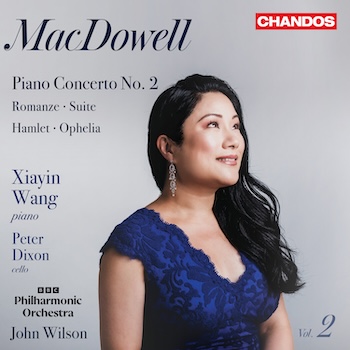 Edward MacDowell’s moment continues, thanks to the ongoing advocacy of pianist Xiayin Wang, the BBC Philharmonic, and conductor John Wilson.
The second installment of their survey of the New York native’s output picks up where the first one left off, with a substantial, if largely unfamiliar, collection of orchestral works that showcase his cosmopolitan bona fides (MacDowell studied and lived for a time in Europe; even after returning to the United States, his scores utilized German subtitles). As on the earlier album, the performances—and Chandos’s recorded sound—are excellent.
This disc’s biggest item is the Piano Concerto No. 2. By a good measure the composer’s best-known major work, it features a pyrotechnical handling of the piano in the spirit of Liszt (the opening cadenza seems to hint at Rachmaninoff, too) and offers a structure that recalls, after a fashion, the second concerto of Camille Saint-Saëns.
Wang makes vivid work of the score’s knotty keyboard writing. Despite the music’s busy textures, her part is unfailingly well-voiced and rhythmically on point, especially in the first movement’s torrid declamations. Here, Wilson and the Philharmonic match her for intensity—but also restraint: the opening section’s turns toward inwardness are managed by all parties with a lovely blend of delicacy and tonal depth.
The latter movements are treated with similar care, especially the Presto, whose lively syncopations and slightly cartoonish refrains frame some unexpectedly dark (and energetic) counterpoint. In the finale, Wang brings a crystalline touch to the music’s high-tessitura peregrinations while she, Wilson, and the orchestra fluently navigate the music’s rhapsodic character.
Conductor and orchestra have most of the rest of the disc to themselves.
Hamlet and Ophelia showcase MacDowell indulging in his day’s enthusiasm for symphonic poems. Though written around the same time that he began the Second Concerto (1884-85), the pair of character portraits lack some of the bigger work’s motivic sophistication and thematic memorability.
Nevertheless, the scoring in Hamlet fits that work’s stormy, spastic qualities (the trumpet writing suggests MacDowell had a thorough understanding of Verdi’s orchestrations). For its part, Ophelia, though it meanders a bit, culminates in a ravishing coda. Wilson directs both performances with a knowing hand and a strong sense of where they ought to be going.
The pairing is on firmer footing, musically, with MacDowell’s Suite No. 1. Completed in 1893, this is the program’s most mature installment and that fact shows, both in terms of instrumentation and musicality. Throughout, the melodic writing is highly evocative, depicting favorite Romantic tropes, like haunted forests, mysterious spirits, and the wonders of nature.
As in the Concerto, there’s a considerable amount of detail to be found in MacDowell’s instrumentation. Part-writing is consistently active and the composer’s ear for color is unerringly impressive. That so much of it emerges both naturally and readily—the subtly muted horns at the end of “Sommer-Idylle” and discreet woodwind grace notes during “Im Oktober,” among them—is a testament to the strength of the partnership between Wilson and the Philharmonic.
The pairing, joined by cellist Peter Dixon, also does justice to MacDowell’s short, melancholy Romanze.
Jonathan Blumhofer is a composer and violist who has been active in the greater Boston area since 2004. His music has received numerous awards and been performed by various ensembles, including the American Composers Orchestra, Kiev Philharmonic, Camerata Chicago, Xanthos Ensemble, and Juventas New Music Group. Since receiving his doctorate from Boston University in 2010, Jon has taught at Clark University, Worcester Polytechnic Institute, and online for the University of Phoenix, in addition to writing music criticism for the Worcester Telegram & Gazette.