
Jazz Albums Review: Two Currents, One Tide — Latin Jazz Reimagines Monk and Modern Traditions
By Brooks Geiken
From Dave Schumacher’s seaworthy Agua con Gas to Carlos Henríquez’s rhythmic Monk con Clave, these new releases fuse Afro‑Caribbean pulse with big‑band imagination, blending tribute, danceable grooves, and inventive soloing into a shared, celebratory soundscape.
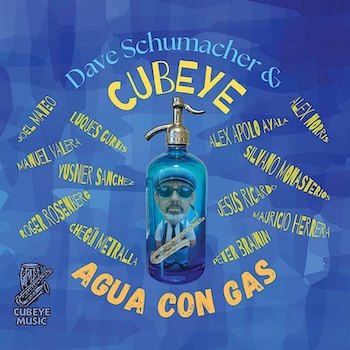 Cubeye’s 2024 release Smoke in the Sky was so enjoyable I was very pleased to hear the group was releasing a new album. And I am happy to report that band leader Dave Schumacher and 12 other musicians have once again struck a rich vein of musical cross-fertilization in Agua con Gas (carbonated water). My interpretation of the title: the group taps into the sea (agua) of Latin jazz and adds its own extra element (gas).
The recording plunges into deep waters, where jazz and Afro-Cuban traditions collide and then embrace in wondrous harmony. Two selections—“Yambú” by the late Cuban conga drummer Tata Güines, and “The Prince of Darkness” by the late jazz tenor saxophonist Wayne Shorter—showcase the power of this blending. In addition to several hard-hitting numbers, Schumacher, a baritone saxophonist, includes two songs as a tribute to the late baritone saxophone master Ronnie Cuber.
A proper review of Agua con Gas must include a full roster of its musicians: trumpeters Alex Norris and Jesús Ricardo; saxophonists Peter Brainin (tenor and soprano), Schumacher and Roger Rosenberg (baritone); pianists Manuel Valera and Silvano Monasterios; bassists Alex Apolo Ayala and Luques Curtis; congueros Yusnier Sánchez and Mauricio Herrera; drummer Joel Mateo; and Héctor Dávila (Chegüí Metralla) on claves.
The title track, “Agua con Gas,” is a compelling Latin jazz composition written by Schumacher. It shifts seamlessly from a rumba rhythm to 4/4 jazz. “Yambú” follows, featuring muted trumpet from Norris, with Sánchez bringing the heat on congas. Most of the tracks on the album include the full ensemble; aside, from the dreamy ballad “Letters from Paris.” Here, a quartet—Schumacher on baritone sax, Monasterios on piano, Curtis on bass, and Mateo on drums—explores a yearning, searching mood.
The influence of Ronnie Cuber resonates throughout Agua con Gas. Cuber was a sideman with several outstanding groups, including those led by Eddie Palmieri, Horace Silver, and the Mingus Big Band. Schumacher honors the musician’s legacy by playing two of Cuber’s compositions, “Cubism” and “Barra Cuber.” To thicken the texture, Schumacher adds a second baritone saxophonist, Roger Rosenberg. “Cubism”’s melody is driven by the two blaring baritone saxes, while Herrera’s congas and Mateo’s drums lay down a solid rhythmic foundation. On “Barra Cuber,” Ricardo soars into the stratosphere with high-register trumpet lines, while Curtis explores the lower register during his solo.
Closing the album, “The Prince of Darkness” highlights the full band, with solos from Schumacher on baritone sax, Norris on trumpet, Brainin on soprano saxophone, Ayala on bass, and Valera on piano. Then the spotlight shifts to the percussionists, as Sánchez and Mateo trade four-bar phrases.
The vision of melding Latin music with jazz, once popularized by Cuban conga master Chano Pozo and Dizzy Gillespie, is given a contemporary leap forward on Agua con Gas. As the Atlantic flows into the Caribbean Sea, the album mixes and matches to striking effect
In 1988, Jerry González and his band—Steve Berrios (percussion), his brother Andy González (bass), Carter Jefferson (tenor saxophone), and Larry Willis (piano)—recorded the groundbreaking Latin jazz album Rumba Para Monk. Taking a different, big-band perspective, Jazz at Lincoln Center bassist Carlos Henríquez revisits Monk’s music with Monk con Clave.
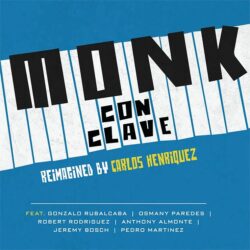 Monk’s compositions are challenging to reinterpret, but they have drawn lots of interest from a variety of different musicians. Henríquez meets these demands with Nuyorican pride and purpose. Eight Monk tunes, including the standards “‘Round Midnight,” “I Mean You,” “Evidence,” and “Blue Monk,” are paired with two new compositions, “El Son de Teo” and “San Juan Hill.”
Rather than list all 21 musicians on the recording, several featured performers should be highlighted. On the ever-popular “‘Round Midnight,” Cuban expatriate pianist Gonzalo Rubalcaba and trumpeter Michael Rodríguez deliver standout interpretations. “I Mean You” features strong solos from Paul Nedzela on baritone saxophone, Osmany Paredes on piano, and Henríquez on bass.
The album then shifts focus to vocal performances by Jeremy Bosch, Pedrito Martínez, and Anthony Almonte. Bosch shines on “El Son de Teo,” composed by Henríquez as a tribute to Monk’s producer during the 1960s, Teo Macero. All three vocalists contribute to “San Juan Hill,” an homage to the historic neighborhood where many Puerto Ricans have lived—and, as the lyrics affirm, will never leave.
A 6/8 rhythm drives the seldom-heard “Raise Four,” featuring Ted Nash on alto saxophone, Jesús Ricardo on trumpet, and Robert Rodríguez on piano. The arrangement of “Green Chimneys” swings vigorously, the players inspired by an inventive chart. During his solo, Henríquez can be heard vocalizing along with his bass lines to impressive effect.
Perhaps the most successful track here is “Plena Azul/Blue Monk,” which fuses Puerto Rican rhythm with Monk’s enduring melody. Don Tucker’s lively trombone, paired with the high-flying trumpet of Kalí Rodríguez and the engaging vocals of Martínez, Almonte, and Bosch, makes this a memorably vibrant track.
As Henríquez notes in the liner notes, the rhythm section is the heart of the record. Drummer Obed Calvaire, bongos player Bobby Allende, and conguero Pedrito Martínez create a bedrock foundation for the horns, piano, and bass. The three pianists—Rubalcaba, Paredes, and Rodríguez—add considerable flare and fire throughout the album.
Monk con Clave — a clever title if there ever was one — draws deeply on Afro‑Puerto Rican and Afro‑Cuban musical traditions, melding them seamlessly with Monk’s idiosyncratic sensibility. Well done, Señor Henríquez!
Brooks Geiken is a retired Spanish teacher with a lifelong interest in music, specifically Afro-Cuban, Brazilian, and Black American music. His wife thinks he should write a book titled The White Dude’s Guide to Afro-Cuban and Jazz Music. Brooks lives in the San Francisco Bay Area.