
Opera Album Review: Argento’s “Voyage of Edgar Allan Poe” Finally Recorded — Rich, Strange, and Long Overdue
By Ralph P. Locke
Dominick Argento’s adventurous 1975 operatic transit through the psyche of Edgar Allan Poe proves to be both delightful and disturbing.
Dominick Argento: The Voyage of Edgar Allan Poe
Peter Tantsits, tenor (Poe), Thomas Meglioranza, baritone (Griswold et al.), Maggie Finnegan, soprano (Virginia Poe), Neal Ferreira, tenor (Doctor, et al.), Kirsten Chambers, soprano (Mrs. Poe, et al.), Felicia Cavilanes, mezzo (Mrs. Clemm, et al.).
Boston Modern Orchestra Project and Odyssey Opera, cond. Gil Rose.
BMOP 1107 [2 CDs] 143 minutes.
To purchase or try any tracks, click here.
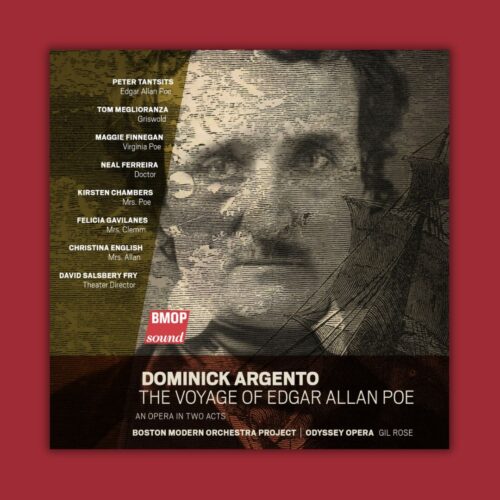
Edgar Allan Poe (1809-1849) holds a unique position in American literature and indeed in world literature, since he was and remains one of our best-known writers abroad. The actor Michael J. Fox, who turns out to be a devoted reader of good prose (and has written three books of memoirs), lists Poe as one of his favorite writers. In an interview in The New York Times, he states that, “[despite] so grim a body of work,… I still find his masterpieces involving and difficult to put down…. No matter what mood I’m in when I launch into one of Poe’s stories, it’s guaranteed to wipe the smile off my face.”
The challenge for Dominick Argento and his librettist was to keep this dreamlike opera about Poe’s dark and doomed life — The Voyage of Edgar Allan Poe — from becoming a nonstop downer. And they have succeeded, as I’ll explain. First, some basic facts.
I list six singers in the header, and there are four others. Peter Tantsits sings the role of Edgar Allan Poe, and soprano Maggie Finnegan sings that of his much younger wife Virginia. Most of the rest take on multiple roles as the opera moves along.
I don’t recall having heard of Argento’s Poe opera before, but the work apparently had a very successful premiere at Minnesota Opera in 1975; some subsequent stagings in Baltimore, Germany, and Sweden; and a major revival in 1988 at Lyric Opera of Chicago. Thereafter, it sat mostly unperformed for 36 years until the intrepid Gil Rose, head of Opera Odyssey and the Boston Modern Orchestra Project, revived it in a simple staging in April 2024 at the Huntington Theatre in Boston (near Symphony Hall). The present recording was made in the same theater (without audience) on the two following days.
Argento (1927-2019) was a much-admired and -awarded composer who taught for decades at the University of Minnesota. His own training was at Curtis and Eastman (and also in Europe, notably under Luigi Dallapiccola in Florence), and his students included Libby Larsen and Stephen Paulus. He composed numerous operas and choral works, plus chamber pieces that involved sung texts. He was widely respected and admired during his lifetime, and won the Pulitzer Prize in 1975 for his song cycle From the Diary of Virginia Woolf. Since the late 1980s, a scarce two dozen recordings of pieces by him have been reviewed in record magazines, but some involved major performers, such as British mezzo Janet Baker and American tenor Vern Sutton.
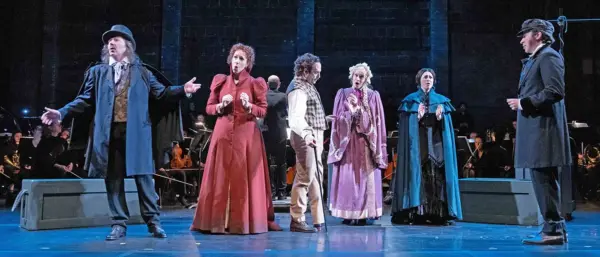
The ensemble for the BMOP/Odyssey Opera 2024 staging of The Voyage of Edgar Allan Poe. Photo: Kathy Wittman
The Argento works that I know best are two that are performed fairly often at university-level music schools: Letters from Composers (for voice and guitar) and the somewhat Pirandello- or Beckett-like opera A Postcard from Morocco (two different recordings of the latter!). But his opera about Edgar Allan Poe is on a grander scale, blending real and apocryphal elements in Poe’s life with imagined conversations, extracts from his poetry, and images from some of his well-known short stories.
This all creates a somewhat unpredictable stew that moves through his life as he might have reconstructed or dreamt it during a packet-steamer trip that he took (or maybe didn’t take) from Richmond, Virginia, to Baltimore, Maryland, and then during his last hours before dying (soon after the real or imagined boat trip). In the booklet, the full libretto is preceded by informative essays by the composer and the librettist Charles Nolte (1923-2010, a noted actor and theater director). Nolte’s essay wobbles somewhat by claiming that the boat trip happened and then admitting that scholars now say it did not. Nolte also reports that after getting off the boat Poe was “apparently” locked up by a gang of rowdies who had been paid to seize derelicts and force them to vote for a particular congressional candidate. This practice of “cooping” is historically attested, but Poe scholars cannot confirm that the poet was a victim of it.
As you can see, we are in uncharted territory during this operatic voyage, and one’s bewilderment is compounded by the fact that different characters often sing their thoughts, or lines from Poe’s poems, simultaneously. I imagine that this would be hard to pull off in a theater, even with supertitles, so it helps to listen with the libretto in hand. Fortunately, the alignment between parallel columns of sung text is, for the most part, correct and helpful. An online version of the libretto provides large brackets showing even more clearly which statements from different characters (even when given in a single column) are sung more or less simultaneously. That website also offers the immensely rich program book published for the work’s 1976 premiere. The CD booklet should have told you this but doesn’t. (Aren’t you glad that you are an Arts Fuse reader?) The singers’ lines are also sometimes better aligned in that online program book (when more than one character is singing) than in the booklet that comes with the CD set.
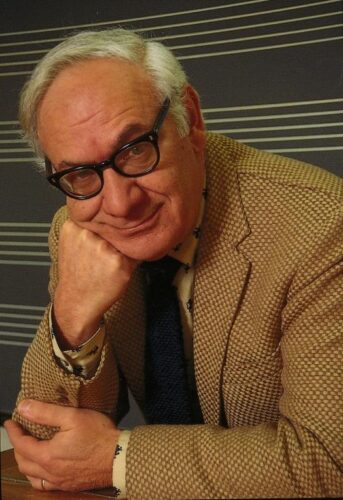
Composer Dominick Argento. Photo: University of Minnesota Archives
My basic feeling is that Argento here was led, or led himself, down a path of self-indulgence that results in a work of great richness and fascination but one that will not have much future in an opera house. The thing lasts a good half hour longer than, say, La Bohème or Carlisle Floyd’s Susannah. Still, it makes an engaging and often touching, even powerful experience for listening at home, with the booklet open for frequent reference.
Many of the characters, when singing one at a time, are quite comprehensible, and the more you already know such poems as “Annabel Lee,” “The Raven,” or “The Bells,” the better armed you will be. At one point, the singer playing the Theatre Director quotes, in French, the epigraph to The Fall of the House of Usher, without translating it, and then contradicts it in English, in a way that probably has gone over the heads of most people who have attended a performance of the work. But, of course, imaginative paraphrase is a standard tool for librettists, especially when using classic literature as a source. One could write a rich article about this opera’s reworkings of Poe’s words and, of course, his “lives” (that is: the ways in which his life has been constructed, interpreted, and reimagined across nearly two centuries).
One could write with similar interest and insight about the work’s many musical styles. Here, as in other works, Argento delights in mixing tonal and atonal, roughly in a manner analogous to what Britten was doing in, say, The Turn of the Screw. (See my review of a recording of the Britten, conducted by Ben Glasberg.) The vocal lines are relatively free of the extreme angularity that has afflicted many otherwise admirable operas in recent decades (see my review of Michael Dellaira’s otherwise vivid and characterful The Leopard). The lines also seem not to exceed the range of a given singer — I don’t think I noticed a cast member’s voice sounding strained at the top or vanishing at the bottom. (By contrast, see my review of Scott Wheeler’s evocative but singer-stressing Naga.) I was glad to find that Argento sometimes engages here in very direct musical means, such as a single chord repeated ever more quickly, a single flute flutter-tonguing while accompanying a singing voice, or a touching, tender cello solo. In short, there is much that the uninitiated listener can hold on to as they get to know the work.
Though this operatic Voyage feels a bit long, the musical styles and dramatic situations shift every few minutes, or even every few measures, helping to avoid any feeling of monotony. Sometimes one scene stops halfway through, a contrasting one — with a different setting — intervenes, and then the previous one is brought to completion. Certain passages are almost chamber-like, with one or two voices singing to each other over a few solo string instruments or a lonely-sounding piano. Yet there are moments when multiple cast members, a chorus, and the full orchestra join to (for example) denounce Poe for taking a 12-year-old Virginia as his wife. There are also occasional orchestral interludes or scene-setters that are full of character and point, occasionally reminding me of, say, Prokofiev or Honegger.
The two central roles are for Poe and his lifelong nemesis, the literary critic Rufus Griswold, who would end up writing Poe’s biography, filling it with extremely negative characterizations and incidents of supposedly immoral behavior. The role for Poe (tenor) resembles, at many points, the roles that Britten wrote for the remarkable Peter Pears, such as Peter Grimes and, in Death in Venice, Aschenbach. The tenor even gets short passages of coloratura that suggest Poe’s flights of imaginative fancy. And the baritone role of Griswold seems to echo, in many ways, the individual townspeople who smugly accuse Grimes and the various baritone nemeses that dog Aschenbach’s every step.
The baritone who sings Griswold also doubles as John Allan, Poe’s adoptive father, who ended up cutting Poe off financially and thus (in opera, as in life) serving as a second male nemesis. The opera also includes a lyric soprano role featuring, like that of Poe, some coloratura expostulations: this character, the young Virginia Poe, gets, among other things, the chance to sing a chunk of “Annabel Lee.” (The music to which Argento sets lines from this or that Poe poem sometimes evokes, though in a cracked-mirror way, various stylistic conventions of 19th-century parlor song.)
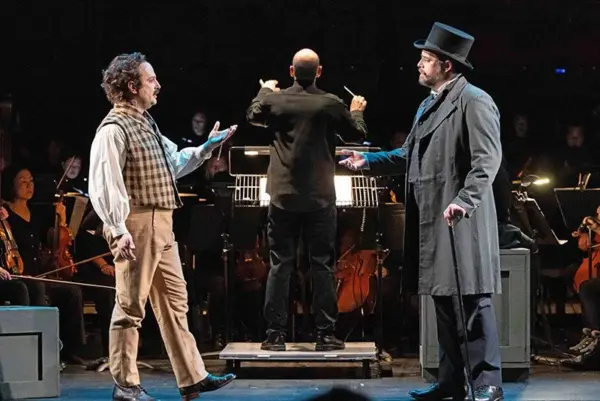
Peter Tantsits as Edgar Allan Poe, conductor Gil Rose, Neal Ferreira as Doctor in the BMOP/Odyssey Opera 2024 staging of The Voyage of Edgar Allan Poe. Photo: Kathy Wittman
The basic structure of the work is sensible: the imagined ship’s voyage stretches across the whole playing time, and individual scenes present events aboard the ship and other events and commentaries that are teeming in Poe’s overheated brain. There are, for example, a game of charades for the ship’s passengers, a lecture by Poe about poetic devices (interrupted by puzzled reactions from his listeners), and a quasi-trial in which Poe is accused, by Griswold and others on the ship, of immorality for taking a 12-year-old as wife and, worst of all, of not loving her but using her: “She had to die for you to live! Confess you wished her dead.” The trial is split into two scenes; in between come a fantastical “auction” of the various women whom Poe has supposedly used as convenient inspiration during his lifetime — reminding me of the similarly frantic auction scene in Stravinsky’s The Rake’s Progress — and a touching portrayal of Virginia lying in state in her bedroom (but still singing).
All of this could possibly seem pretentious or overheated, but the performance, under the ever-remarkable conductor Gil Rose, is precise and carefully pointed, helping us accept the whole as a careful re-creation-cum-invention of the personal journey and distorted public reception of a major figure in American cultural life. The echoes for later eras, including our own today, are many, and I will leave individual readers the challenge of proposing them for themselves.
The best singers here are, happily, the ones in the central roles: tenor Peter Tantsits (as Poe), baritone Thomas Meglioranza (as Griswold/Mr. Allan/et al.), and a soprano with a heavenly, pure, and precise voice, Maggie Finnegan (as Virginia Poe). The male singers in smaller roles are capable and appropriately cast, and the chorus sings with great precision and punch. The female singers in smaller roles are full of character, though one of them, Kirsten Chambers (as Poe’s mother, the Ballad-singer, et al.), has a slow, wide vibrato that makes it hard for the listener to catch the words. Everyone involved seems to know what they are doing and to understand the importance of the task they have undertaken: reviving an opera of real substance that has gone shamefully neglected for too long.
All in all, hats off, once again, to Gil Rose and his admirable Boston-based team! I have previously praised Odyssey Opera’s recordings of forgotten works by Gounod, Saint-Saëns, Mario Castelnuovo-Tedesco, Tobias Picker, Gunther Schuller, and (more briefly) Norman Dello Joio. This Argento opera may be one of the group’s most important achievements yet.
Ralph P. Locke is emeritus professor of musicology at the University of Rochester’s Eastman School of Music and Senior Editor of the Eastman Studies in Music book series (University of Rochester Press), which has published over 200 titles over the past 30 years. Six of his articles have won the ASCAP-Deems Taylor Award for excellence in writing about music. His most recent two books are Musical Exoticism: Images and Reflections and Music and the Exotic from the Renaissance to Mozart (both Cambridge University Press). Both are now available in paperback; the second, also as an e-book. Locke also contributes to American Record Guide and to the online arts-magazines New York Arts, Opera Today, The Boston Musical Intelligencer, and Classical Voice North America (the journal of the Music Critics Association of North America). His articles have appeared in major scholarly journals, in Oxford Music Online (Grove Dictionary), and in the program books of major opera houses, e.g., Santa Fe (New Mexico), Wexford (Ireland), Glyndebourne, Covent Garden, and the Bavarian State Opera (Munich).
Tagged: "The Voyage of Edgar Allan Poe", Boston Modern Orchestra Project, Dominick Argento, Gil-Rose, Maggie Finnegan, Odyssey Opera, Peter Tantsits
Mr. Locke: As a graphic designer, I appreciate ANY music review that takes a CD’s visual materials into account. As the designer of *this* cd, and BMOP/sound’s entire recording output to date, I am particularly grateful. The libretto was a massive undertaking because of its size and the complexities of overlapping voices you discuss. Also, there was no master text file to use for a manuscript. Re-keyboarding the original 1976 version you cite was out of the question (time! money!), so the whole thing was OCR-scanned, and then corrected (extensively) by comparing it to the recording and the original.
I’m glad you found it “for the most part, correct and helpful”! 😉 Kudos to Eric Hollander and the whole BMOP team for pulling it off. I’m disappointed that you didn’t find that my marginal/vertical lines worked as well as the original’s “large brackets showing even more clearly which statements from different characters (even when given in a single column) are sung more or less simultaneously.” We aim to honor the listener/reader and thought those lines would be of assistance.
I am glad you linked to the program book: “That website also offers the immensely rich program book published for the work’s 1976 premiere. The CD booklet should have told you this but doesn’t.” (Point taken about failing to reference it!) That printed object is a wonder. It seems to come from a distant time/place of immense artistic and scholarly resources — something completely out of reach for all but the most massively endowed institutions these days, as we approach, with hearts saddened but pitchforks raised, another major anniversary for this democratic experiment. Thanks.
(And of course the usual disclaimer: I speak only for myself and not for BMOP!)