
Theater Review: A Strong SpeakEasy Stage Cast Steers “Swept Away”
By Robert Israel
SpeakEasy Stage’s musically rich production grips with its performances, even as the drama struggles to fully deepen its tale of a crisis at sea.
Swept Away, Book by John Logan, music and lyrics by The Avett Brothers. Directed by Jeremy Johnson in collaboration with music director Paul S. Katz and choreographer Ilyse Robbins. Staged by SpeakEasy Stage Co., Calderwood Pavilion, Boston Center for the Arts, 527 Tremont St., Boston,through May 23.
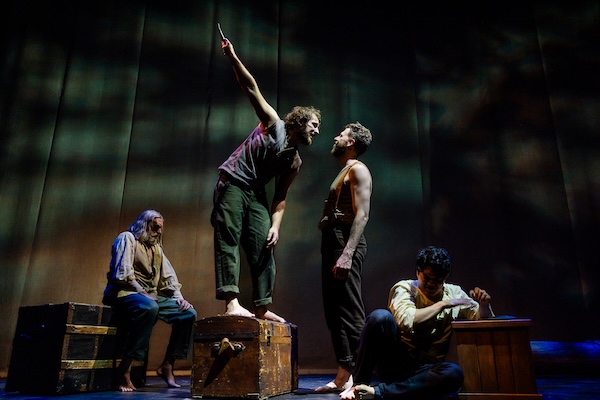
From left: Christopher Chew, Peter DiMaggio, Bishop Levesque, and Max Connor in the SpeakEasy Stage production of Swept Away. Photo: Nile Scott Studios
This year’s Boston-area theater season comes to a spirited close on a high note with an atmospherically engaging production of Swept Away. A one-act play with music, it features an 11-member cast and boasts glorious harmonious singing chops, a scintillating set by Janie E. Howland, and inspired lighting by Karen Perlow. Taken as a whole, the production — although it tells a horrific tale —glows with warmth and generates plenty of dramatic tension.
Based on a true story about the yacht The Mignonette, which set sail from Southampton, England, in 1884, to Sydney, Australia, the play runs around 100 minutes as it chronicles how its captain, two crewmen, and a cabin boy survived on a lifeboat for around three weeks. Subjected to starvation and dehydration, and suffering in extremis, they eventually resorted to cannibalism.
If this story sounds familiar, that may be because it resembles a gruesome chapter of Massachusetts maritime history. Our own local version involved a 19th-century sailing vessel, the Essex, a whaler that sailed from Nantucket, in 1819, got struck head-on twice by a bull whale, and sank, leaving the survivors similarly dying from thirst and starvation. They would commit a similar act of cannibalism, as did the men who survived The Mignonette.
What makes this production particularly praiseworthy is the strength of its cast, who move the grisly story forward with aplomb. Kudos to an ensemble that splendidly supports the lead actors/singers. Yes, there are lugubrious moments in the early part of the play, when it takes a bit too much time for the narrative to gain momentum. And, while I found the set to be inspired, it lacked one crucial element: a sense of motion. We are to believe we are witnessing the action on the deck of a ship, but rarely do we get a sense of movement. It takes far too long for the lighting to suggest — on the upper reaches of the stage — the rippling effect of waves. Yes, the curtains are very effective, rippling and flowing marvelously. But that’s not because the director has chosen to help them along. And James Cannon, the sound designer, is too reserved for most of the evening, when he could be pumping up the air to create the aural sensation of being out at sea.
Along those lines, the book misses the opportunity to add complicating aspects to the drama. One of the sailors tells us seamen are “pagans [and] idolaters” who go to sea because of the camaraderie, but also to sully themselves with “whoring.” Yet, despite being told that the men succumb to these distractions, none of them act on these salacious desires. They come across as clean-cut sailors with nary a personality blemish among them.
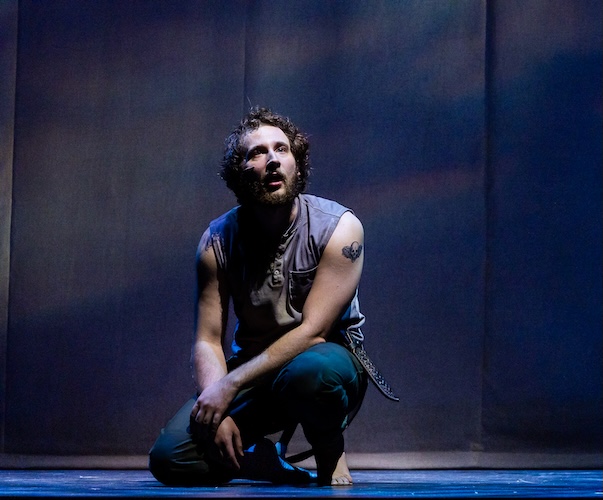
Peter DiMaggio in the SpeakEasy Stage production of Swept Away. Photo: Nile Scott Studios
A bit of foreshadowing might have also been useful in structuring the tale, and for that, the writer and his collaborators would have been wise to turn to the prose of Herman Melville, who in Moby-Dick used Father Mapple’s sermon — at the Seamen’s Bethel in New Bedford — to project a metaphysical chiaroscuro that darkened the mood and substance of his novel, long before we meet the villainous Captain Ahab, who leads his crew of “idolaters” to ruin.
It was good to see Christopher Chew, a veteran of the Boston stages, return to the boards. He sports a gray beard and shoulder-length hair these days, but his presence remains commanding, and his singing chops, which have always been outstanding, continue to impress. When he sits puffing on his pipe at stage right, I thought of Bob Seger’s haunting ballad “Ship of Fools,” wherein he describes the captain of the song’s ill-fated ship to be as approachable as “a statue.”
Living as we do in Massachusetts, which hugs the sea, we are acutely aware of the precariousness of life for those who “go to sea in ships,” as the statue in Gloucester reminds us — sometimes never to return. The SpeakEasy Stage production has put together a compelling voyage. It is entertaining, surely, but it is haunting, too, a warning of the fragility of existence just beyond the horizon.
Robert Israel, an Arts Fuse contributor since 2013, can be reached at [email protected].
Tagged: Christopher Chew, Jeremy Johnson, Peter DiMaggio, SpeakEasy Stage Company, Swept Away, musical
2 Comments
Leave a Comment

You didn’t mention anything about the music…
It was spectacular! The play, the actors and especially the music♥️The sailors hit every note perfectly.