Fest Review: IFFBoston Shorts — Part Four
By Betsy Sherman
Part four of a run-down of live-action narrative shorts. As usual for the IFFBoston, the quality is high, with intriguing subject matter and technical polish.
Part One, Part Two, and Part Three.
Shorts Clarendon: Narrative Sunday April 26 at 2:45 p.m., Tuesday April 28 7:45 p.m. at the Somerville Theatre.
Another fab program of narrative shorts at the 2026 IFFBoston bears the name of the Copley Square thoroughfare. The theme of this collection may be “under the influence,” and that includes hormones as well as intoxicants. And yes, there are two different Elises at two different Brooklyn bars. The total running time is 92 minutes. There may be in-person appearances by some of the filmmakers at the screenings.

A scene from John Robert Hammerer’s December, Day Zero. Photo: IFFBoston
December, Day Zero—There are no false moves in this memorable vignette set in a cozy Brooklyn bar at Christmastime. Marco Torriani and Marissa Ruben are phenomenal as Chris and bartender/aspiring playwright Elise. Nothing about their formerly close relationship is stated on the nose, but the words and looks between them convey that Chris’s behavior as an alcoholic led to a painful breakup. Now in recovery, Chris has crossed the bar’s threshold to drop off a gift; he didn’t know Elise would be working that night. Through his eyes, we feel his affection for the place, but also his fear of becoming the elderly barfly to his left. It’s pure poignance. Writer-director John Robert Hammerer studied film at Emerson College and NYU.
G.O.A.T.—Dutch goat farmer Gerard (Micha Hulshof) believes a trip to Paris would soothe the recent tensions in his marriage to Chantal (Samya Ghilane). That’s the prize offered at a best-goat competition to which the couple travel with their standout nanny, Ermerelda. There’s more than gag value in the animal riding in the car with them (though it is quite funny). A complex kinship develops between the goat and the couple when the pregnant Ermerelda gives birth sooner than Gerard expected. Chantal, who has experienced a stillbirth, physically identifies with the nanny. The surge of grief she displays makes her husband realize there’s healing to be done. The cast is superb. Daan Bunnik directed and co-wrote with Roze Elisa. Bunnik teaches screenwriting at Emerson College. In Dutch with subtitles.
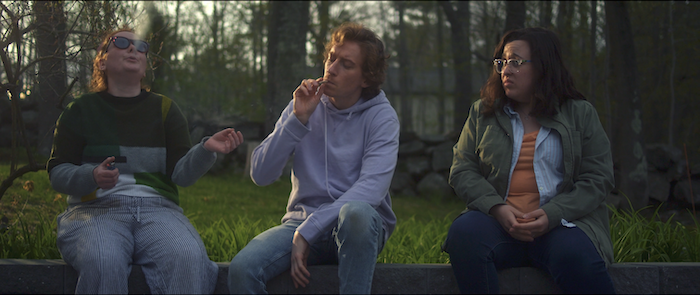
A scene from Anthony Matos’ High Street Hangover. Photo: IFFBoston
High Street Hangover—This Maine-set comic drama by Anthony Matos captures 24 hours in the life of party girl Marnie (Meg Salisbury). The question is whether this day will be repeated ad infinitum or if Marnie will turn her life around. Nighttime drunkenness—Marnie leaves her car running for hours in the driveway after getting home from a bar—leads to a killer hangover. When morning comes, her house becomes an unwanted hub of activity — the ailing Marnie uses various substances to try to perk up. There’s a nice contrast among the characters: the forthright, independent Marnie; her mopey ex, Leeza (Samantha Quirion); and Marnie’s brother (Thomas Ian Campbell), an energetic mood-lifter who has come over to bake a cake for his daughter’s party. The well-written last scene effectively deepens the sketch-like piece.
Noumena—Elise and Noah grew up in Brooklyn, were high school classmates, and are catching up at a Brooklyn bar after connecting on a dating app. Eloquent and seemingly from affluent backgrounds (in a Whit Stillman movie kind of way), they chat about acquaintances and familiar places. Elise tells alarming stories about her mental health episodes while maintaining an unflappable composure (she’s played by Lily McInerny, star of the 2024 Bonjour Tristesse). The night brings intimacy because, why not? Intimacy, in turn, triggers fragility: actor Jake Anderson reveals a new side of Noah in the shadows of the bedroom. Director-writer Niall Cunningham took this absorbing film’s title from Kantian philosophy.

A scene from Hằng Lương Nguyễn’s Rooftop Lempicka. Photo: IFFBoston
Rooftop Lempicka—It’s 2002 in Ho Chi Minh City, Vietnam. Prepubescent Thi glimpses one facet of womanhood as she snuggles against her pregnant mother’s belly. She learns another, more performative femininity by observing and befriending the family’s new boarder, Ngoc—a club waitress and sex worker (which Thi’s parents aren’t aware of). Thi marvels at the sexpot Ngoc’s clothes and tries her lipstick. The apartment building’s rooftop offers an opportunity for freedom; it’s where Thi clandestinely pores over a book of Tamara de Lempicka’s Art Deco female nudes. The film doesn’t endorse Ngoc’s path; it sees everything through a child’s curiosity. Writer-director Hằng Lương Nguyễn’s gorgeously mounted, sensual film is an instant classic of the coming-of-age genre.
The Xenogender—Writer-director Masataka Ishizaki was born in Boston and raised in Osaka, Japan. He stars as Kenzo Ushi, a transplant to New York City whose mother has his life planned out for him if he returns to Japan. He’s lonely but doesn’t let it drag him down. Kenzo takes lessons to improve his spoken English and uses a dating app. Lately, he’s been inspired by videos about the possible sexual fluidity of crocodiles. He identifies as xenogender, which doesn’t faze his counterpart on a first date, Jack. The deal-breaker comes when Jack incurs Kenzo’s rage by saying — like too many Americans — that he loves Japanese culture but can only name the same few clichés. Ishizaki’s film is joyful in its imagination and compassion, and he’s hilarious on-screen. English- and Japanese-language, with subtitles.
Mouthfeel was not available for preview.
Betsy Sherman has written about movies, old and new, for The Boston Globe, The Boston Phoenix, and The Improper Bostonian, among others. She holds a degree in archives management from Simmons Graduate School of Library and Information Science. When she grows up, she wants to be Barbara Stanwyck.