Theater Review: “When Playwrights Kill” — A Wickedly Funny Backstage Farce About Art, Ego, and Desperation
By Martin B. Copenhaver
In this high-energy comedy of creative frustration, history—and hubris—repeat themselves to hilarious effect.
When Playwrights Kill by Matthew Lombardo. Noah Himmelstein directs. Staged at the Huntington Theatre, 264 Huntington Avenue, Boston, through April 18
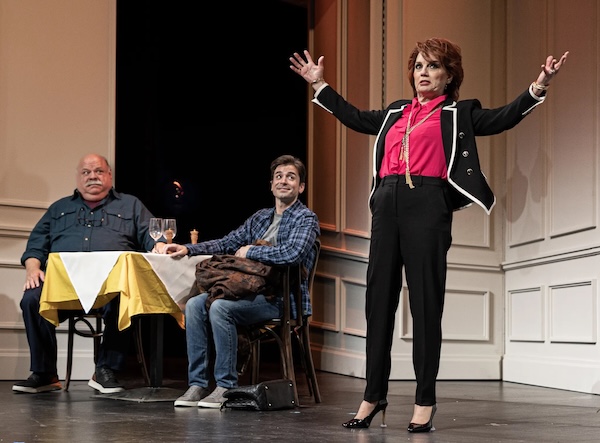
(L-R) Kevin Chamberlin (The Director), Matt Doyle (The Playwright), and Beth Leavel (The Actress) in When Playwrights Kill. Photo: Jim Sabitus
When Playwrights Kill is a play about a play, inspired by another play.
In 2019, Tea at Five, a play by Matthew Lombardo, premiered in Boston. It was a one-woman show about Katharine Hepburn, who was played by screen legend Faye Dunaway. Even though Dunaway had not appeared on Broadway for three decades, her star power, combined with the strengths of the script, seemed to destine the show for Broadway. There was only one problem—the show was a disaster. Dunaway couldn’t remember her lines. She seemed terminally distracted and lost on stage. Then, shortly before one performance, in a drama that occurred offstage, she slapped a crew member and began to throw things. The performance was canceled, as well as the remainder of the run. In the slap heard ’round the theatrical world, the show’s Broadway hopes were suddenly dashed.
Fast forward to 2026. Another play by Matthew Lombardo, When Playwrights Kill, premieres in Boston. It is about a playwright (in a spot-on performance by Matt Doyle) who aspires to have his new one-woman show make it to Broadway. The producer insists on casting a Hollywood star (played by a marvelous Beth Leavel) who has not appeared on Broadway for three decades. And she is—we could all see this coming—a disaster. In an incident that closely tracks one that occurred in Tea at Five, when the phone rings, Leavel neglects to pick up the receiver before intoning, “Hello?” When it is clear that she will never learn her lines, they hire a gender fluid prompter (a wonderfully over-the-top Tomás Matos) to feed her the lines. That might have worked, but, in addition to her lines, she also recites the stage directions that are fed to her.
The experience of working with the star is so exasperating that the playwright can see only one way out. He must kill her. And thereby hangs the tale.
The results are hilarious. It is a theatrical version of Karl Marx’s famous remark, “History repeats itself, first as tragedy, second as farce.” And what a farce it is.
The combination of the script and the acting creates the rapid-fire rat-a-tat-tat of masterful comic dialogue. In the first hour of the show, at least, there is a kind of effervescence in the dialogue that delights. The pace never lags and the comic timing is pitch perfect.
A skilled playwright who aspires to write comedy knows the value of repetition. If set up properly, a recurring gag can be just as funny—and sometimes even funnier—with every iteration. And so it is here, with the repetition of the phone greeting miscue and the unintentional reading of stage directions, as well as other gags. A gifted writer of comedy, aided by skilled actors, can milk a gag for more than its worth, and that is the case here. It takes a certain kind of creative courage to stick with a schtick until just the moment before the repetition exhausts the joke.
There are also a lot of winking theater references. Time-honored theater superstitions (such as never saying the title of “the Scottish play,” or wishing an actor “good luck”) are lovingly skewered. Even the repeated references to the Dramatists Guild and Actors’ Equity avoid coming across as annoying inside jokes.
Unfortunately, near the end of the second act, the play begins to fizzle a bit. Perhaps that is because it is difficult to maintain the sprightly pace and rhythm that marked the first part of the play. Even a fine champagne, once opened, loses some of its effervescence over time. But there is another reason the play does not maintain its energy throughout. For reasons I do not understand, in the second half of the play Lombardo gives five of the six characters a moment when they reflect ponderously on Life (with a capital “L”), on themes like lost dreams or the inexorable passage of time. There is nothing comic, or particularly profound, in these meditations. They do not contribute to character development and, in a couple of instances, seem downright out of character. They are like speed bumps that slow everything down, which is deadly in a farce.
Clearly, When Playwrights Kill, unlike the ill-fated Tea at Five, may well land in New York. The run at the Huntington Theater is the kind of out-of-town tryout that used to be staged at Boston’s Colonial Theater (which, not coincidentally, is the imagined setting for part of this play). It deserves its shot at the big time. With a few tweaks in the script, it could be a hit in New York. My hope is that it is produced with the same superb cast. They, as well as others associated with this production, have trophy cases chockfull of awards, including multiple Tonys, and it is easy to see why. Most playwrights would kill for a cast like this one.
Martin B. Copenhaver is a retired pastor and seminary president who lives in Woodstock, Vermont and Cambridge. Once upon a time, he studied theatre criticism with Stanley Kauffmann.
Tagged: "When Playwrights Kill", Beth Leavel, Kevin Chamberlin, Matt Doyle, Matthew Lombardo