
Book Review: Wilhelm Furtwängler in Wartime – Reflections on Ian Buruma’s “Stay Alive”
By Joseph Horowitz
If there is a through-line consolidating Ian Buruma’s account, it is the admonition: Do not rush to judgment.
Stay Alive: Berlin 1939-45 by Ian Buruma. Penguin Press, 400 pages, $35.
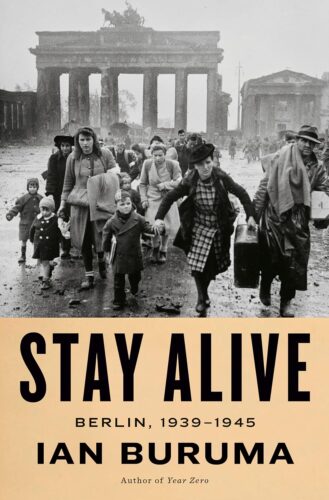
One learns from Ian Buruma’s Stay Alive: Berlin 1939-45 – an absorbing study of what it was like to live in the German capital during World War II – that on December 12, 1944, a concert was conducted by Wilhelm Furtwängler. The audience included Leo Buruma, who in 1951 would father Ian Buruma. The program included Beethoven’s Fidelio Overture and Brahms’s Violin Concerto. Because the Berlin Philharmonic’s home had been leveled by Allied bombers, the makeshift venue was a theater: the Friedrichstadt-Palast. Both the audience and the musicians wore winter coats. Detained in the occupied Netherlands, Leo had become a prisoner of Berlin, forced to work in a factory that made brakes and machine guns. The Philharmonic concert, he recorded, “lifted one high above the dreariness of our existence.”
I wish Buruma had further pondered this event. For one thing, Fidelio happens to be Beethoven’s supreme paean to human dignity and freedom. For another, 21 of Furtwangler’s wartime Berlin concerts (although not the one Leo attended) survive in excellent broadcast sound. And, in some ways even more than the letters and diaries Buruma powerfully samples, these performances bear witness. They constitute an under-utilized resource, and not only because Furtwangler, as Germany’s most eminent symphonic conductor, entrusted himself with sustaining cultural memory. To an uncanny degree, he was also a musical interpreter who channeled the moment.
An analogy to Dmitri Shostakovich, in Soviet Russia, would not be out of place. During the Nazi siege of Leningrad, Shostakovich’s Seventh Symphony, bearing witness to stoic resolve, was heroically performed amid the starvation and carnage. The Soviets piped the performance to the encircling German troops. After the war, a German soldier testified that “it had a slow but powerful effect on us. The realization began to dawn that we would never take Leningrad. We began to see that there was something stronger than starvation, fear and weather – the will to remain human.” Furtwängler was a conductor, not a composer. But Tchaikovsky’s Pathetique Symphony, interpreted by Furtwängler in 1951 (a famous Radio Cairo broadcast), is not the same piece he recorded in Berlin in 1938; the swooning love music of the first movement becomes an expression of worldly fatigue.
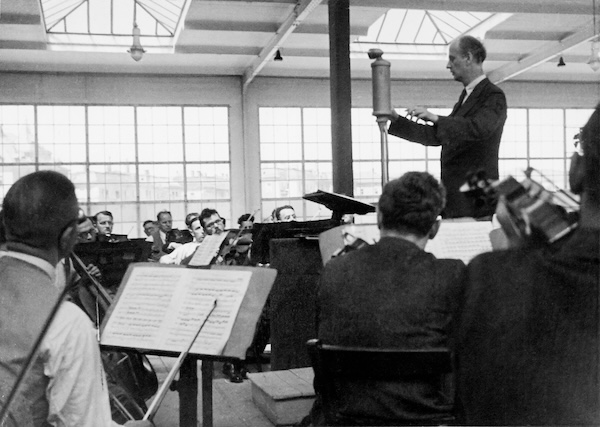
Wilhelm Furtwängler and the BPO in rehearsal in the Munich Rehearsal Hall, 1935. Photo: Berlin Philharmonic Archive
The last of Furtwängler’s wartime Berlin broadcasts took place – incredibly – on January 23, 1945. The city lay in ruins. The program began with Mozart’s Symphony No 40, which had to be abandoned after the lights failed. The audience, starving in body and soul, heedlessly remained. An hour later, the electricity was restored. Rather than return to Mozart, Furtwängler skipped to Brahms’s First Symphony – of which the finale survives in vivid sound. The scorching dynamics and eruptive tempo changes of this reading have nothing to do with Brahms’s Vienna. What I hear is something I could not have predicted: not terror, but pride and defiance. The music itself is triggered by a clarion horn call that refers to the finale of Beethoven’s Ninth, with its epochal call to humanity. I have little doubt that in 1945 many in Furtwängler’s audience felt recalled to a “real Germany,” stalwart in the face of barbarism.
In Beethoven’s Ninth itself, broadcast in 1942, the final reprise of “Alle Menschen werden Bruder!” acquires a giddy intensity verging on hysteria. Far more remarkable, as a feat of interpretive clairvoyance, is Furtwängler’s reading of Schubert’s Ninth, also broadcast in 1942. The symphony’s second movement begins as a rustic march with trumpet tattoos – a gemütlich vignette. But Furtwängler is never gemütlich. When Schubert’s march gathers maximum force and momentum, it becomes a juggernaut hurtling toward an abyss. The abyss is a silence of three beats. Furtwängler’s silence lasts eight seconds: an eternity. Some years ago, auditioning this moment on a radio broadcast with conductor Bill McGlaughlin, he said he heard “a firestorm.” He added: “This time we really broke it; we really broke civilization.” And he characterized the music that lifts the silence – the tenuous pizzicatos, the tender cello song – as an act of dazed consolation.
Compared to other recorded Furtwängler performances, these wartime readings are identical in blueprint. Their external details of tempo and rubato, however personal or eccentric, remain the same. And yet they are fundamentally different in spirit. That is: the differences are interior. For that matter, Furtwängler’s tempo for the third movement of the Ninth is an Adagio so solemnly slow that the initial pulse cannot possibly be gauged. He relies on his players to “feel it.” And, after a moment’s groping (also audible), they do.
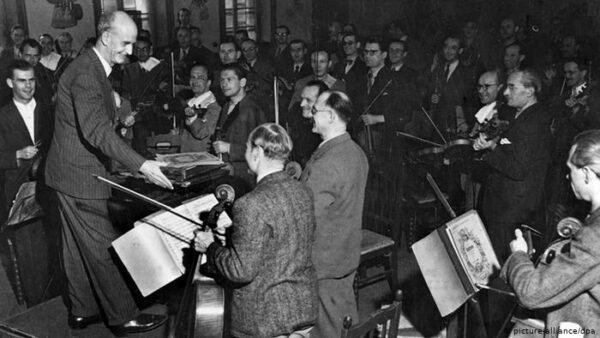
Wilhelm Furtwängler conducts the Berlin Philharmonic in 1935 with prominent Nazis in attendance.
Wilhelm Furtwängler’s wartime activity remains immensely controversial. Certain non-Jewish artists – most famously, Thomas Mann – fled Germany once the scope of Hitler’s intentions became apparent. It was Furtwängler’s contention — as he put it in his denazification trial — that “I felt responsible for German music, and it was my task to survive this crisis, as much as I could. The concern that my art was misused for propaganda had to yield to the greater concern that German music be preserved.” His Beethoven performances, he said, preserved “a message of freedom and human love.” He did not join the party. He helped Jewish musicians and attempted to engage Jewish soloists. In a 1947 address commemorating the Felix Mendelssohn centenary, he said of Mendelssohn, Joseph Joachim, Heinrich Schenker, and Gustav Mahler: “They are both Jews and Germans, and added: “They testify that we Germans have every reason to see ourselves as a great and noble people. How tragic that this has to be emphasized today.”
Furtwängler’s apologia has many times been dismissed as sophistry. It was not, and the wartime broadcasts bear witness to that. He has also been called a tool of the Nazis, which he unquestionably became. And he was an ideological conservative who even after the war clung to a murky Romantic inwardness whose susceptibility to totalitarian abuse had just been tragically confirmed. As Roger Allen underlines in Wilhelm Furtwängler: Art and the Politics of the Unpolitical (2018), Furtwangler seems not to have paused to reflect upon that position prior to his death in 1954. Allen’s book (whatever its shortcomings) suggests something unpleasant about the Furtwangler persona, a nearly atavistic truculence.
What does Stay Alive add to this picture? Two things, I would say. Buruma puts human faces on those who stayed. And he resists passing judgment. Here’s a passage on life in a Berlin bunker of as 1945:
There was so little room that people had to spend days and nights on the concrete stairs. There was hardly any place to sit, let alone to lie down, or wash, or take care of other physical needs. One of the people there was Waltraud Sussmilch, a fourteen-year-old schoolgirl, who had not joined the Hitler Maidens. But she was still ordered by her school principal, a fervent Nazi, to go and help refugees . . . She found it hard to breathe in the fetid air underground. She met a mother and four children who had fled from the east. The mother was beside herself. “We must get out of Berlin,” she screamed. “You have no idea what the Bolsheviks to do women and young girls! Get of out here! Get out of Berlin quickly!”
And these fears were not unfounded.
Scanning a variety of individual responses to wartime Berlin, Buruma observes the behaviors of Nazis and non-Nazis. Of course, expressions of discontent were regularly reported and brutally punished. Many Berliners seem to have become outwardly numb, hard to read. Buruma hesitates to criticize the accommodations they made for the sake of survival. He observes the resentment of exiles and resisters who consider those who do not leave or hide “morally compromised.” He cites the diary of Ursula von Kardorff, who considers it a “fatal mistake” that the Allies no longer distinguish between “good” and “bad” Germans. Of the famous July 1944 plot to assassinate Hitler, Buruma notes that it “went beyond a ‘clique’ of Prussian officers. Civilians were involved as well as soldiers, and among the conspirators were leftists and liberals, as well as arch conservatives. Some of them had been Nazis and keen supporters of the war when things were still going well for Germany. All wished to rescue their country from a devastating defeat.”
Leo, meanwhile, attended concerts, movies, and soccer matches. Buruma observes: “Talking about the assassination plot, let alone writing about it in his letters home, would have been perilous . . . His one mention of the coup attempt hints at what may have been a more widely shared sentiment in Berlin. On August 8, he explains to his best friend at home why he hadn’t mentioned what had happened before: “The reason is that it hardly made any impression here. We are immune to any sensation these days. That may sound a bit exaggerated. Perhaps it is. But it is basically true, I didn’t hear anyone at the factory talking about it.”
After the war, Leo married a British woman with German-Jewish roots: Ian’s mother. “His experience as an unwilling worker in wartime Berlin haunted him for the rest of his life. . . . Had he made the right decision? Should he have tried to escape? He knew that some of the men his age who had managed to remain in hiding regarded the workers in Germany as morally compromised. He also learned quickly from experience that life under dictatorship and occupation throws up all kinds of moral dilemmas.”
Leo died in 2020. Ian ultimately experienced what Berlin became after the reunification of Germany in 1990. In a final chapter, “Aftermath,” he writes:
My book is partly a love letter to Berlin. Since the book is also a history of Berlin’s darkest years . . . this may seem like a perversion. What I love about Berlin, however, is not just the way it has become one of Europe’s most vibrant cultural centers. . . What is most remarkable about Berlin is the way it has dealt with its past, the way the scars of its worst crimes are openly on display. . . . The city itself is a monument, not only to man’s blackest depravity, but to its capacity to be reborn and live again.
This revelation comes as a surprise, if not a non-sequitur. And yet if there is a through-line that consolidates Buruma’s account, it is the admonition: Do not rush to judgment. Buruma’s own closing assessments include this paragraph:
Wilhelm Furtwängler was the leading German orchestra conductor. He performed at Hitler’s birthday, and helped to showcase classical German culture in the Third Reich. Compared to some other prominent conductor, his complicity in the Nazi regime was minor. Unlike Herbert von Karajan, Furtwängler was never a Nazi Party member. Unlike Karl Böhm, director of the Vienna State Opera, he didn’t glorify the Nazis. And he protected several Jewish musicians from persecution. But Furtwängler was singled out for a painful trial before a “denazification” court. Thomas Mann, who saw himself, like Furtwängler, as the personification of German high culture, was unforgiving. He refused to accept that any artist could continue to function in the Third Reich without tainting his reputation forever. Acquitted from charges of antisemitism and Nazi collaboration, Furtwängler was offered the position of principal conductor for the Chicago Symphony Orchestra in 1949. Various famous musicians protested, including his equally celebrated Italian colleague Arturo Toscanini, and the offer was withdrawn. Furtwängler died of pneumonia in 1954. The violinist Yehudi Menuhin, one of his most ardent champions, attributed the hostility of his enemies to their jealousy of the conductor’s greatness.
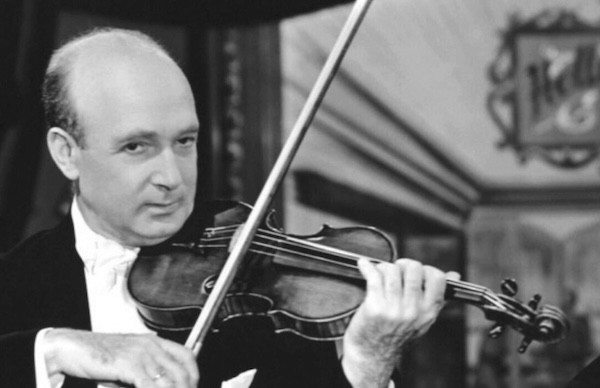
Jewish Hungarian violinist Joseph Szigeti. Photo: Schubert Club
Furtwängler’s American career had begun in 1925 with a series of engagements with the New York Philharmonic over the course of three seasons. After that, he was not asked back. His final appearances with the orchestra included two concerts with Joseph Szigeti as violin soloist. A celebrated Jewish Hungarian violinist, Szigeti was musically kindred to Furtwängler; he would emigrate to the United States in 1939. Remembering Furtwängler at Carnegie Hall, Szigeti described “the uneasy, strained atmosphere backstage, the demonstrative ovations out front that seemed to protest against a ‘fait accompli’ . . . and the resigned, forgiving smile of the obviously hurt artist, a smile that seemed to answer the acclaim with a philosophical ‘too late!’” Szigeti also wrote: “Granted that the emergence of the Nazi regime became an insurmountable obstacle to [Furtwängler’s] return . . . how do we explain away his absence between 1927 and, say, 1932?” The obvious explanation was the the presence of an antipodal genius of the baton: Arturo Toscanini, who had taken New York by storm and whose champion in the New York Times, Olin Downes, found Furtwängler’s interpretations “exaggerated in pace, sonority, and phrasing,” “striving after effect.” Toscanini’s speed, precision, and virtuosity counted heavily in his American favor, as did his proclaimed objectivity.
That Furtwängler did not practice “textual fidelity” – that he felt attuned to a higher authority than the composer’s written instructions — has everything to do with his subsequent refusal to desert wartime Berlin. His ties to a German cultural community, to German musicians and audiences, were dangerously subjective. The danger was inherent in the music. Thomas Mann said it best in 1918’s Reflections of a Non-Political Man, a patriotic wartime text documenting an allegiance he subsequently disowned:
Art will never be moral or virtuous in any political sense, and progress will never be able to put its trust in art … It has a fundamental tendency to unreliability and treachery; its. . . predilection for the ‘barbarism’ that begets beauty [is] indestructible; and although some may call this predilection . . . immoral to the point of endangering the world, yet it is an imperishable fact of life, and if one wanted to eradicate this aspect of art . . . then one might well have freed the world from a serious danger; but in the process one would almost certainly have freed it from art itself.
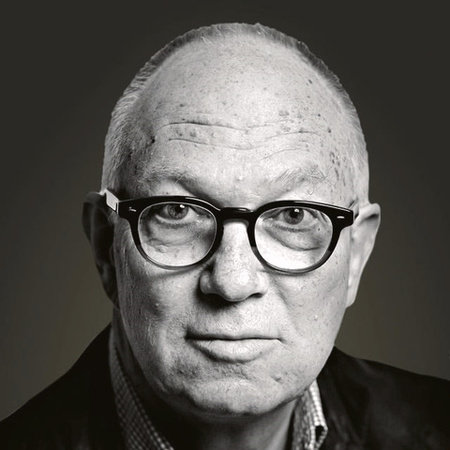
Dutch-born writer, journalist, and intellectual Ian Buruma. Photo: Merlijn Doomernik
Mann knew that his revered Richard Wagner planted dangerous seeds. Though no more than Furtwangler could Mann rid himself of susceptibility to The Ring of the Nibelungs, Tristan, Die Meistersinger, and Parsifal, his political conscience impelled him to move to California – only to return to Switzerland when the Red Scare poisoned his new American homeland. Mann impugned Furtwangler as an embodiment of the “German-Romantic counter-revolution” that fostered the Nazi mindset. His Los Angeles neighbor Arnold Schoenberg, arguably Germany’s leading composer, shaded Furtwängler’s conservative pedigree differently: “I am sure he was never a Nazi. He was one of those old-fashioned Deutschnationale from the time of Turnvater Jahn, when you were national because of those Western estates who went with Napoleon. This is more an affair of Studentennationalismus, and it differs very much from that of Bismarck’s time and later on, when Germany was not a defender, but a conqueror. Also I am sure that he was no anti-Semite – or at least no more than any non-Jew.” Germany’s pre-eminent pianist, Artur Schnabel – like Schoenberg, born Jewish; like Schoenberg, an émigré to the US; like Toscanini, a disciple of textual fidelity — met with Furtwängler after World War II and found him a “slippery character,” a “shoddy hypocrite” who was susceptible to “arrogance, cowardice, and self-pity.”
Eight years ago, in a spirited online conversation debating “Furtwängler in Wartime,” I discovered myself suggesting:
Maybe we could summarize that the truth about Furtwängler falls within two polarities:
1.He stressed the communal experience of music, felt he couldn’t access that outside Germanic lands (I find this credible), so he accommodated the Third Reich insofar as he had to — so long as he didn’t have to join the Party and otherwise publicly endorse Nazi ideology, ethnic cleansing, and book-burning. At the same time, his conservative cultural/political mindset created some degree of common ground with the Nazis. . . . [But] I cannot envision WF feeling personally kindred to a Hitler or Goebbels; his breeding was aristocratic.
2.All of the above – but add to that some degree of actual enthusiasm for what the Third Reich stood for – e.g., concerts that were patriotic occasions, flaunting German exceptionalism/Kunst. Especially given the passions/exigencies of wartime. In other words: crossing the line Mann refused to cross, and doing so with some degree of fervor.
For Leo Buruma, Wilhelm Furtwängler in wartime “lifted one high above the dreariness of our existence” – above the rubble and corpses, above the swagger of Nazi troopers, above the preening falsehoods of Goebbel’s ubiquitous speeches, above the killing fields inflicted on Europe and Africa and Russia.
That is what the broadcasts tell us.
Joseph Horowitz is most recently the author of a novel: The Disciple: A Wagnerian Tale of the Gilded Age. He writes about Furtwangler’s abortive American career in Understanding Toscanini (1987).
Tagged: "Stay Alive: Berlin 1939-45", German History, Ian Buruma, Wilhelm Furtwängler. Berlin
1 Comment
Leave a Comment
This is a compelling read. Furtwängler’s case is endlessly fascinating. How many other conductors have had a play and a movie made about their personal aesthetics and politics? Contrasting the condemnation he has received, with the treatment of other controversial careers such as von Karajan’s and Schwarzkopf’s will probably never cease. Most interesting for me is the shadow cast by Toscanini over Furtwängler’s American career. It is so easy to put up saintly Arturo, impeccable anti-fascist, against the Faustian Wilhelm, Nazi-appeasing Musikoberherr. But as we see, Toscanini was bedeviling Furtwängler’s career before the Nazis did. As the essay reveals, Furtwängler and Toscanini held each other in contempt. Furtwängler once deserted a Toscanini performance of Beethoven’s 9th after a few notes, calling out, “Bloody timekeeper!” Toscanini’s strictures about following the score reflect his political absolutism; Furtwängler’s looseness, his lubricated accommodating. Horowitz’s review gives us deep insights into a fraught topic.