
Film Festival Roundup: Berlinale’s Political Palette — Red Hangars, Rose Rebels, Yellow Censorship
By David D’Arcy
This year’s Berlin International Film Festival was nothing if not political.
If you read any of the reporting on this year’s Berlin International Film Festival, you probably read about Palestine and a dispute that almost got the festival’s director ousted.
Things got started with the statement from Jury President Wim Wenders that the festival should not be political, which prompted another juror, the author Arundhati Roy, citing Gaza, to cancel her participation.
“To hear them say that art should not be political is jaw-dropping. It is a way of shutting down a conversation about a crime against humanity even as it unfolds before us in real time – when artists, writers and film-makers should be doing everything in their power to stop it,” said Roy, who wrote the script for In Which Annie Gives It Those Ones (1989). A restored version showed at the festival.
Things got worse. The festival director, Tricia Tuttle, an American who previously led the British Film Institute, came under attack after the awards ceremony, when the director of the Palestinian film, Chronicles from the Siege, which won the best First Feature Award, accused the German government of “being partners in the genocide in Gaza by Israel.”
Criticism of Israel and the destruction of Gaza came at the Berlinale from almost anyone who had a stage from which to speak.
Right-wing German media placed the blame for criticism of Israel on Tuttle, and amid the ideological fracas she came close to being fired. Tuttle is still there, thanks in part to stalwart support from the film community. Arguments back and forth about the crisis in the Middle East took up much of the press coverage. The festival’s board, which met to debate “the future direction of the Berlinale,” concluded that the dustup was not cause for dismissing her.
Bottom-line: it was hard to avoid politics in the Berlin program, which drew a record audience. Here’s a sampling.
A scene from The Red Hangar. Photo: courtesy of the Berlin International Film Festival
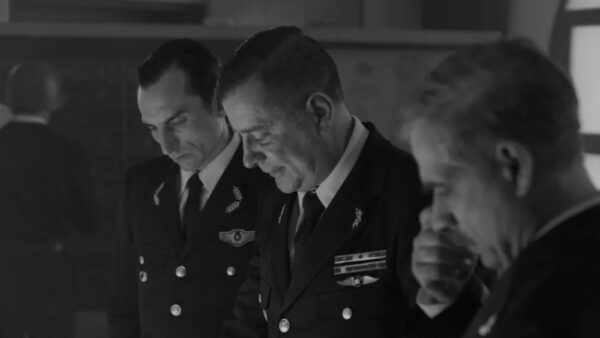
The Red Hangar, the debut by Chile’s Juan Pablo Sallato, is a terse saga in black and white, set in 1973, when the leftist regime, led by Salvador Allende, was toppled by the country’s military, with U.S. support. If that’s not a political subject — Richard Nixon, Henry Kissinger, many thousands of casualties and decades of smoldering resentment — what is?
The story is told through the eyes of a career officer who served the Allende government, and whose loyalty to the new military regime will be put to the test.
Nicolas Zarate plays Jorge Silva, an officer who had been in charge of Air Force intelligence, and who is now tasked with training new cadets. Silva is seen by the army putschists to have two jobs. One is to train young officers now serving the military commanders who are in control of the state. The other is to be part of an apparatus dedicated to purging and punishing anyone loyal to the Allende regime. Silva, when the story opens at the beginning of the coup, was just that, an Allende loyalist. So was his wife, an academic. The air force base where he’s assigned now includes a camp where prisoners are taken and treated with extreme brutality.
In this tale, based on real life characters, Silva is also an admired hero; he once parachuted out of an airplane into a football stadium. The reference to a football stadium won’t be lost on Chileans. Captured Allende supporters were taken to a stadium in Santiago, the capital, where they were tortured. The singer/guitarist Victor Jara had his hands slashed apart there.
This relatively short drama (81 minutes) moves slowly and deliberately. Silva finds himself trapped; he is a military officer whose job is to follow orders, yet his morality is rooted in that of the deposed regime. That irreconcilable contradiction makes it fee like an adaptation of a Kafka story. A man accustomed to giving and following orders struggles with an un-winnable choice of course of actions. He see the future of his country in the hard, cruel behavior of his superiors. He sees the miserable fate of political opponents when they are led, now under his supervision, to the “red hangar” where torture takes place. The violence we don’t see, but can imagine, is well known to Chileans.
Nicolas Zarate as Silva is poker-faced under relentless tension. The black-and-white palette, including close-ups of newspaper photographs, reminds you that this horror is a matter of record. This fascist seizure of power led to seventeen years of military rule.
Jorge Silva, played with anguished control by Zarate, escaped into exile. He was one of the lucky ones, if becoming a refugee can be considered fortunate. For the stories of those who didn’t escape, seek out the films of another Chilean exile, Patricio Guzman. Nostalgia for the Light (2010), considers the legacy of the Pinochet years in the remote Atacama Desert of northern Chile, one of the driest places on Earth, where the families of disappeared prisoners whose bodies were dumped there, sift through the sands for human remains.
A scene featuring Sandra Hüller in Rose. Photo: courtesy of the Berlin International Film Festival
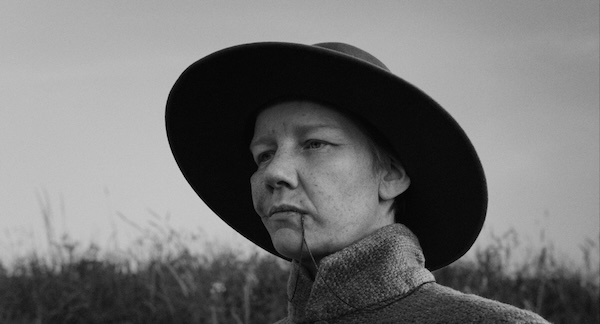
A different shade of red came in Rose, directed by Markus Schleinzer, which premiered in competition at the Berlinale. This tactile and tightly focused historical drama is set somewhere in rural Germany, sometime in the 17th century. A soldier (played by Sandra Hüller) arrives in a small Protestant village and quickly settles in, helping the locals solve their problems, which involve self-preservation and finding enough to eat. The newcomer wins their confidence — until he is revealed to be a woman. The hard-earned welcome turns perplexing, vengeful, and worse.
Any film about an outsider being viewed with suspicion, and then being persecuted and punished is topical in Germany today, given the history of the 20th century. The resurgence of anti-immigrant nationalism in the country makes it even more provocative. Watching it, I wondered how the movie will play in the immigrant-frenzied U.S.
Rose chronicles the everyday lives of its characters with what feels like an anthropological intensity. One element in the narrative is the persistent power of folklore. This hardheaded, tough-surfaced tale has the hand-wrought atmosphere of a woodcut — yet it is anything but folkloric. It’s hard to feel romantic about the grating cloth of that time and the villagers’ rudimentary structures. Even harsher are the villagers’ fears and prejudices, which govern the fates of those found guilty of violating taboos.
Rose arrives in the community with a scar on her face, a masculinizing attribute, and a story of war behind her. After her bumpy adaptation to the village — and marriage to a strong-boned local woman — the bride reveals what Rose, at least, couldn’t imagine was possible. She becomes pregnant. The fall from grace — and shunning that follows — are even more severe than the life that we’ve observed so far. Schleinzer, an actor and a former casting director for Michael Haneke, is reminding us here that, given the chance and the right beliefs, people can justify their own inhumanity. Think Joan of Arc.
After seeing this film in Germany, where it stunned some in the festival audience, I thought that some might find it easy to point an accusatory, self-satisfied finger at Germans. (Markus Schleinzer is an Austrian, I should note, but so was Hitler.)
We in the U.S. should remember that, back in the 17th century, clergy gave their blessing to the burning of witches in Massachusetts.
Ozgu Namal and Tansu Bicer in scene from Yellow Letters. Photo: courtesy of the Berlin International Film Festival
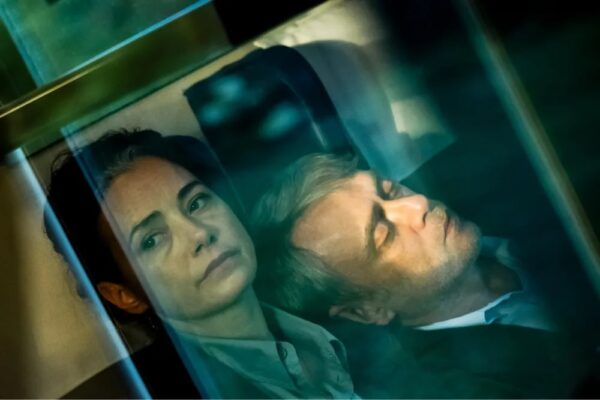
In Ilker Catak’s Yellow Letters, the enemies of the state whom we see are not burned or tortured. Instead, they are sidelined or excluded. The story of two artists who face the consequences of their politics won the Golden Bear, the top prize at the Berlinale. The script is built around a cultural life controlled by a government that punishes its critics. Catak, who co-wrote the script, tells us that it doesn’t take much.
Derya (Ozgu Namal) is an actress. Aziz (Tansu Bicer) is a playwright and academic. The film opens with their misdeeds, which seem more like indiscretions. Derya performs in a play by Aziz that bemoans the state of artistic freedom in Turkey. After the show, she slights an official who wanted to meet her.
We then see Aziz, a professor, in a classroom with his students while a noisy protest rages outside. He tells his pupils that he wouldn’t mind if they joined the demonstration, since they might learn something that they wouldn’t get in a classroom.
Both Derya and Aziz lose their jobs. They decamp from their home in Ankara and relocate along with their teenaged daughter to Aziz’s mother’s home in Istanbul. Aziz ends up driving a cab at night. Derya takes a part that pays well in a TV show on a network known for its support of the government. They think about selling their home for the cash.
If this is Turkey today, it’s repressive, but things could be worse. Neither Derya nor Aziz is in prison. Still, their freedom is constricted. The couple faces all sorts of petty inconveniences and embarrassments, including having to ask a right-wing relative to lend them money.
The film underlines the tightening of free expression in Turkey, pointing to the capitulations the artists feel they need to make. The drama is set in Turkey, yet it was filmed in Germany, where Catak was born to Turkish parents and lives today. The name of Turkish president Recep Tayyip Erdogan is never mentioned. Most of the funding for the film came from sources in Germany, a safe place from which to criticize Turkey. But could that mean that Catak is somehow pulling his punches?
Catak received an Oscar nomination for The Teachers’ Lounge (2023), a drama set in a German school about a teacher forced out of her job when the search for a thief goes awry. The protagonist, played by Leonie Benesch, was a portrait of uneasiness, the victim of wrongful blame. Yellow Letters may be an accurate picture of conditions that some artists face in Turkey today. But it never quite catches fire dramatically. You feel that there are darker stories to tell.
David D’Arcy lives in New York. For years, he was a programmer for the Haifa International Film Festival in Israel. He writes about art for many publications, including the Art Newspaper. He produced and co-wrote the documentary Portrait of Wally (2012), about the fight over a Nazi-looted painting found at the Museum of Modern Art in Manhattan.
Tagged: "The Red Hangar", "Yellow Letters", Berlin international Film Festival, Ilker Catak, Juan Pablo Sallato, Markus Schleinzer