
April Short Fuses — Materia Critica
Complied by Arts Fuse Editor
Each month, our arts critics — music, book, theater, dance, television, film, and visual arts — fire off a few brief reviews.
Blues
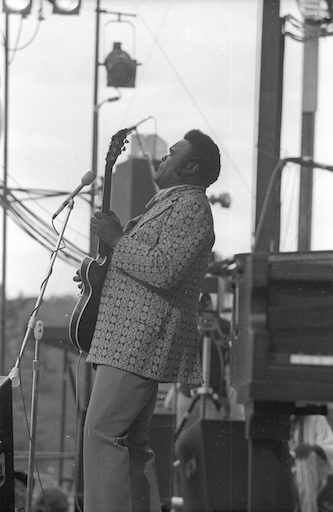
Freddie King at at the Ann Arbor Blues Festival in the early ’70s. Photo: Michael Ullmann
Must a blues guitarist be able to sing? Muddy Waters thought it was a bottom-line requirement. He had a point. But if anyone could have made it as a mute blues guitarist, it would have been Freddie King, whose 1960 instrumental “Hideaway” was as close to a hit as blues singles could be. (It was collected with twenty-three other instrumentals on Just Pickin’.) Numbers such as “Sen-Sa-Shun,” King’s version of “Got My Mojo Workin’,” prove that he stands as one of America’s most melodically inventive blues guitarists. He also swung hard. His “What’d I Say” on My Feeling for the Blues is the one version — besides Ray Charles’s original — that I’d recommend. King could also sing.
King’s Feeling Alright: The Complete 1975 Nancy Pulsations Concert (three LPs, Elemental Music) begins with a tantalizingly slow version of “Have You Ever Loved a Woman,” which he uses to introduce the band. Later, King takes on the Big Joe Turner hit “Wee Baby Blues,” also at a crawl. King can generate as much excitement playing long, bent notes at a whisper as when he is moving at full volume. On “Feeling Alright,” he plays extended versions of Chicago blues classics like “Got My Mojo Working” and “Sweet Home Chicago.” On the medley “Sen-Sa-Shun/Feeling Good/Boogie Chillen’,” he and his sextet hit a groove and stay there, sustaining considerable excitement without prominent solos. King was never about virtuosity, but the agility of his guitar playing is something else. King’s performances at the Ann Arbor Blues Festivals I attended during the early 1970s are among the highlights of my listening career. Feeling Alright generates much of the same feeling.
— Michael Ullman
Alternative and Popular Music
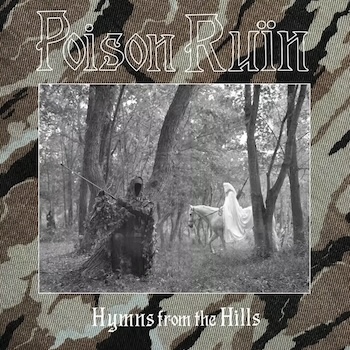
Poison Ruïn’s Hymns from the Hills (Relapse) invokes two different historical periods. Performing an amalgam of punk, metal, and post-punk, the group could’ve been part of a Motörhead/Killing Joke gig in London during the early ‘80s. (The Philadelphia band sounds quite British.) The other element from the past: the group’s music is set in a medieval world, where serfs struggle against nobility for power over their lives. The imagery of the band’s album covers, which incorporate scythes and spiked flails, is central to its artistic mission.
Until now, Poison Ruïn’s music was coated in fuzz. Although Hymns from the Hills was still recorded at home by singer/guitarist Mac Kennedy, it’s considerably cleaner than their 2023 album Harvest. Jonah Falco’s mix and Arthur Rizk’s mastering give the band a sharper focus. While the guitars still sound raw, the keyboards in the background of “Lily of the Valley” are faint yet clearly audible, as are the bells on “Pilgrimage.” The title track even features a spaghetti-Western-style harmonica.
“Eidolon” starts with an ominous metallic riff, which turns toward thrash once the drums race and Kennedy barks away. He emerges as the album’s MVP, capable of a throat-searing roar and quieter tones. He draws on both voices on “Howls From the Citadel,” nearly a power ballad. No matter how nebulous the lyrics, he’s always highly expressive. Drummer Allen Chapman also brings some swing to the band — his fills push the music’s energy level up further. On “The Standoff,” he lays down a furious barrage of snares and cymbals, as though setting the stage for a battle.
Hymns from the Hills maintains a dark, foggy mood, but it does so in a way that is much bigger than Poison Ruïn’s previous music. Not that the band betrays its essence. For all the Renaissance Faire imagery, the group’s fantasies still include the dirt of real life.
— Steve Erickson
 After almost 30 years, the hip-hop duo dälek is more pissed off than ever. Their latest album, Brilliance of a Falling Moon (Ipecac), tears into “a world thoroughly on fire” with winningly thunderous wrath: “I, for one, am never numb to brutality.” Rather than tumbling into rote self-righteousness, they let their incisive lyrics and MC Will Brooks’ impassioned vocals speak for them.
Without ever leaving hip-hop behind, the production—handled by Brooks and Mike Manteca—pushes at the genre’s creative boundaries. Their approach maintains hip-hop’s classic grit: piano and drums crack like boom bap fed through a guitar-shop’s worth of distortion pedals. Brooks and Manteca’s CV leans toward metal, industrial, and art rock; they’ve collaborated with the Young Gods, Faust, and former This Heat drummer Charles Hayward. Together they weld electronic noise of hurricane strength, engineered to grate on the nerves.
“Normalized Tragedy” and “Substance” insist on hip-hop as a culture, not just a sound. dälek’s abrasiveness defends its own kind of traditionalism—a reminder of how long they’ve stuck to their convictions. Picking up the thread from Public Enemy, politically and musically, they extend the line forward to early-2000s underground staples like Cannibal Ox’s The Cold Vein, El-P’s Fantastic Damage, and more recent noise rap.
“Better Than” lays out a manifesto: “no time for the trash they’ve been peddling / why the fuck would I bow when I’m better than.” The album never strays far from explicit politics: it calls out Henry Kissinger, ICE raids, and the Trump administration’s lies about Haitian immigrants. “Most of y’all spit but lack substance” is a charge that could never be aimed at Brilliance of a Falling Moon. Even if you tune out the words, the record still captures the exhaustion of surviving in a world thoroughly on fire.
— Steve Erickson
Jazz
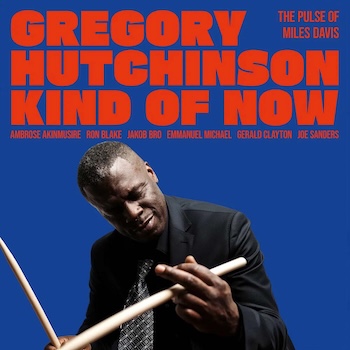
In this centenary year of Miles Davis, drummer and bandleader Gregory Hutchinson has put together Kind of Now – The Pulse of Miles Davis (Warner Music), an all-star tribute to the late master musician. Noticeably omitting music from the final years of the trumpeter’s career, Hutchinson focuses on what many consider Davis’s lengthy golden period, ranging from the late-’40s bop era to the early fusion excursions of the ’70s, interspersing the homage with a few punchy drum solos.
To mash clichés, the attitude here seems to be “if it ain’t broke, have fun with it.” And there is plenty of entertainment to be had, and serious respect must be paid to Hutchinson and his fine band, which includes Ambrose Akinmusire (trumpet), Ron Blake (tenor saxophone, bass clarinet), Jakob Bro (guitar), Emmanuel Michael (guitar), Gerald Clayton (piano), and Joe Sanders (double bass). The musicians take listeners on an enjoyable trip through a selection of genre-defining compositions.
A large part of the album’s success stems from its reliance on the established trio of Clayton, Sanders, and Hutchinson. The threesome’s energy is immediately felt on the disc opener “Ah-Leu-Cha,” a Charlie Parker bop hybrid. Akinmusire and Blake are fully engaged in the proceedings, though the trumpeter asserts his own divergent style. In the following track, “Fran Dance,” Clayton and Sanders shine, smoothly building on Davis’s late-’50s aesthetic and adding pleasurable accents to this esprit de jazz.
A bit out of chronological order, “Seven Steps to Heaven” suggests Davis’s impressive ’60s phase; there is also plenty of excitement generated in bubbly, guitar-immersed takes of Wayne Shorter’s “Fall,” with Bro and Michael exploring out in the mist, plus “Orbits” and “Water Babies.”
On those cuts, saxophonist and composer Blake dances stealthily around the melody while the rhythm section gently churns. A rewarding version of Tony Williams’s “Black Comedy” cements my impression that Hutchinson intended his tribute group to spotlight the ’60s. The drummer manages to get close to Williams’s distinctive combination of strength and subtlety.
“Bitches Brew” and “Feio” show Akinmusire at his most Milesian, while Blake is handed an opportunity to honor Bennie Maupin from the original performances of the pieces—he supplies some appropriately meandering lines on bass clarinet. “Circle in the Round,” riding on the heft of a strong Michael solo, eases the album into its closing Hutchinson solo.
One wonders if the disc, particularly with two guitarists on board, might have given a nod to the mid-’70s, recorded-in-Japan experiments on the edge of cacophony that preceded Davis’s legendary semi-retirement. Regardless, Kind of Now – The Pulse of Miles Davis reinvigorates some really wonderful music.
— Steve Feeney
Theater
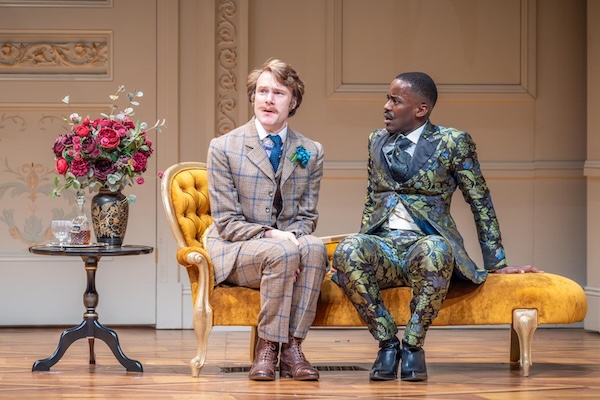
Hugh Skinner as Jack and Ncuti Gatwa as Algernon in the National Theatre’s production of The Importance of Being Earnest. Photo: Marc Brenner
The National Theatre’s latest production of Importance of Being Earnest is currently available for streaming exclusively on National Theatre at Home. The production was a hit. Fortunately, not a syllable has been uttered about the mixed-race casting, nor has the incursion of cross-dressing caused any complaints. (Has anyone not seen Lady Bracknell played by a man?) Its extra-textual drag performances were praised as well, though a number of critics were not thrilled with what the performers did with the Oscar Wilde’s script.
My critique of the production centers on its travesty of Victorian fashion. Costume designer Rae Smith deserves a dressing down. My gorge rises at the thought of the ridiculous suits that Algernon and Jack are kitted out in. In Act One, Jack looks like he’s dressed in a “horse-blanket” tweed suit (at least we are spared the cliché of a green carnation boutonniere). Algernon looks like he’s wearing a suit cast off by Frank Gorshin’s Riddler from the 1960s Batman TV series—not to mention that later on both Jack and Algernon appear in waistcoats in mixed company. Worst of all are Gwendolyn and Cecily’s bare arms during their teatime verbal tussle—it is a grotesque inaccuracy. Ladies and gentlemen of the class Wilde portrays would never have committed such sartorial atrocities.
I am not defending assertions of authorial autocracy by Eugene O’Neill, Samuel Beckett, or David Mamet. But the bungled costuming here, no doubt at the behest of the director, is so wrong-headed that it renders the production incoherent. We’re meant to accept Wilde’s comedy as a soufflé but, as some critics point out, the staging also emphasizes Wilde’s roasting of Victorian marriage codes. How, then, can the latter point be taken seriously when the designer is allowed to play fast and loose with Victorian dress codes? On top of that, the production includes two large nude male statues as part of the set design, which characters interact with briefly (for example, Jack strokes one). If you’re lancing the era’s hypocrisy, you can’t jettison its armor and hidebound etiquette.
— Tom Connolly
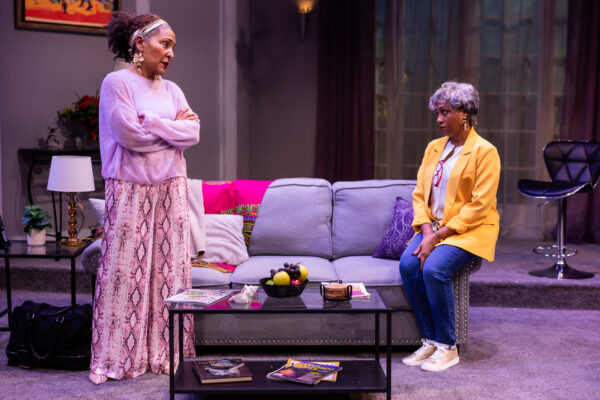
Patrice Jean-Baptiste and Inés de la Cruz in the Lyric Stage production of Angry, Raucous, and Shamelessly Gorgeous. Photo: Nile Hawver
Playwright Pearl Cleage’s 2022 play Angry, Raucous, and Shamelessly Gorgeous (running at the Lyric Stage through April 12) is a dynamic character study that examines generational tensions in theater and feminism. The plot centers on the trials and tribulations of the aging performer Anna (Patrice Jean-Baptiste), who returns to the U.S. with her best friend and manager, Betty (Inés de la Cruz), after nearly thirty years abroad. Anna believes she has been invited to perform her defining work, “Naked Wilson,” at a women’s theater festival in Atlanta. In the ‘90s, she presented a controversial series of monologues from the plays of August Wilson — performed in the nude — as a way to call attention to how women’s narratives have been dismissed in theater.
But times have changed. The festival’s producer, Kate (Deannah “Dripp” Blemur), insists that the work is overdue for a reinterpretation, and she has hired a much younger and inexperienced actress, Precious “Pete” (Yasmeen Duncan), to perform the piece. When the four women come face to face in Anna and Betty’s hotel suite, the debate about who is going to do what — and what revolutionary theater means today — is on.
Structurally, the play is a collection of amusing, though pointed, confrontations between different pairings of the four characters. The hotel room becomes a kind of ring, the women exiting and entering the fray at different times. Director Jacqui Parker does wonders with the staging, moving the women — alternately introspective and aggressive — around as they mark their territory by retreating into corners or circling the couch. The cast members bring plenty of engaged energy to their roles as poignant pugilists.
— Hannah Brueske
Visual Art
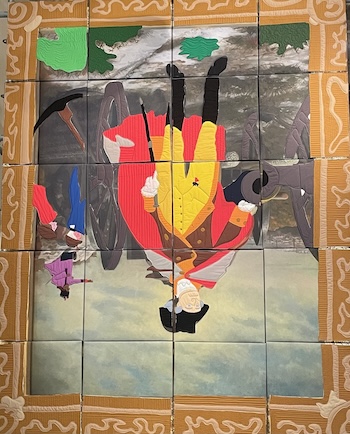
Upside down George Washington quilt. Photo: Lauren Kaufmann
Sometimes contemporary artists turn tradition on its head. That’s certainly the case with Michael Thorpe, the contemporary artist who created Out of Order, Fortification of Dorchester Heights for Revolution! 250 Years of Art + Activism in Boston at the Boston Public Library.
Thorpe grew up in Newton and now innovates with quilts and collage. The BPL asked him to be a consulting artist for the exhibit, and commissioned him to make a work of art for the show. After he learned that Washington at Dorchester Heights, 1852, would be in the exhibit, Thorpe decided to make something that responded to Emanuel Leutze’s monumental portrait.
Out of Order, Fortification of Dorchester Heights is made up of 20 movable squares. When I first saw the exhibition last November, Thorpe’s work looked like a jumbled jigsaw puzzle. I could see that the pieces related to the Leutze painting, but the composition was out of whack.
Thorpe has returned to the BPL twice since the exhibit opened. Each time, he has rearranged the squares. When I revisited the exhibition last week, the pieces fit together logically — but Thorpe had hung the piece upside down.
I talked to Thorpe on the phone last week and asked if he had intended to make a political statement with his most recent hanging. He said that he didn’t have that in mind, but he is pleased with the timing, considering what’s happening in American society today. For me, given that the world feels as if it is being turned upside down, this new arrangement is a stroke of genius. If you haven’t seen this exceptional exhibition, head to the BPL before its closes on April 21. The good news is that Thorpe’s piece will become part of the library’s permanent collection, so you’ll find it there sometime in the near future.
— Lauren Kaufmann
Classical Music
 That Iceland has emerged as a powerhouse for new music is one of this century’s welcome developments. And its staying power is neatly demonstrated in Daníel Bjarnason’s The Grotesque & The Sublime (Sono Luminus), which showcases how that composer’s voice continues to develop through three large-scale works: Feast, Fragile Hope, and Inferno.
The latter is a percussion concerto and, by a couple of minutes, the album’s longest entry. Its title references Dante’s epic and the concept of journeying is a constant across its three-movement arc. Throughout, Bjarnason’s writing is lively and fresh, with the dialogues between solo percussion and orchestra in the first movement (“The Bells”) standing out for vigor and invention.
His writing doesn’t stint on personality, either: the concluding “Dark Shores” is impish while the central “A Passage” offers bristling accretions of energy, as well as dissipations of the same. Across it all, percussionist Vivi Vassileva navigates her involved part with brio and precision.
Pianist Frank Dupree manages much the same in FEAST, Bjarnason’s piano concerto after Edgar Allan Poe’s The Masque of the Red Death. Slashing, lyrical, eerie, grand, and fragmented, the score makes for a compelling listen, especially its transitions from one movement to the next. Throughout, the soloist is in fine form navigating the music’s dense textures and punching gestures.
— Jonathan Blumhofer

You’ve got to hand it to Neeme Järvi: as the Estonian conductor approaches 90, he’s hardly resting on his laurels. Granted, his output of recordings has slowed down in recent years; even so, Järvi’s latest release with the Gothenburg Symphony Orchestra (Chandos), which pairs works by Hugo Alfvén and Einojuhani Rautavaara, stands with the best of what he was doing forty years ago.
The centerpiece is Rautavaara’s enchanting Cantus arcticus, a work Järvi previously taped with these forces in 2002. This new account of the Finnish composer’s 1972 hit for prerecorded birdsong and orchestra is just as good as the last one—which is to say, as persuasive as they come.
Atmospheric, shapely, spacious, there’s a sense of direction to the performance that manages to tap into various things—Ravel-esque opulence in the first movement, Sibelius-like spareness in the second—without losing sight of the big musical picture. What’s more, the finale, with its hypnotic textures and mystical aspect, builds to a truly resplendent climax before wrapping with a powerfully haunting coda.
In this context, Alfvén’s more traditional Festspel and suite from Gustav II Adolf pale somewhat in comparison. The former sounds a bit like gloss on a Tchaikovsky polonaise, though the Gothenburg’s performance is good and lively.
Alfvén’s incidental music has a bit more going for it, including a trio of lilting dances. Järvi, who’s recorded a good bit of the Swedish composer’s music across his career, clearly loves it and the Suite’s tender moments—the “Vision” and “Elegi,” in particular—glow warmly.
— Jonathan Blumhofer
Books
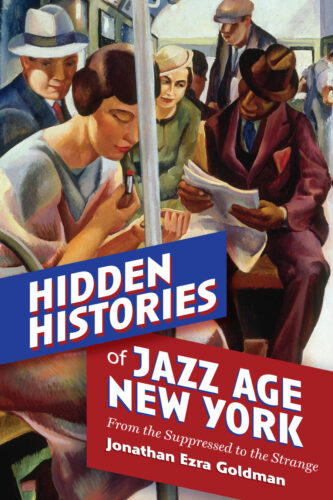
In Hidden Histories of Jazz Age New York: From the Suppressed to the Strange, Jonathan Ezra Goldman has amassed a tremendous amount of information about New York City in the 1920s, mostly the early years of the decade. The volume is a grab bag of material, some entries short, some several pages long, grouped by class, gender, sexuality, race, and ethnicity. In particular, the author goes deeply into the role of women, Native people, and African Americans, probing the Marcus Garvey movement in detail.
Among the topics are the health obsessions of millionaires, women performers challenging social taboos, the rise of nativist movements, debates surrounding women’s rights and immigration reform, technological innovations that revolutionized music consumption, and the emergence of the cult of personality. Goldman tells us who owned the NYC nightclubs, who went there, and who got into trouble.
A look at the bibliography discloses that the author relies less on books than on the reportage of New York newspapers, especially the Daily News. This reliance gives the book the virtue of giving readers a sense of how contemporary New Yorkers viewed the urban world around them.
The author chooses a subject and tracks it through various cultural byways. For example, in “The Sheiks,” he traces the genesis of the song “The Sheik” and its relationship to Rudolph Valentino’s film character. He then follows the history of the recordings of the song, including its ethnic spinoffs, such as Fanny Brice’s “The Sheik of Avenue B.” We learn that the word migrated into Black vernacular and eventually became the name of a brand of condoms.
Hidden Histories of Jazz Age New York is well illustrated, well sourced, and easy reading. There’s no single through line here—no thesis—which is not a problem. This is the sort of book one dips in and out of, usually with rewarding results
— Steve Provizer
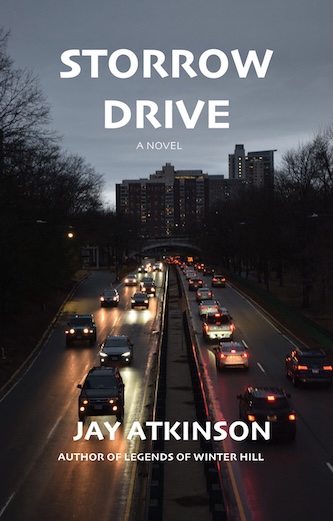
Jay Atkinson’s Storrow Drive won over this inveterate T-rider from the get-go with its knowing description of Kenmore Station and its denizens, just one of many settings that will resonate with local readers and beguile those from out of town.
Drawn in part from his 2006 bestseller Legends of Winter Hill: Cops, Con Men, and Joe McCain, the Last Real Detective, the novel is a rollicking epic of the Boston criminal underground, told in salty, sui generis argot by Atkinson’s alter ego Joe Dolan, a multi-hyphenate academic/journalist/gumshoe/ex-hockey player struggling to put together a scoop for the Boston Globe Magazine. He gets a tip from a student whose drug-dealing boyfriend has been robbed, which spurs a renewed investigation into a case that was left unresolved after a messy bust six months earlier.
Among the cops with whom Dolan works is Jimmy Ford, a hard-bitten Mass. State Trooper who is guided by the mantra “go with the flow” and who is “a cold-blooded guardian angel” for his informants, like sad-sack addict Soapy Taylor. Dolan, meanwhile, has put together a motley crew of panhandlers, students, and “the best parking lot attendant since Neal Cassady” to help wend his way through the convoluted, densely detailed plot (as one detective confesses, “I need a flow chart”).
Well-crafted though that plot might be, it is less engaging than Atkinson’s sprawling dramatis personae. It includes such indelible characters as Janice Cozelli, a prostitute and snitch with a colostomy bag and a knack for knifework, and Marty McTavish, a malignant Globe hack redolently described as “a dirty-underwear kind of guy.”
Atkinson’s vivid verbal repertoire is not just streetwise and scatological but also erudite and inventive. It’s a cornucopia of high and low culture, which in the course of a page or two might drop an allusion to Vladimir Nabokov and Ginger Rogers, or to the Zapruder film and The Night of the Hunter, or to Triumph of the Will and The Rockford Files. He also has a knack for similes, which he can overindulge. No matter – this book ranks up there with those by such masters of Boston noir as Dennis Lehane and Robert B. Parker.
— Peter Keough
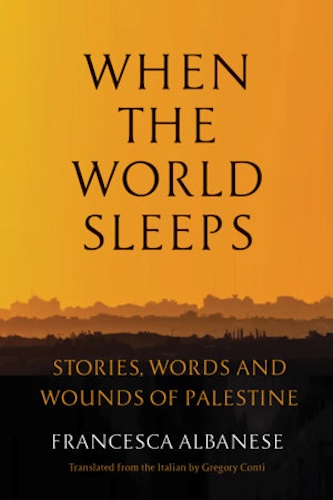
When The World Sleeps: Stories, Words, and Wounds of Palestine is more than just a heartbreaking work of moral lucidity — a horrifying vision of Gaza’s degradation via interviews, personal testimony, legal analysis of the scuttling of international law, and conversations with scholars, activists, journalists, and artists. Francesca Albanese is a prominent Italian human rights lawyer and UN Special Rapporteur on the occupied Palestinian territories; she has been publicly maligned for her outspoken (courageous) critiques of Israel’s apartheid policies and unchecked militancy. Recently, the U.S. has sanctioned her as part of a campaign to discredit her reporting on Gaza. But, as Albanese states, “before a genocide can be stopped, it must be seen.”
When The World Sleeps is particularly valuable because it does more than just sound a wake-up call for the world’s empathy. It is a warning about the utter breakdown of international law that made genocide possible, a systematic eradication of human rights underwritten by a lack of political will and enabled by some of the world’s largest corporations, who profit from maintaining what amounts to global nihilism.
Albanese points out how deeply dangerous this erasure of elemental human protections is for the future. “Israel has continued systematically to bulldoze not only the territories but also international law,” she argues, “distorting the very essence of law and justice. The illegality of this conduct is irremediable, because it touches on the cornerstones of the international order, that it is the rule of law that must govern relations between states, not the arbitrary will of the strongest.” Who will fight to establish human rights when the powers-that-be are silent? When our leadership accepts, without qualms, the genocides that will come with the universal acceptance of “might makes right”? For those preparing for the herculean battle against kratocracy ahead, When The World Sleeps is an imperative read.
— Bill Marx
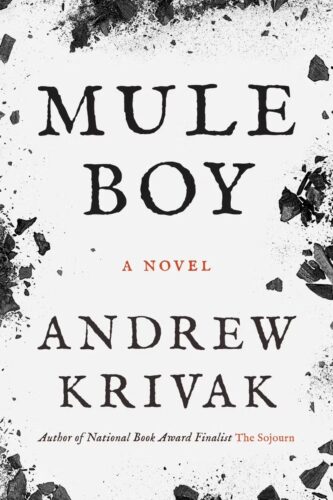
In 1929, a thirteen-year-old boy leads a mule named Wicked into a Pennsylvania mine and learns about skill, the camaraderie of workers, and what might rise to the surface in the last moments of a man’s life. Andrew Krivak’s Mule Boy brings the boy’s world up into the light in this deliberately quiet, shattering novel.
After surviving what will later be named the New Year’s Mine Disaster, Ondro Prach tries college, spends time in prison as a conscientious objector, and later becomes a fire watcher, and the reader learns how his hours in the dark carried him to those choices. Mule Boy proceeds in gulps of breath, in sentences and chapters that never end in a period, yet it is never hurried; these colliers and their families don’t talk much, letting their silence do their speaking for them. Yet against that reticence are exquisitely observed moments – the ritual of setting a kettle on to make tea, feeling the temperature shift as the cage descends into the mine shaft, and plainspoken descriptions of an injured miner that open up into an entire culture: “…his jacket dark with blood at the shoulder, the dust settling on it and staying there like flour in the bottom of a greased baking pan.”
— Debra Cash
Design
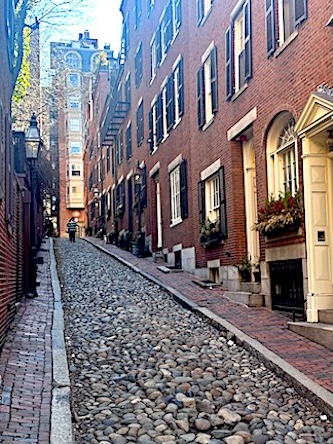
Beacon Hill’s Acorn Street. Photo: Mark Favermann
It could be considered just a touristy contention, but Beacon Hill’s Acorn Street has been called one of the most photographed streets in America. The location began as a place where artisans, tradespeople, and servants to Boston’s Brahmin elite lived. Today, it provides visitors with a revealing look back at history. It’s a cobblestone street lined with Federal-style, attached red-brick houses that elegantly frame birch trees, while ivy and seasonal flowers punctuate the scene—establishing Boston’s physical, historical, social legacy for visitors and residents to document and personally celebrate.
A private street open to brief public visits, it is a narrow, picturesque lane featuring iconic 1820s historic row houses. Particularly beautiful during the fall and holiday seasons, the area features one of the few remaining examples of authentic pre–Civil War-era residential structures built in Boston. The Acorn Street Association prevented it from being paved over in 1980, thus preserving the short street’s quaint, quiet character and charm.
Besides its stunning Beacon Hill location, the street is a terrific example of human scale married to the idea of “soft edges.” The opposite of modern hard-edge and geometrically rigid modern architecture, the notion of “soft edges” has been a focus of Danish urbanist Jan Gehl, who finds value in the “in-between” spaces (or transition zones) where private buildings interact with public spaces like alleys, lanes, and pathways. Gehl’s theory holds that these spaces nurture a rich intersection of city life: social interaction, human perception, urban activity, and sensory experience. This sense of “in-between” space is why we respond so positively to Acorn Street.
The neighborhood’s narrow streets feel intimate and pedestrian-friendly compared to many contemporary city-planning efforts. Here destination elegantly surpasses location. The red-brick edifices on Acorn Street provide a harmonious ballast to our environment: that enduring quality is part of the reason so many of us love Boston.
— Mark Favermann
Film
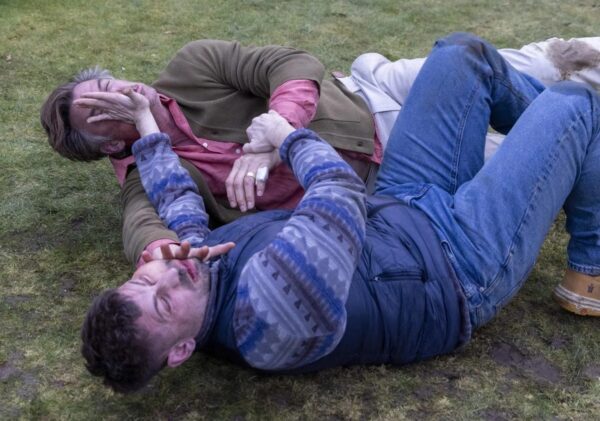
Josh Duhamel and Michael Sorcha in a scene from Preschool.
Actor Josh Duhamel’s third feature as a director, Preschool, is a comedy set in London. The veteran actor (who once starred in All My Children) plays Alan, who’s married to Lauren (Charity Wakefield, terrific in The Great). They live in a large, elegant mansion with their precocious four-year-old daughter, Grace. Their daughter is vying for a spot in a prestigious preschool, as is the son of Sarah (Antonia Thomas, from the excellent British series Lovesick), and Brian (Michael Socha, best known for playing Tom in Being Human), a middle-class couple determined to see their equally precocious son Dylan succeed.
The two couples meet at the office of the preschool’s director (the wonderful Fenella Woolgar), who informs them that only one spot is available and that Grace and Dylan are the top candidates. The husbands are immediately combative and competitive; the wives are more level-headed and compassionate (shocker, I know). When Lauren suggests they all meet for dinner, Sarah tries to convince Brian to be on his best behavior — despite his compulsion to outdo Alan in every possible way.
The relentless one-upmanship not only grows tiresome but also constrains the story (co-written by Nicole and Richard D’Ovidio, who also penned the 2013 thriller The Call, directed by Brad Anderson). Still, the cast’s sharp performances keep it afloat, sustaining a stylish comedy‑of‑manners tone that plays cleverly with topical targets that include helicopter parenting and social ambition. Even when the contrived suspense of the preschool admissions contest fails to fully convince, the film’s smart, timely satire keeps Preschool engaging and surprisingly relatable.
— Peg Aloi
Tagged: "Brilliance of a Falling Moon", "Feeling Alright: The Complete 1975 Nancy Pulsations Concert", "Hidden Histories of Jazz Age New York: From the Suppressed to the Strange", "Hymns from the Hills", "Kind of Now – The Pulse of Miles Davis", "Mule Boy", "Out of Order Fortification of Dorchester Heights", "Preschool", "Revolution! 250 Years of Art + Activism in Boston", "Storrow Drive", "The Grotesque & The Sublime", "When the World Sleeps", Acorn Street, Andrew Krivak, Beacon Hill in Boston, Daniel Bjarnason, Einojuhani Rautavaara, Francesca Albanese, Frank Dupree, Freddie King, Gothenburg Symphony Orchestra, Gregory Conti, Gregory Hutchinson, Hidden Histories of Jazz Age New York, Hugo Alfvén, Josh Duhamel, Michael Ullman, National-Theatre, Neeme Järvi, Poison Ruïn, Steve Erickson, The importance of Being Earnest, dälek