
Film Review: Christian Petzold’s “Miroirs No. 3” — Light as Air, Heavy with Secrets
By Peter Keough
The narrative is filled with secrets and mysteries that tease and fade away — and the deepest mysteries lie within that basic social unit, the family.
Miroirs No. 3, written and directed by Christian Petzold. Screening at the Coolidge Corner Theatre, March 27 through April 2.
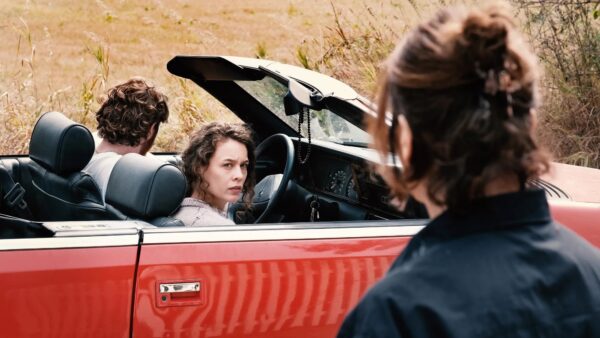
Paula Beer in scene from Christian Petzold’s Miroirs No. 3. Photo: Christian-Schulz/Schramm-Film
The third in a Kieslowski-like “elements”-themed trilogy, with previous entries based on water (Undine in 2020) and fire (Afire in 2023), Christian Petzold’s Miroirs No. 3 — the slightest, and in some ways most evocative, of the three — addresses and aspires to emulate the wispy, elusive element of air. In doing so, it attains the limpid simplicity of an Éric Rohmer moral tale.
Like Kieslowski’s Blue (1993), it begins with an off-screen fatal car crash. Unlike Juliette Binoche’s bereaved widow, though, the surviving partner of the dead man, Laura (played by Petzold’s enigmatic frequent collaborator Paula Beer), does not seem to grieve much over her loss (and for good reason — the guy is a dick). Instead, she moves on to another, more rewarding but also problematic, relationship.
Ominously, prior to the accident, the car had twice passed by Betty (Barbara Auer), an older woman painting a picket fence,. Both times she and Laura had locked eyes in a kind of recognition or premonition. Sure enough, in one of the film’s first serendipities — and near-contrivances — the accident occurs just down the road from where Betty is standing. She’s first on the scene, and Laura, who is uninjured except for a cut, declines to go to the hospital. Instead, she asks to stay with Betty to recuperate.
Betty is delighted to have her as a guest and — shades of Vertigo (1958) and Petzold’s own Phoenix (2014) — offers Laura her absent daughter Yolanda’s clothes to wear. She calls her new guest by her daughter’s name. Laura doesn’t mind; she feels immediately at home. A piano student at a Berlin conservatory, Laura passes on Betty’s untuned spinet. Instead, she opts for simpler pleasures, joining her host in whitewashing the fence — inspiring Betty to relate the famous Tom Sawyer hoodwinking story. Laura responds to Betty’s maternal attentions by offering to make dinner, cooking Königsberg dumplings — coincidentally a dish Betty’s two “men” love but the only one she can’t get right. “You should invite them over for dinner,” Betty says, and reaches for the phone.
So far, so idyllic. But ominous signs emerge. Earlier, while Laura and Betty were painting the fence, a couple of locals passed by and shot a suspicious look at the pair. And as cozy as Betty’s house seems, not all is quite right. Not just the fence and the piano need attending to; the dishwasher is on the blink and the tap drips. This disorder and neglect suggest an unstable family situation. When Betty makes her phone call, the film’s point of view shifts briefly to her “men” — her husband Richard (Matthias Brandt) and their son Max (Enno Trebs), a pair of salt-of-the-earth grease monkeys who appear to be transacting a shifty deal with a rich customer. They try to talk Betty out of her dinner plans, exchanging a “not this again” kind of look. “She’s off her pills,” one mutters. Reluctantly, they accept the invitation.
After a rough start, though, dinner goes well. Things around the house are repaired, and Richard and Max see the positive effect Laura has on Betty, so they accept her. Still, uneasiness lingers. Unlike the other two films in the trilogy, this one does not concern itself with environmental issues so much as class and social differences. Laura comes from money, and at times her attachment to Betty’s relatively lumpen world seems like a kind of slumming. Later, watching Max arrange another of his shady deals, Laura asks coyly, “Are you criminals?” As Laura becomes more attached to the household, she keeps trying to tell Betty something but is always being interrupted. The narrative is filled with secrets and mysteries that tease and fade away — and the deepest mysteries lie within that basic social unit, the family.
Oddly, it’s in Richard and Max’s van that the Maurice Ravel piano piece (“Miroirs: No. 3”) is first heard, a movement in the suite titled “Une barque sur l’océan” (“A Boat on the Ocean”). Elementally speaking, it would seem to be more appropriate for a film about water. Is this the kind of music that non-arty types like Richard and Max might be listening to? Is it a recording made by Yolanda? Was she a pianist too? What happened to her? Ultimately, the film feels more in tune with Hitchcock’s Rebecca (1940) than Vertigo — as if what matters most is not what’s seen but what’s absent: a void that cannot be filled, something that has vanished into thin air.
Peter Keough writes about film and other topics and has contributed to numerous publications. He was the film editor of the Boston Phoenix from 1989 to its demise in 2013 and has edited three books on film, including Kathryn Bigelow: Interviews (University Press of Mississippi, 2013) and For Kids of All Ages: The National Society of Film Critics on Children’s Movies (Rowman & Littlefield, 2019).