
Book Review: “This Is Where the Serpent Lives” — From Favorite to Felon
By Roberta Silman
This portrait of modern Pakistan is not only wrenching, but unflinching and true.
This Is Where the Serpent Lives by Daniyal Mueenuddin. Knopf, 343 pages, $29
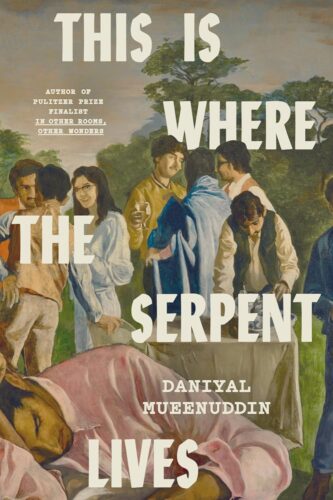 Daniyal Mueenuddin is a 63-year-old Pakistani-American writer, born in Los Angeles, who spent his first 13 years in Lahore, then returned to the United States for high school and college at Dartmouth. After graduation, he went back to Pakistan to help his aging father run a mango farm, then back to the United States for law school at Yale and an MFA at the University of Arizona. After working for several years in a law firm in New York, he returned to Pakistan, where he now runs the farm and writes fiction. I loved his first book, a very successful collection of short stories, In Other Rooms, Other Wonders, which I read in 2009, and have been eagerly awaiting his next book.
Billed as a novel, This Is Where the Serpent Lives is actually three stories and a novella about a large cast of interconnected characters who live mostly in the Punjab, although some have spent time in the States and Europe. Thus, there is a clash of cultures, which Mueenuddin explores in compelling ways. In vivid and often gorgeous prose, he creates a portrait of modern Pakistan, where the powerful aristocracy perpetuates the caste system that has existed for hundreds of years. Intermingled with the government officials (both petty and grand) are the farm workers, gardeners, and house servants. Add to those the truly privileged — the ones who lived in the West, trained in its manners — and the stunning picture that emerges is one of cruelty, corruption, power, frustration, and shame. And, although I find this book a wonderful read, ambitious and evocative (its descriptions of the physical landscape are beautiful), and at times very moving, I must confess that I wish Mueenuddin had sat with this material a little longer and shaped these stories into what could have been a great novel instead of a second very good collection of linked episodes.
It begins in the mid-1950s with the street boy, Bayazid, “who never knew how he came to be a little boy alone in the streets of Rawalpindi.” He is adopted by a kind man, Karim Khan, the owner of a tea and curry stall. Instead of living the life of an abandoned unwanted child, he is given a chance at a future. Known as Yazid, he finally ends up as the chauffeur for the great Atar family and becomes the mentor and guiding light for Saquib, the main character of the book’s last section. Mueenuddin is a master at describing the ragtag lives of the lower classes — how chance and personality and even physical appearance play their roles — and also the subtle differences that have evolved over the last 75 years in the power structure of Pakistan. He shows how the middle class plods along, keeping up the ancient rituals, while the upper classes have honed cruelty to a fare-thee-well in their striving for money, power, and all manner of sex.
After relating Yazid’s story in the first section, Mueenuddin shifts to the protagonists of the final novella — Hisham Atar and his wife Shahnaz. We learn how they met at Dartmouth when Shahnaz was the girlfriend of Hisham’s younger brother, Nessim. That story, told as a story within a story in “The Clean Release,” is a heartbreaking tale of almost biblical proportions and reminds me of Turgenev’s First Love in its structure and impact. In this case, it is not a story of father and son, but, as Hisham explains at the end, “Brothers and birthright, I guess. That’s what it’s all about.” Although Hisham gets the girl, Nessim seems to have won the luckier, fuller life; he lives back in the States with a wife and children and works as a successful lawyer. Here is Hisham, jet-setting around the world, drinking too much, experimenting with drugs, engaging in adulterous sex, and finally reflecting on how it has all turned out:
The party would carry on, Hisham slipping away to his meetings, welcomed back by a chattering crowd. He had his girl in Karachi, someone known to them all, and she too would be there later, everyone getting tight around sunset. That had come too soon after his marriage to Shahnaz, his little first forays into infidelity, and then her more suave love affairs, carried on with mannered discretion and no drama and thus even more painful to him, more final…. yes, he had it all, land, business, politics. It meant so much to have power…. And yet here he was on the dawn PIA flight, dropping into the smoking hill of Karachi, and Nessim flourished untouched in a faraway city that by contrast seemed to float clean above the clouds.
Yazid is an engaging character, and, ultimately, the linchpin of the plot, but the most appealing figure in these stories is Saquib, the only son of the head gardener at Ranmal Mohra, “the estate in central Punjab where Hisham Atar’s family had grounded their fortune several generations back.” Catching the eye of Shahnaz, who is always on the lookout for good household servants, Saquib is special. Here is how Mueenuddin tells it:
Saquib had charm, a quality not often found in boys of his class. Charm ripens in the sun of youth, lineaments and color — but for those millions of poor boys all over the country, brought up in the arms of no matter how loving a mother, in villages, in tenements, in slums, it is a quality that withers. It is taken as proof of loving things too much, of a corruptible mind; and so the quick ones, the ones who will get ahead, conceal themselves behind an air of servility or bumptiousness or at least a featureless impassivity.

Author Daniyal Mueenuddin. Photo: Chris Blonk
Saquib proves equal to the tasks Shahnaz gives him and becomes a favorite not only of the sahibs, but of everyone on the estate, especially Yazid. He also fulfills the role of a child to Hisham and Shahnaz who have, sadly, remained childless. Their deep affection for this boy, and his for them, seems a true gift. Highly intelligent, adaptable, lovable, and diligent, Saquib increasingly assumes more responsibility, finally becoming a farm manager on the estate. But that’s when the troubles start. Saquib’s surrender to envy, his betrayal of those who have nurtured him, and his subsequent rise and fall are Mueenuddin at his best. This novella is a heartbreaking story, filled with enlivening detail, at times excruciating to read. As the story builds, everyone’s expectations for Saquib grow. Yet, in the end, those hopes are dashed, bringing emotional devastation to them all.
We are brought into the lives of not only Yazid and the Atars, but the petty officials in government, the money managers, the gangs hired to do the dirty work of their betters, and even Saquib’s father and his wife, an educated young woman whose courage proves crucial to him at the end. This portrait of modern Pakistan is not only wrenching, but unflinching and true. Saquib’s tragic story will remain with you long after you have finished the last page.
Roberta Silman is the author of five novels, two short story collections, and two children’s books. Her second collection of stories, called Heart-work, was just published. Her most recent novels, Secrets and Shadows and Summer Lightning, are available on Amazon in paperback and ebook and as audio books from Alison Larkin Presents. Secrets and Shadows (Arts Fuse review) is in its second printing and was chosen as one of the best Indie Books of 2018 by Kirkus. A recipient of fellowships from the Guggenheim Foundation and the National Endowment for the Arts, she has reviewed for The New York Times and Boston Globe, and writes regularly for The Arts Fuse. More about her can be found at robertasilman.com, and she can also be reached at [email protected].