Dance Review: Gibney Company’s Chamber-Scale Brilliance Lights Up the ICA Stage
By Debra Cash
The Gibney Company has brought a three-work evening to town that any chamber-sized contemporary dance company in the world would admire.
Gibney Company, presented by Global Arts Live at ICA/Boston, March 14
Gina Gibney is one of the engines of dance in New York City, having assembled a small real estate empire that includes two “multidisciplinary arts centers” encompassing 23 rentable studio spaces and five performance spaces, and sponsoring a number of socially engaged programs designed to bridge artistic and social justice concerns, such as programs to support survivors of gender-based violence and work towards youth empowerment.
Valuable initiatives, of course, but what about her eponymous company?
The 9 dancers of the Gibney Company came to the ICA this past weekend with a world-class contemporary repertory. Gina Gibney, her signature red pixie haircut and matching glasses gleaming over a sparkly black jacket and patent leather loafers, was in the house to see a three-work evening that any chamber-sized contemporary dance company in the world would admire, with works by Roy Assaf, William Forsythe, and Lucinda Childs. (By coincidence, I happened to be seated next to her Friday night.)
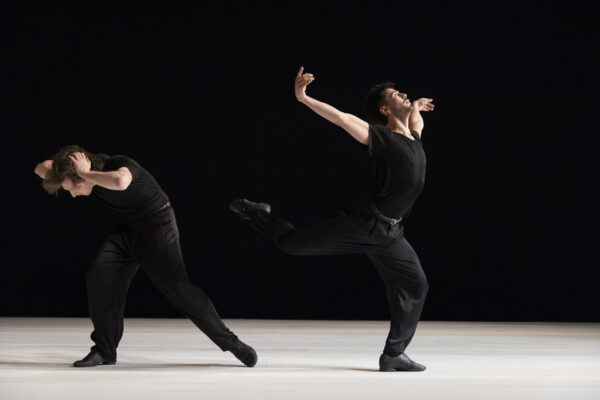
A scene from Gibney Company’s performance of Roy Assaf’s A Couple. Photo: Whitney Browne
A Couple by Roy Assaf, a self-taught Israeli choreographer who got his start with Emmanuel Gat and has spent most of his creative life as a freelancer in Europe and the US, is a 15-minute excerpt from a longer work, Figure No. 16. It made me want to experience the complete 60-minute source. This nourishing duet opens in a frantic mood, as the beautifully matched Madison Goodman and Lounes Landri gesture, smirk, and do handstands like a couple of discombobulated Keystone Cops. The dancers’ comfort with gaga technique is a real plus here, giving them a kind of interior clarity that conveys that these are two independent, complicated people whose lives are intersecting in ways they can’t control or even necessarily understand. Brahms piano music smooths out their edges, or shows the ways those edges can’t be smoothed; an argument breaks out in a gibberish sprinkled with words from various languages, including Hebrew. But this is a brief dance of many seasons, and romantic, low-altitude lifts eventually give way to what looks like exhaustion more than reconciliation.
Boston has become a kind of subsidiary home base for dancemaker William Fosythe; during the tenure of former Forsythe dancer and sometime stager Jill Johnson at the Harvard Dance Center, the American-German master’s work was part of its foundational identity. Later, Boston Ballet established a five-year partnership with regular settings of his repertory. I gotta tell you: I prefer the way the Gibney company dances Forsythe. Sure, his linear and spatial imagination can refresh any ballet company’s more hidebound habits, but the way Boston Ballet dances Forsythe, they lean into his glossy, extreme athleticism and turn his wit into leavening jokes instead of an integral aspect of his polyglot language.
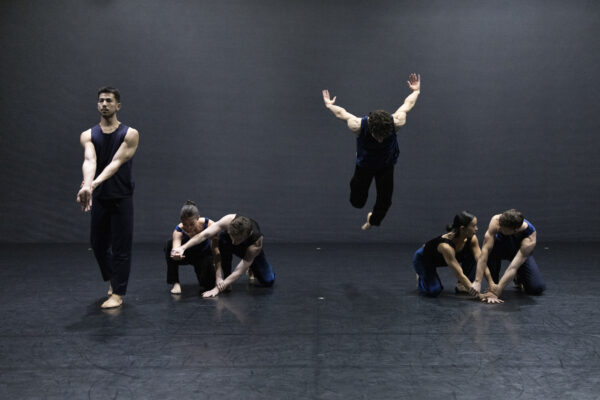
A scene from Gibney Company’s performance of William Fosythe’s Trio (of Six). Photo: Whitney Browne
Trio (of Six) is a doubling of a 1996 work that reportedly has been adapted over the years in a number of configurations. In silence, we meet four men and two women as they expose their wounds, or something like that — the inside of an elbow (place to insert an intravenous catheter?), cradle a kneecap (does it hurt?), a site below their ribs (is a tattoo in the offing?) The gestures are clinical, but the dancers’ faces are proud, even smug. Then, to gusts of a Beethoven string quartet that somehow can’t make up its mind whether to continue or not — and because of this has the feel of a truncated rehearsal — these odd gestures are linked up like tinker toys, two distinct trios in undancerly shapes.
And that’s the point. Movement that is done by dancers becomes dance whether or not it’s something usually identified that way (and in this, Forsythe is an interesting run-up to the Lucinda Childs piece on the Gibney program, which I’ll get to in a minute). The standouts in Trio (of Six) are the saucy Tiare Keeno, (who I think we’ve seen here with Bodytraffic) and the remarkable Graham Feeny who dances with profound amplitude and breath. (Note to casting directors: call Feeny in next time someone considers making a new biopic about Hans Christian Andersen. He looks just like him.)
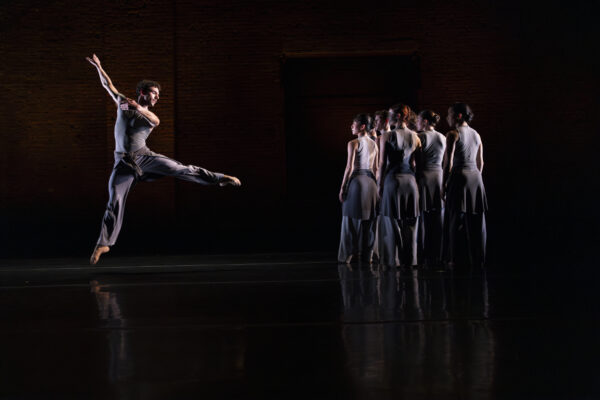
A scene from Gibney Company’s performance of Lucinda Childs’ Three Dances (For Prepared Piano) John Cage. Photo: Whitney Browne
During intermission, Gina Gibney told me that Lucinda Childs’ Three Dances (For Prepared Piano) John Cage is one of the few works she has created for an American company recently, as most of her work is presented in Europe where the luster of her early conceptual work with Judson Dance Theater and stage collaborations with Robert Wilson and Philip Glass have not been forgotten. Childs is 85, but has lost none of her clarity of purpose. With Cage’s prepared piano clanging like a cross between a gamelan and a steel drum band, we meet 8 dancers in gray with fabric tied around their waists like sweaters taken off during a studio rehearsal. Carefully spaced from one another, they lunge and wheel in strict diagonals, but the effect is balletic and courtly rather than Childs’ more typical austerity. Balletic épaulement — refined shifts of the shoulders — seem to propel the dancers in certain directions, and even when they pair up in spotlit circles, you see the clarity of the space between their crossed arms as much as you see their connection.
The repetitious nature of Childs’ work is her signature, and I know that some audiences find it tedious, but for me, Three Dances moved from a chant towards the ecstatic. If this dance were a quilt, it would be the classic pattern of constantly expanding triangles called Wild Goose Chase.
Debra Cash is a Founding Contributing Writer to the Arts Fuse and a member of its Board.
Tagged: Gibney Company, Gina Gibney, Graham Feeny, Lucinda Childs, Roy Assaf, Tiare Keeno