
Visual Arts Review: Flux and Form — Calder-Klee and Giacometti-Rothko Dialogues at MFA Boston
By Mary Sherman
Taking a Line for a Walk: Alexander Calder & Paul Klee and An Imagined Dialogue: Alberto Giacometti & Mark Rothko are touching reminders of of the remarkable kindness inherent in making art — the desire to reach across time and space to offer something to another.
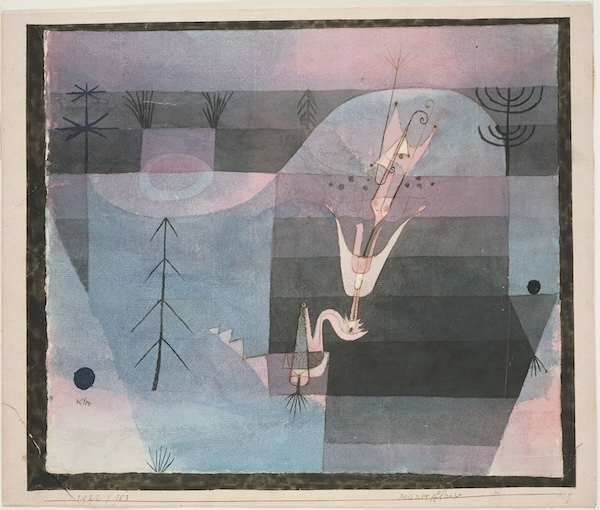
Paul Klee, Mauerpflanze (Wallflower), 1922. Photo: Seth K. Sweetser Residuary Fund
Photo © Museum of Fine Arts, Boston
In these times of constant uncertainty and chaos, moments of peace and glimpses of human greatness are needed more than ever, if only to keep us from succumbing to hopelessness or distracting ourselves with mind-numbing reels. Two exhibitions — Taking a Line for a Walk: Alexander Calder & Paul Klee and An Imagined Dialogue: Alberto Giacometti & Mark Rothko — currently on view at the Museum of Fine Arts, Boston, offer an antidote. Both are part of a larger rehanging of the museum’s modern collection in the Rosamund Zander and Hansjörg Wyss Gallery for Modern Sculpture. I can’t say the shows’ works are necessarily soothing, but they are inspiring in a way that watching a kitten pal around with a puppy is not. They are touching reminders of the heights that humans are capable of and of the remarkable kindness inherent in making art — the desire to reach across time and space to offer something to another.
Both shows are thoughtfully presented and, thankfully, understated. Explanatory texts are satisfyingly minimal. The hanging is judicious; the installations are well composed, and the juxtapositions sublime. The art is left unencumbered for us to enjoy without being told how or why we should.
The works span the period surrounding World War II, and it is interesting to note that none of the artists in either show fought in the war, although in different ways they were affected by it. But unlike artists such as Käthe Kollwitz, Georg Grosz, and Max Beckmann, they didn’t overtly represent or choose to directly comment on the horrors of their times. Instead, they masterfully captured and expressed the relentless, ever-shifting nature of modern life — a disorienting world that is never static. Even the exhibitions’ nonkinetic sculptures and two-dimensional works convey a constant state of flux, of which war is one of the most extreme examples.
In Taking a Line for a Walk, the Swiss artist Paul Klee’s two-dimensional works face off against the gregarious American Alexander Calder’s mobiles and stabiles — the artist’s name for his sculptures that don’t move. Essentially, two perpendicular walls showcase Calder’s sculptures; the other two, Klee’s. The more obvious overlaps between the artists’ works — for example, Calder’s ingenious twisting of a single wire to portray a face in the same way the jaunty line forms the dancing figure in Klee’s Danse Macabre — are abandoned here for something more subtle and indelible. Both artists’ works are playful, but distinctly so. As distinct as the artists themselves.
White and black shapes with accents of red and touches of yellow dominate Calder’s charming mobiles. A more varied, yet similar, palette likewise appears in the pieces chosen to represent Klee. In no way does this curatorial choice misrepresent either artist’s output, but it does help unify the show. Bigger chromatic leaps would only have been jarring.
Calder’s idea for making playful mobiles in which biomorphic shapes dangle from wires that freely bend and sway in the air came from his visit to the Dutch artist Piet Mondrian’s studio. Mondrian was so obsessed with finding the perfect balance in his abstract paintings that when given a tea set, he was unable to leave his house for days: like with his paintings, it was impossible for him to do anything until he found exactly the right spot to place his present in relation to everything else. It’s hard to imagine Calder doing the same. He took one look at the dynamic rhythms of Mondrian’s paintings and thought: how marvelous it would be to see them move in space. And, thus, the idea for mobiles was born.
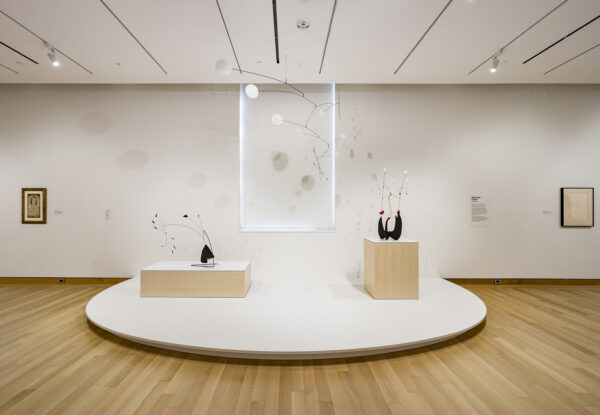
Newly opened galleries for modern art at the Museum of Fine Arts, Boston. (L to R) Alexander Calder’s Wheat, Snow Flurry, and The Cherry Tree Photo: © Museum of Fine Arts, Boston
Calder’s interest in movement is obvious. The suspended biomorphic shapes of Wheat, Snow Flurry, and The Cherry Tree accomplish what Calder hoped after visiting Mondrian’s studio: they literally move. Dangling from their armatures, they twist and turn, endlessly defining themselves and our relationship to them. The same happens in Calder’s delightful stabile The Palette, but in a different way. Like the mobiles, The Palette projects shadows outward onto another plane — in this case, mainly onto its pedestal. The result is something that unites the four artists that make up the two shows — not the use of shadows as a visual element, but that the works are designed to be experienced across time and space.
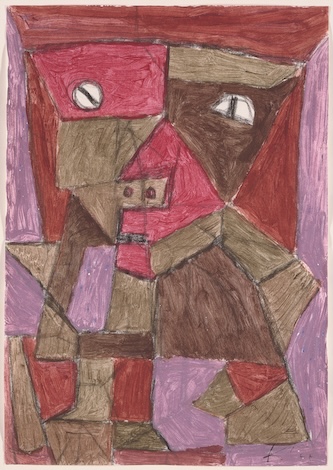
Paul Klee, Nomad Mother (Nomaden Mutter), 1940. Photo: © Museum of Fine Arts, Boston
Look closely at Klee’s Nomad Mother. Roughly brushed, geometric tiles of opaque watercolor, bounded by black crayon, make up a prismatic figure — the titular woman, a cubist concoction whose head is as large as her body. She appears to be holding a child, depending on how you interpret the red shape around her nose, which flickers back and forth between another head and the lower part of her face like those images that at one moment look like a rabbit, the next, a duck. And then there are the eyes of the Nomad Mother: One is represented by a circle with a slash, suggesting a no-go zone; the other, a half circle dome pierced by a black vertical line, like a stick, keeping her lid propped open.
“Even a stable state,” according to Klee, “is always subject to those elements which are in movement.” Take, for instance, Parable of Blossoming and Landscape UOL. Outwardly, these works are stylistically dissimilar. Parable of Blossoming consists of a few highly stylized forms that seem to represent stamens, seeds, stems, flowers, raindrops, the sun, and a patch of dirt. These objects occupy a flat, light pink field, in which an ocher ground peeks through, mostly along the edges. The elements function like a visual poem with a handful of carefully placed symbols, left for us to interpret. Conversely, Landscape UOL is filled from end to end with small colored dots that coalesce into fewer, more ambiguous shapes. One seems to be an abstract building; some of the others, I wouldn’t even venture a guess. A similar pointillist-like treatment is used in Landscape with Donkeys, but here a silver border contains the stick-like creatures, and the tonal range of the dotted shapes is narrower.
One of the things that unites these three works of Klee’s — if not all his works — is his remarkable understanding of materials. By alternating matte and glossy surface effects, Klee creates rhythms and timbres that waver and quiver. In another work, Wallflower, he builds up fine gradations of tones that ebb and flow like a sonic wave. Perhaps it is not surprising. Up until the age of 18, Klee pursued two career paths — that of a painter and that of a violinist. Although he was a gifted musician, in the end, he chose to be an artist, but never abandoned his love of music.
The beauty of a show like Taking a Line for a Walk is the chance to see such pieces in person, where their subtleties can be understood. The shifting encounters with Calder’s sculptures and the orchestration of surface effects in Klee’s are impossible to grasp in reproduction. Although primarily visual, our senses always operate in tandem, and the experience of looking at both artists’ works involves so many intricate movements that our aural sense is heightened, since it is the ear that is better suited than the eye for processing information over time. This would be lost in print.
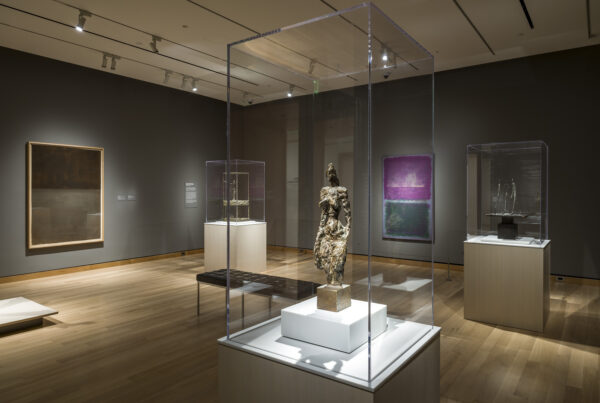
Newly opened galleries for modern art at the Museum of Fine Arts, Boston. The sculpted figures, being so much smaller than life-size, thus appear further away from us, quietly underscoring one of the many perceptual qualities Alberto Giacometti was deeply interested in. Photo: © Museum of Fine Arts, Boston
The same is true of An Imagined Dialogue. Here, Rothko’s paintings create a stunning pairing alongside the work of the Swiss artist Alberto Giacometti. Like in Taking a Line for a Walk, Rothko and Giacometti’s works extol multisensory qualities, but the mood has precipitously dropped. The most obvious clue is the choice of hue for the show’s walls — a somber greenish umber versus the white behind the Klee and Calder works. The viewing arrangement has also changed. The two Rothkos and one Giacometti painting are hung against the walls, while the Giacometti sculptures are smartly placed within the room for viewers to walk around and among, not unlike the figures in Three Men Walking (Grand Plateau). The sculpted figures, being so much smaller than life-size, thus, appear further away from us, quietly underscoring one of the many perceptual qualities Giacometti was deeply interested in, in this case, the mental construction of depth.
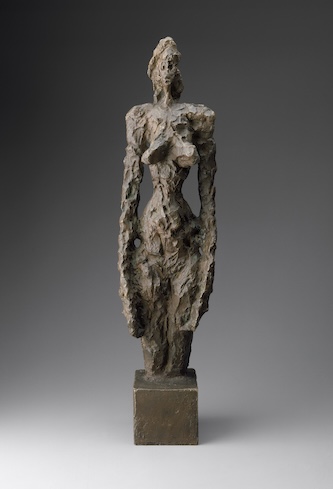
Alberto Giacometti, Annette, 1953. Photo: © Museum of Fine Arts, Boston
Rothko also plays with depth in his paintings. Although much larger and more abstract than Klee’s works, Rothko’s paintings of fields of color also shimmy and shimmer. Like Klee, Rothko accomplishes this through experiments with various media. Typically, in his late canvases, he started with a base of tinted rabbit-skin glue. Afterward, he applied thin layers of oil paint, alternately with pigments suspended in damar resin or egg white as a binder to create variations in opacity. The result allowed him to blur his tones and create gauze-like frissons to mark transitions. In Untitled (Lavender and Green), for instance, a fuzzy magenta rectangle hovers above a smaller, raw-edged green patch below. Within the lower verdant mass, a magenta outline pulsates almost like an afterimage while the two complementary colors compete for our attention through the use of simultaneous contrast — the optical phenomenon that causes us to see a color and its complement at the same time.
Neither this work nor Untitled (Brown and Gray) is as funereal as Rothko’s more famous compositions at the Rothko Chapel in Houston, but a meditative quality still exists, although less effectively so in Untitled (Brown and Gray). Painted a year before his death, Untitled (Brown and Gray) harkens back to another artist interested in visual and aural equivalents: James McNeill Whistler, and, in particular, to Whistler’s Nocturnes. Untitled (Brown and Gray)’s vertical orientation and execution on a larger scale, however, discourage a more natural tendency to scan a surface horizontally rather than from top to bottom, robbing Rothko’s work of Whistler’s haunting musicality. Additionally, Rothko’s use of acrylic creates a uniform stratum that blunts the vibrating tensions so instrumental to the transcendental states his paintings more typically evoke. These effects are not totally submerged here, but they are, definitely, muted.
The Giacometti works are anything but. Giacometti’s craggy, elongated figures are an accumulation of decisions and indecisions in search of form. Like an Impressionist painting, Giacometti’s sculpted figures are quickly grasped at a distance but, up close, the subject recedes from view, and we are faced with a dense network of hard-won marks.
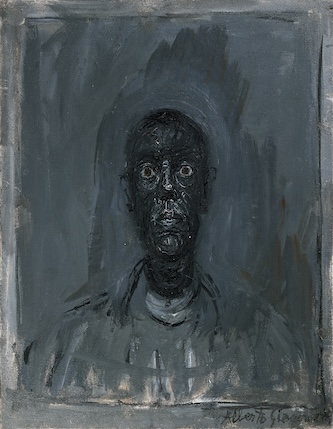
Alberto Giacometti, Head of Diego, 1961. Tompkins Collection—Arthur Gordon Tompkins Fund. Photo: © Museum of Fine Arts, Boston
This is also true of Giacometti’s paintings. He is not so much trying to use color or chiaroscuro to create the illusion of a face, such as his brother Diego’s in Head of Diego, as he is building up his black, gray, and white hues in a kind of low relief, allowing Diego’s head to emerge from the thinly painted background. Similarly, the way Diego’s face is attached to his body, like the face of anyone in a close conversation, recedes from our attention. We know it is there, but as Giacometti expresses it with a few loose strokes, our attention remains focused on his brother’s features.
The tactile quality of Giacometti’s works is inescapable. Visually scanning his sculptural figures, like Annette or Diego on a Stele II, is akin to a blind person reading braille. Three Men Walking (Grand Plateau) nearly begs us to mentally tap out our paces between the figures. This preoccupation with the relationship of forms in space ties Giacometti’s work to Calder’s, but Giacometti’s insistence on touch — an almost brutal insistence for those who are sighted — conveys a feverish search for something — something that seems never quite grasped, a perfect metaphor for the anxieties of our age, a time in which we struggle for meaning amidst an ever-shifting world order, increasingly indifferent to us.
For two decades Mary Sherman wrote about the arts, beginning as a freelancer for the Chicago Reader, followed by being the art critic for the Chicago Sun-Times and, later, as a regular contributor to The Boston Globe, Boston Herald, and ARTnews, among many other national andinternational publications. In addition to writing, she is a widely exhibited artist and founding director of TransCultural Exchange. Currently, Mary is at work on her first book, A Legacy of Deceit. It is part memoir, part Cold War investigative journalism, prompted by the many unexplained encounters she had with her late father, not the least of which was his once showing up at an airport, a briefcase handcuffed to his wrist.
Tagged: "An Imagined Dialogue: Alberto Giacometti & Mark Rothko", "Taking a Line for a Walk: Alexander Calder & Paul Klee"
5 Comments
Leave a Comment

Wonderful review, Mary. There is an inner joy in each of the pieces of Klee and Calder, while there is a muted meditative aura to both Rothko’s and Giacometti’s expressive pieces.
Thank you, Mark. I hope the review will encourage more people to see the shows.
Excellent review! I am looking forward to seeing the exhibit at the MFA and witnessing the work in person.
Klee and Calder, Rothko and Giacometti are exceptional modern artists , a great addition to the museum experience.
I agree: thank goodness that Klee, Calder, Rothko and Giacometti are up in these galleries now. Your review is terrific, and now I’m intrigued to get over there.
Thank you and Sunne for your kind words. I’m glad the article did the trick: to get you to see the shows.