Book Review: Wishing Well — Gary Lippman’s Wild, Wise, and Wistful Exploration of Desire
By Vincent Czyz
Gary Lippman’s latest offering is the least classifiable of his books so far. It’s an inventive assemblage of fiction, historical anecdotes, autobiography, authorial meditations (and advice), quotes, song lyrics, and literary allusions.
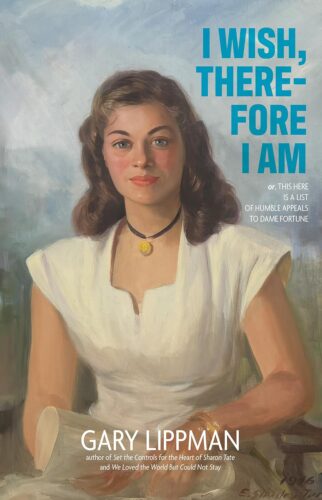
I Wish, Therefore I Am by Gary Lippman. Rare Bird Books, 378 pages, $20
“If you think you’re having a bad day, the graveyard is full of people who would love to be doing what you’re doing.”
—Billy Connolly as quoted in I Wish, Therefore I Am
 Gary Lippman made his literary debut in 2019 with Set the Controls for the Heart of Sharon Tate, a title that more than hints at the kind of writer he is. The novel, with its “Sharonophiles” (fans obsessed with the slain starlet) and “Sharonfest” (self-explanatory), is a dark satire of fame, Hollywood, and the cult of celebrity. Lippman followed this up with We Loved the World But Could Not Stay, a compilation of stories that last for precisely one sentence. (Admittedly, some of those sentences run to a page and a half.) While certain tales have the compactness and subtlety of a haiku, others come across as lively flash fictions. Still others are creative nonfiction (I recognized one as a distillation of Lippman’s moving essay Let’s Go Thundering. What both books have in common is that they’re hard to categorize. We can call Set the Controls satire, but it also includes elements of horror and the surreal. And who knows how to classify We Loved the World?
Lippman’s latest offering, I Wish, Therefore I Am, is the least classifiable of all. It’s an inventive assemblage of fiction, historical anecdotes, autobiography, authorial meditations (and advice), quotes, song lyrics, and literary allusions. The premise of the book is unpromising: Lippman is going to enumerate and elaborate upon wish after wish after wish. I was reminded of Mozart as portrayed in Milos Forman’s Amadeus: When describing to the king how a trio of singers in his new opera turns into quartet and quartet into quintet, and so on, he asked, “How long do you think I can sustain that, Majesty?” The king isn’t sure but he’s dubious.
Surprisingly, Lippman keeps this up for 276 pages with few narrative lags. One of the ways he does it is by roping in scores of artists, writers, philosophers, poets, novelists, historical personages, and the like via the aforementioned anecdotes and quotes. A very, very short list includes Herman Hesse, Ezra Pound, comic Steven Wright, Irving Berlin, Rainer Maria Rilke, Warren Zevon, Charles Baudelaire (who maintained, according to Lippman, that “to be human is to be wistful”), Carl Jung, Bob Dylan, Salvador Dali, jazz great John Coltrane, social theorist Theodor Adorno, Nick Cave, humanist psychologist DW Winnicott, blues singer Blind Willie McTell, Situationist International (the avant-garde artist group), country singer Waylon Jennings, and renowned physicist Richard Feynman.
Lippman does it also with an engagingly chatty style, pithy observations, fanciful imaginings, and humor. Humor, in fact, is Lippman’s guiding light, and he cites novelist Tom Robbins, who, by his own admission, “insists on joy in spite of everything …. All depression has its roots in self-pity, and all self-pity is rooted in people taking themselves too seriously.” Robbins’s psychoanalytics aside, it’s that last bit that Lippman refuses to do. He wishes, for example, that his toilet had “an alternate flush function, which could turn the thing into a time machine.” “Given a time-travel choice,” he writes, “I’d rather get whooshed into the past. So instead of sitting around on my toilet while reading British music magazines and ‘doing what no one else can do for me’ … I could behold the moment when the world’s first named author, a high priestess called Enheduanna, who lived two thousand years before Greece’s golden age, decided to press her reed stylus into a tablet of clay …. Who wouldn’t flush to witness that?”
Lippman classifies each wish as one of five “imps,” that is, as impertinent, implacable, implausible, impractical, or imprudent. The toilet time machine is neither implausible nor impertinent, but for some reason implacable. An impertinent one: Opining that the heart of “the city” is Times Square, Lippman wishes he’d been born “not in a New Jersey hospital but, like singer Tom Waits, on the backseat of a New York taxicab.” He wishes he “could have consulted the Oracle at Delphi in ancient Greece, if only so I could observe exactly what was going on there.” He wishes “we could know who Jesus’ father was. His genetic father, I mean.” Then he recounts a legend that maintains Jesus was sired by a Roman soldier whose nickname was Pantera, which, translated from the Latin, means panther—obviously, impertinent. He also wishes he knew for sure what Jesus looked like (this one’s merely imprudent). He uses his wishes and life experiences to explore coincidence, premonition, destiny, human nature, and, among other topics, philosophy.
Whatever this book is, it’s also an oblique autobiography, ghosting an outline of Lippman, who’s traveled extensively and lived in some lively locales, including London, Key West, Paris, South Beach in Miami, and the infamous Chelsea Hotel in New York City. He was in East Berlin three years after the wall fell, visited Greenland, spent a lot of time in the unreformed Times Square of the’80s and did volunteer work at an orphanage in Tanzania. One of his many misadventures takes place in Costa Rica. From Frances come a tidbit of timeless wisdom: “When a Frenchman in a Paris bistro overheard my friend David Amram complaining about the state of the American government, the Frenchman sidled over to David and said, ‘You’re right to worry and feel angry, monsieur, but politics all over the world have been a dreadful mess for the past three thousand years—so don’t forget, in the midst of your worry and anger, enjoy your food.’” Lippman hung out with Ken Kesey (color me green). He also sat down to dinner with Raquel Welch, to whom he puts a truly impertinent question. While reading I Wish, we learn about the books Lippman has read, the films he’s watched, the music he’s listened to and their effects on him. His favorite charity is, of course, the Make a Wish Foundation.
The wish that perhaps runs deepest in Lippman is covered by “‘amor fati,’ or ‘loving your fate,’” a concept he attributes to Nietzsche—certainly he popularized the phrase—although it was also staple of the Stoics, who do not escape Lippman’s notice. Amor fati shows up in various permutations in I Wish, most notably in a Leonard Cohen quote: “There is only one achievement, and that’s the acceptance of your lot.” But also, a bit more obliquely, when Lippman wishes he could “better follow the Stoic recipe for happiness, as stated by the philosopher Epictetus: ‘Do not seek to have everything happen as you wish, but wish for everything to happen as it actually does happen.’”
Lippman’s last official wish—“I wish that Esther Lippman had told me she was dying of cancer when she was in her forties and I was a teenager”—leads to the book’s most poignant and emotionally charged episode. It’s an account of how for years Lippman’s mother misled him, of how he wrestled with his fears, suspicions, and eventual rage as the deception crumbled, and of the envelope she left to him that went unopened for thirty years. Genuinely heartrending.
I Wish is by turns whimsical, funny, thought-provoking, nostalgic, wise, painful. Do I, as a reader, have any wishes of my own? Just one, really. I wish Lippman had included a little more detail, physical and metaphysical. I would’ve liked to have seen more clearly some of the places he’s been as well as some of the people he’s met. And I wouldn’t have minded spending a little more time on some of the esoterica he brings to the reader’s attention. Quibbles aside, it’s been quite a ride for Lippman, and I’m glad he’s handed us a ticket to ride along with him.
The author of two short story collections, one of which won the Eric Hoffer Award for Best in Small Press, two novels, a novella, and an essay collection, Vincent Czyz is the recipient of two fiction fellowships and a prose finalist award from the NJ Council on the Arts, the William Faulkner-William Wisdom Prize for Short Fiction, and the Capote Fellowship at Rutgers University. He has placed stories and essays in New England Review, Shenandoah, AGNI, Boston Review, The Massachusetts Review, Southern Indiana Review, Tin House, and Copper Nickel, among other publications.