
Music Feature: A Folk Music Business Convention — “An Antidote To America”
By Daniel Gewertz
Folk Alliance International Conference is a business conference. But because the business is folk music, the event has become nothing less than a cultural celebration.
It is fair to say that the ambiguously defined genre known as folk music has lost a share of mainstream acceptance in recent years. On the whole, the scene’s become a cozier, homespun affair. Yet there are exceptions to this trend toward the small, one of them being the Folk Alliance International Conference. This peripatetic gathering of performers and music industry types recently completed its 38th annual event, this time in New Orleans, at the Sheraton Hotel. What was born as a gathering of a couple dozen friends in Malibu, California in 1989 has grown into a five-day international extravaganza with a record attendance this year of 2,800.
In essence, it is a business conference. But because the business is folk music, the event has become nothing less than a cultural celebration. Is it the nature of the people it collects that makes it unusual? Here are some descriptive adulations I gathered in the Sheraton Hotel lobby.
“The conference is a way-station, a gathering of the tribes. Do you want a philosophic answer? It is a phenomenon, a non-religious spiritual event.”
“I sometimes think to myself: how could this amazing anomaly exist?”
“The people here are an antidote to America.”
Folk music being a genre attuned to history, a celebration of the music’s elder stars is natural to FAIC. Tom Paxton, 88, and Taj Mahal, 83, were presented with highly deserved Lifetime Achievement Awards at the Conference’s opening ceremony. Both Paxton and Mahal are smack dab in the middle of what is normally thought of as folk. The rest of the Conference is almost boundless in its definition. Any music stemming from a tradition might count as folk music.
My attendance this year was different from my visit in 1998 in Memphis in at least one regard. The press badge I wore on that long-ago visit motivated many musicians to push their albums my way. This year saw less salesmanship, more communal camaraderie.
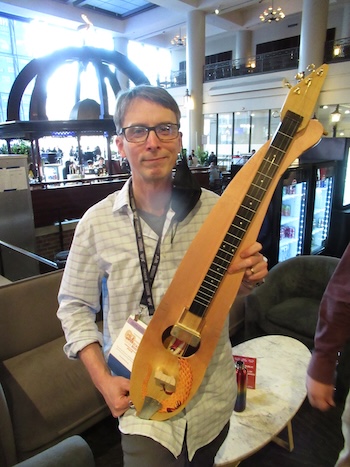
Michael Futreal of Rural Space Music, and his self-made gourd dulcimer. Photo: Daniel Gewertz
The first conference I reported on was in my hometown of Boston in 1994. With 500 attending, it was considered Folk Alliance’s first big success. The dramatic increases in attendance, the conferences in Canada, and, ultimately, the addition of “International” to their name came later.
But even by ’94, the phenomenon of unofficial or “private” hotel-room music-making until the wee hours of the a.m. had been born. (I fondly recall the song-swaps until past 3 a.m. with New York talents such as Rod MacDonald, David Massengill, and Christine Lavin.) For a number of years these late-night sessions were not mentioned in the program books. Though not quite of outlaw status, you could only find them through word of mouth. But it grew obvious to the organization that a majority of their attendees came mainly to play the makeshift spaces. And so, a complex listing of artists and hotel room times was instituted. The Conference couldn’t have grown without these semi-renegades. By 2026, even a country mainstay such as Beth Nielsen Chapman could be heard in a hotel room at 2:30 a.m. (in addition to a large space “official showcase” in the early evening).
Whatever time of night or morning, Chapman’s appearance at FAIC raises the question: why should a country music mainstay pay to play a set at FAIC? In Chapman’s case, at age 67, it is a matter of a second act in her long career. She may have written seven #1 country hits for other stars, but on her own she’s never climbed as high as the Country Top 100. (Chapman’s made the ‘Adult Contemporary’ chart several times.) So, time on stage, in front of a musically savvy, admiring crowd, is valuable. She proved to be as personable, low-key, and natural a country performer as I’ve seen. Chapman is so at ease on stage that she is able to talk about her own tragic life — two deceased husbands, both cancer victims, her own successful battles with cancer and a brain tumor — and somehow make us aware of life’s darkness without bringing us down at all.
In the case of another famous singer-songwriter, Ani DiFranco, the reason for attending the conference, and participating in a trio of panel discussions, is more obvious: she now lives in New Orleans. Her own label — Righteous Babe — presented several artists at the conference’s Official Showcases.
DiFranco and her business partner, Peter Casperson, stressed that after 27 years of recording other artists, Righteous Babe is less interested in pushing talent for purely musical reasons. “Mission driven artists are all we’re interested in, not artists who just want to be famous,” said Casperson.
DiFranco was at her most disarming when discussing her nearly five-month stint on Broadway, playing a lead part in Anais Mitchell’s hit musical Hadestown, in 2024. “Acting on Broadway made touring music seem simple by comparison,” DiFranco said with a laugh.
When the panel’s host, lawyer Judy Tint, asked DiFranco about the long, arduous paths that the little-known artists at the conference face in the 2020s, the singer quoted the late U. Utah Phillips’ quip: “The way to make a million in folk music is to start out with two million.”
Tint commented on the illusion of the so-called “openness” of today’s modern music scene “Today, anyone can put a record out. That’s the good part. The bad part is that anyone can put a record out.”
(l to r): Judy Tint, Ani DiFranco, and Jenny Reynolds. Photo: Daniel Gewertz
Casperson dug deeper into the indifference to aesthetics in the music industry. “Musicians have such long roads ahead of them. You truly need good people behind you. Big labels today are all about metrics. Taste and intuition are things of the past. It’s all about how many thousands of followers you have.”
Only a small share of the songs at FAIC seemed to be touched by politics, but peace, civility, and warmth were the event’s unstated code words. If you are bounding from hotel room to hotel room at two in the morning, discovering a multitude of musical pleasures, you might think the joint was jumping with a (non-druggy) touch of old hippie magic. As one older fellow opined, “It’s like heaven, but a heaven with worldly gravity.”
Some of the most gorgeous music — and certainly the most heaven-sent vocals — were sung by L.A.’s Milk Carton Kids, a popular act for the past 15 years. Kenneth Pattengale and Joey Ryan possess close, angelic harmonies that are often compared to Simon & Garfunkel, but are in fact even prettier. They also have a well-known, bitingly witty rapport reminiscent of the Smothers Brothers. But neither man plays ‘the dumb guy’. In a sense, their approach is pure pop, but since they are an acoustic guitar duo, they easily fall into the broad category of folk.
Is “acoustic” an essential element in the definition of folk? In a word, no. Neither is |”old fashioned.” The conference embraces an expansive use of the word folk. Wide-ranging might well be FAIC’s raison d’etre. One panel — cutely titled “What The Folk Is Up With Folk?”– discussed the challenging issue of nomenclature and identity. One folkie on the panel sounded positively jealous of the fact that the term “blues” carried no negative or confusing connotations. But “folk” is what we’re stuck with, so… we might as well use it with pride!
With late night/early morning hotel room presentations going full blast until 3 a.m., the duration of each day’s activities caps off at a whopping 17 hours. Musicians would be wise to catch a share of the daytime seminars: one’s chances of gaining valuable business information at 11 a.m. is greater than the stray possibility of impressing a passing booking agent at 3 a.m. True, the post-midnight party atmosphere is infectious, but considering the high cost of the event — the travel, hotel and restaurants, plus the conference fees ranging from $289 to $770 — business savvy cannot be ignored.
So. Considering the dwindling money and fame available in folk music, what is the FAIC’s continued appeal? With ages ranging from the 20s all the way to the 80s, what makes this crazy mélange of folks such devotees of the conference? It turns out that the word devotee is surprisingly accurate. This is a business gathering that is more about love than the bottom line: not just love of music, but also a low-keyed, utterly unpretentious desire to create a nicer, better society. No slogans or directives. No chanting or praying or bibles. Regardless, one subtly becomes aware of an underlying group desire to live, for five days, in a happier, more benign society. Every elevator ride is a social occasion.

Three National Guardsmen patrolling in New Orleans. Photo: Daniel Gewertz
And what about the scene right outside the 49-story Sheraton on Canal Street? There are a fair share of beggars, awake and asleep. If you try to buy a slice of pizza for one of them you may be dissuaded – the price tag is $10. Before my trip to New Orleans, I read about ICE arresting 370 people over the last two months. But ICE is nowhere to be seen downtown. A musician at the conference filled me in on the details. Mark Rubin — who performs under the stage-name “The Jew From Oklahoma” — has been living in New Orleans for 14 years. “ICE is in Kenner,” he said. (Kenner, a city 13 miles away, is known for its immigrant population.) “ICE is scared to come downtown. We hate them. But we love the National Guard ‘cuz of (Hurricane) Katrina. And these Guard guys are from Louisiana.”
It was impossible not to notice the National Guard. In drug stores, restaurants, on sidewalks, they could be seen in groups from three to six, armed with guns or rifles. It was unsettling watching them adjust their rifle holsters while waiting in line next to me at Cafe Beignet.
One of the few overtly political symposiums in the conference was saddled with the rather naive title “Singing Truth To Power.” But ICE’s politics had a nasty way of intruding more directly. On January 24, in Minneapolis, Minn, Alex Pretti, an ICU nurse, was murdered by ICE agents. A memorial ceremony was quickly organized in the Sheraton hotel’s lobby. That afternoon, the conference lived up to its 2026 slogan: “Rise Up.” The Black national anthem, “Lift Every Voice and Sing,” was given a hearty rendition. A speech reminded the attendees that anti-ICE, anti-Trump protests were only in their early stages. As one songwriter in the crowd told me: “This conference is like being nestled in a beautiful bubble of music, hope. It is the spirit of kindness, respect, a desire for the warmth of community. And it just happens to be surrounded right now by dangerous, violent national forces.”
The evening after the conference was over, on touristy Bourbon Street, my wife and I were drawn toward a small night-spot named The Famous Door. A searing sound drew us into the bar: an R & B sextet ripping it up with finesse, a female singer supplying a sultry opening to “Proud Mary.” By the point the “rollin’ on a river” chorus kicked in, we were completely knocked out — amazed at both the singer and the crackerjack band, a propulsive, Black sextet called Retro Punkz. The gymnastically fervent female singer reached the level of Tina Turner, circa 1985. The band’s molten energy was kinetic. The other singer, a slender male, then roamed the small barroom with a pail for tips. It suddenly occurred to me: this was as rich and real an American folk music as we possess in this cockamamie country.
A handful of highlights…
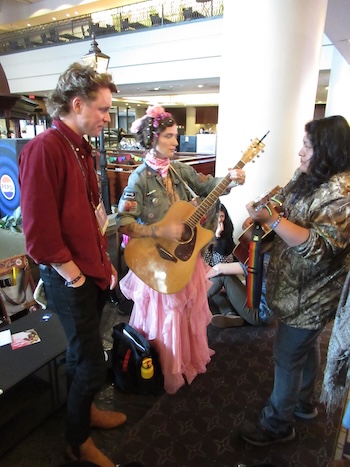
Musicians jamming in the Sheraton Hotel lobby. Photo: Daniel Gewertz
1) The astonishing Feng E is an 18 year-old ukulele player from Taiwan who can generate moments of intimate delicacy, and then rise up like thunder, his tiny instrument orchestral in its dexterous power. He’s already wizardly.
2) Violinist Darol Anger and Bruce Molsky (guitar, fiddle and vocals) were their usual masterly, wit-rich selves, most deliciously on Duke Ellington’s “East St. Louis Toodle-loo.”
3) Okan Musica was one of the event’s stars. Okan is a female couple, keyboards and percussion, and it is one of the prime examples how the boundaries of folk are being erased — right into modern jazz. The Canadian Afro-Cuban jazz duo (Elizabeth Rodriguez and Magdelys Savigne) performs with a propulsive joy that rockets upwards.
4) The witty Todd Adelman came up with the best song title: it is a tune about the irritants of aging called “Why Are Old Guitars So Proud of Their Age?”
5) Finally, there was the miracle act of the whole five-day event. Singer-guitarist Rafy Essam is an Egyptian banished from his native land for (fiercely and musically) protesting Egypt’s dictatorial regime. He is tall, bearded, and moves like a sizzle of electricity. Exactly two days before we saw his early morning hotel room show, he just happened to be introduced at the conference to trumpeter Josue Estrada. To say they hit it off is like saying fire and oxygen have a touch of chemistry. One would’ve assumed they played together for years. They had insane magic — like Miles Davis and John Coltrane at the end of their five years together. It was little short of a miracle. “Everything is so good with you,” Estrada said on stage, with a shy smile. And to top off this miraculous fusion, Essam’s songs, introduced in English but sung in Arabic, were like riptides of communicative passion.
Daniel Gewertz has been influenced by the people he has interviewed for newspapers and radio, including jazz artists Ray Charles, Sonny Rollins, Artie Shaw, Dizzy Gillespie, Jay McShann, Gil Evans, Dave Brubeck, Keith Jarrett, Steve Swallow, J.J. Johnson and Milt Jackson; roots musicians B.B. King, Bill Monroe, Brownie McGhee, Vassar Clements, Phil Everly, Roger Miller, Carl Perkins and Bo Diddley; folkies Libba Cotton, Joan Baez, Pete Seeger, Leonard Cohen, Rambling Jack Elliot, Judy Collins, Roger McGuinn, Steve Goodman and John Prine; classic popsters Tony Bennett, Mel Torme, Eartha Kitt and Pearl Bailey; and film/theater artists Louis Malle, Edward Albee, Jeremy Irons, Glenn Close, Susan Anspach, Yul Brynner, Michael Douglas, Diahann Carroll, Jewel, Jack Klugman, and John Sayles. Daniel’s first live interview, at age 16, was with Art Garfunkel in 1966.
Tagged: Ani DiFranco, Beth Nielsen Chapman, Folk Alliance International Conference, Jenny Reynolds, Jerod Rivers, Judy Tint, L.A.’s Milk Carton Kids, Rafy Essam