Popular Music Reviews: Ray Charles — The Quintessential Sound of American Popular Music
By Allen Michie
Add these four remastered Ray Charles albums to your collection and remind yourself what the real thing sounds like when it finally comes along.
No One Does It Better; Ingredients in a Recipe for Soul; Love Country Style; Come Live with Me – Ray Charles (Tangerine)
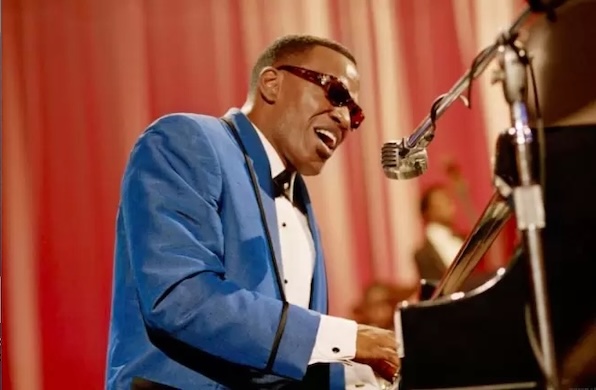
Ray Charles in performance. Photo: Tangerine Records
When Ray Charles died in 2004, someone commented that it was like losing the Statue of Liberty. His was the quintessential sound of American popular music, with equal parts from each of its main tributaries: soul, blues, jazz, rock, and country.
Charles was, thankfully, presciently prolific. His productivity would still be amazing for someone who wasn’t blind, Black throughout Jim Crow and the Civil Rights era, never had drug addictions, and happy to stay in his segregated lane for record sales and radio airplay. Despite a grueling tour schedule that lasted basically his entire adult life, he found time to record often and with consistent brilliance for 20 years (and intermittent brilliance for 20 years more).
In 1962, Charles was at a creative and popular peak. Modern Sounds in Country and Western Music and its sequel were released to critical acclaim and miraculous crossover success. The two albums not only seamlessly brought together the whitest and the Blackest musical genres of the day, country and soul, but they also helped bring country music into the popular mainstream. (No Ray Charles, no Taylor Swift.) He had huge momentum from the year before with three #1 hits, “One Mint Julep,” “Unchain My Heart,” and perhaps his biggest hit of all, “Hit the Road, Jack.”
He was on two major record labels, Atlantic and ABC-Paramount, but he was still restless to take control of his own business. He took a huge gamble with his success so far and started his own record label, Tangerine, in 1962. He cut a deal with ABC-Paramount for promotion and distribution. Several other artists besides Charles had releases on Tangerine, including Ike & Tina Turner, Jimmy Scott, Percy Mayfield, Louis Jordan, and the Ohio Players. Some of Charles’s own Tangerine records are among his classics: Crying Time, Ray’s Moods, and Volcanic Action.
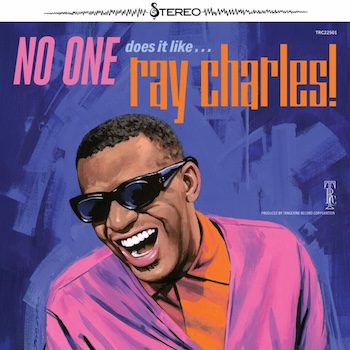 Charles didn’t start releasing his own work on Tangerine until 1966, and he left it in 1977 and started a new label called Crossover. The Tangerine catalog is now controlled by Ray Charles Enterprises, which has been gradually releasing remasters on CD and vinyl. The latest four are under review here.
The most interesting of the lot is No One Does It Like…Ray Charles!, which is a collection of assorted singles and bonus tracks from around 1965. The clever cover design makes the album look like a reissue of a Charles album you’ve somehow overlooked all these years. Of course the record is a killer — it would be impossible to put together a bad record of Ray Charles tracks from around 1965. Charles sounds young, energetic, ambitious, and at the top of his inimitable game.
One Charles innovation that doesn’t get enough attention is his advancement of the soul samba, his fusion of R&B with Latin rhythms and a jazz big band. “My Baby Don’t Dig Me,” “Hide Nor Hair,” and “Don’t Set Me Free” are all infectious delights. This version of “Don’t Set Me Free” is a companion song to the more famous “Unchain My Heart,” with the same chord changes and structure, only a bit faster and with comically opposite lyrics. It’s also a feature for one of the Raylettes, who sounds a lot like the future Randy Crawford.
The Raylettes also get chances to shine on “My Baby (I Love Her, Yes I Do),” where Charles sings with the fervor of an evangelical minister over their gospel harmonies. It’s a new classic you need to hear. It’s odd that Charles is associated with two styles of choir backgrounds that couldn’t be more different: there are his sassy and Motown girl-group-influenced Raylettes, and then there’s that lily white-sounding ooh-ah “choir of angels” that appeared on so many records (including Elvis Presley’s) in the mid-’60s. They glide into position on “My Heart Cries for You,” which sounds like it could/should have been on Modern Sounds in Country and Western Music. You’ll hear them repeatedly on the other three Tangerine releases. I’m not necessarily complaining about the background chorus and saccharine strings — from today’s vantage point, they add a certain period nostalgia and charm, the arrangements aren’t bad, and they offset Charles’s gritty and authentic soul voice in unexpected ways. For better or worse, it’s also the sound of effective racial integration in 1965.
The remastering is exquisite at times. On “No One,” just to pick one example, the horns in the big band have great separation, and you can hear the full power of the rumbling baritone sax, the percussive trumpets, and the silky sax section. I haven’t heard the vinyl, but background noise on the digital version is completely eliminated. Charles’s voice has never sounded more dimensional and full of conviction: he wails the blues on Big Maceo’s “Worried Life Blues,” he’s closely miked on “Something’s Wrong,” he wears his big heart on his sleeve on “My Heart Cries for You,” and he gets to roar at the end of “Who You Gonna Love.”
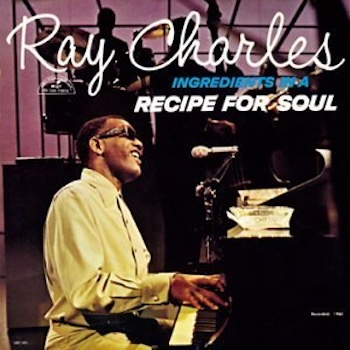
Ingredients in a Recipe for Soul has the same 10 songs as the 1963 original release, plus the four tracks that appeared on the 1990 CD version. It has the familiar hits “Busted” and “That Lucky Old Sun.” The latter has always been a masterpiece —Charles sings it like he means it, and he lifts both himself and his audience up at the end when he sings “Lift me up to paradise/Oh show me that river, take me across.” The contrast with the white chorus is stark, but not as stark as it is on “Old Man River,” which is just this side of Stephen Foster minstrelsy. It starts with the white choir singing, and they keep butting in with lines like “he don’t plant ‘taters, he don’t plant cotton,” but when Charles comes in, the contrast is powerful.
“In the Evening (When the Sun Goes Down)” feels like a stiff drink after all the choir-of-angels nonsense. (And enjoy it, because they’ll be back with a vengeance in “Over the Rainbow.”) It’s straight blues piano, and the vocals don’t come until halfway through. The remastering puts the out-of-tune piano right there in your room. Add a great trumpet solo, and this one is a standout track. The ballad “A Stranger in Town” has the misfortune to follow it, and it sounds a bit anemic.
There’s a diverse mix of styles on this record, which you may see as a welcome showcase of Charles’s range or a failed attempt at a cohesive album experience, depending on your taste. There’s “Ol’ Man Time,” a swinging Count Basie-style arrangement with the big band; the dark and moody “”Something’s Wrong,” the commercial “Brightest Smile,” and the overwrought “You’ll Never Walk Alone” (complete with oboe intro). It’s a portrait of the era, and it’s the sound of R&B growing up and out and sideways.
Love Country Style is from 1970, and it’s a late follow-up to the two Modern Sounds in Country and Western Music albums from 1962. It didn’t do as well, but it has the hit “Don’t Change on Me” (the background singers are pronouncing it “change awn me” because it’s a country record).
 It’s a hit and miss affair. When it hits, it hits hard, as on “Ring of Fire.” It’s better than the Johnny Cash original, and that’s saying something. Where Cash just recites “burns, burns, burns,” in his jaded baritone, Charles sings it like he’s feeling the flames and trying to hold in the pain with a mix of resignation and desperation. Add a driving bass line and a punchy horn section, plus an intimate whisper at the end (thanks again to the excellent remastering), and you have a song of torturous unrequited love that Cash only hinted at.
When it misses, it misses hard, too. “Till I Can’t Take It Anymore” will test your patience for sappy strings, and the chord changes sound like Bobby Goldsboro’s glutinous hit “Honey” from two years prior.
The tracks that fall between the extremes are often a delight, such as the twangy blues guitar of “You’ve Still Got a Place in My Heart,” or the shifts in tempo and meter in the catchy “I Keep It Hid” (which shows that Charles can play piano like Floyd Cramer when he wants to). Just listening for the remastering is fun, too — enjoy the unmuddied bass, bright bells, rich strings, and detailed vocals in “I Keep It Hid” or “Your Love Is So Doggone Good.”
“Show Me the Sunshine” wraps up the album appropriately, bringing the country-flavored music back to a firm R&B foundation and emphasizing their shared roots in the blues. Charles makes it all sound perfectly natural and effortless. The album is just a notch or two below the two Modern Sounds in Country Western Music albums, and that’s high praise indeed.
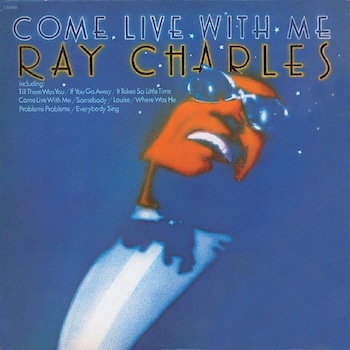 Finally, there’s 1974’s Come Live with Me. Charles is slipping from his place on top of the charts as the Motown, Stax, and Atlantic R&B sound gives way to singer-songwriter rock and pop at the top of the charts. Come Live with Me has earned a mixed reputation as Charles’s “heartbreak” album, and it didn’t chart well. But it’s all done with great feeling, despite the even heavier-than-usual dose of strings and feathery chorus of white angels.
The album drags at the start with “Till There Was You,” closer to the Music Man version than the Beatles cover, full of corn mush. “If You Go Away” (Jacques Brel’s “Ne me quitte pas”) isn’t a song suited to Charles’s strengths, and the soulful electric piano introduction doesn’t really fit the melody. “It Takes So Little Time” plods with a slow tempo and a meandering melody in a key too high for Charles’s best vocals.
The fourth track, “Come Live With Me,” is more like it, and the album gets rolling in earnest. Ray wails, there are some slick electric piano fills, the chorus isn’t in the way, and the strings stay in their lane. “Somebody” replaces the cheeseball chorus with a party crowd of sorely missed Black folks and the Raylettes. The remaining four tracks look forward to some upcoming albums from Charles after he returned to Atlantic in the late ’70s, such as Love and Peace and True to Life (never reissued, and if you see them in the wild, pick them up at any price). They’re looser, funkier, more fun, and they replace the chorus and strings with an amazing swinging/rocking/grooving big band. “Louise,” for example, has a thumping bass, tight and spare funk drums, and a disciplined and soulful horn arrangement (probably from Charles himself). It makes no sense at all to have it on the same album as “Till There Was You,” but it’s great to have it however it arrives.
There’s much more in the Tangerine vaults, and hopefully Ray Charles Enterprises has a long-range plan to keep these fine remasters coming. Hopefully they’ll inspire Atlantic to come up with a similar plan for their many Charles albums that have never been reissued. Until then, add these four Ray Charles albums to your collection and remind yourself what the real thing sounds like when it finally comes along.
Allen Michie has a PhD in English Literature, and he works in higher education administration in Austin, Texas.
Tagged: "Come Live with Me", "Ingredients in a Recipe for Soul", "Love Country Style", "No One Does It Better", Ray Charles, Tangerine