
Album Review: Peggy Lee’s “Mirrors” — Fifty Years of Cabaret Noir
By Steve Provizer
The musicians assembled here for the updated recordings of tunes from fifty years ago are first-rate, and Peggy Lee still convincingly inhabits a wide range of material.
Peggy Lee: Mirrors — Expanded Digital Edition. The collection Compiles Peggy Lee’s Complete A&M Sessions, Featuring Seven Bonus Tracks, Five Previously Unreleased
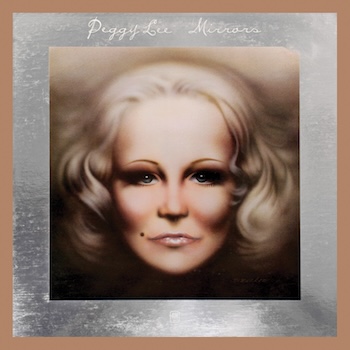 America imported European cabaret around 1900, but we never bought into the dark political satire, overt sexuality, or gallows humor that Europeans favored. We have the musical Cabaret, of course, and occasional performances of Belgian Jacques Brel. Some “saloon singers” have nibbled at the edges of the bitter — Mabel Mercer and Sylvia Syms, chiefly. Frank Sinatra calls himself a saloon singer, but even a tune like “One For My Baby” lacks the requisite combination of ennui, decadence, world-weariness and psychological density that defines the genre. One might argue that some of this ground was covered in the U.S. by the blues. A comparison would be complex but interesting.
The only real dose of dark cabaret that reached the masses here was the anomalous hit “Is That All There Is,” which reached number 11 on the pop charts in 1969. The song was written by R&B notables Jerry Leiber (lyrics) and Mike Stoller (music), arranged by Randy Newman and performed by Peggy Lee. Several of the songs on the 1975 album Mirrors explore the noir-esque territory that Lee and Leibert and Stoller covered in “Is that All There is.” It’s a unique album for that, or any other era.
Like many of the tunes here, “Ready to Begin Again” was written for theatrical use. The notes, by Peter Stoller, say: “It was composed as an audition for a musical version of Jean Giraudoux’s play The Madwoman of Chaillot.” It starts off squarely in the cabaret-noir style, echoing “Is That All There Is.” Lee picks up where she left off, her vocal a combination of halting confession and direct emotional expression. The tune becomes lighter, moving briefly to waltz time — more Broadway than cabaret — then back to cabaret style, ending with a slightly ambivalent sense of optimism.
“Some Cats Know” is an interesting take on a punchline in comedian Slappy White’s routine—“if a cat don’t know, a cat don’t know.” Leiber expands the lyrics into some creative spaces. George Young on flute and Ray Brown on bass give it a solid jazz-blues footing. Lee’s capacities as a storyteller meet the moment.
“I’ve Got Them Feeling Too Good Today Blues” is a straight-up ragtime tune that uses a large ensemble to evoke Scott Joplin’s “Red Back Book.” The lyrics cleverly play against the up-beatness of the tune. Sample: “Cause when I’m unhappy, I’m tippito tappin in my shoes.” Lee makes no attempt to play off the subtext, which is the right decision.
The backstory of “A Little White Ship” is interesting. In the early ’50s, Stoller composed “Suite Allegro” for violin, cello, clarinet, and bassoon and eventually he and Leiber adapted some of its themes into songs. Leiber had met with Tennessee Williams to discuss transforming his play Camino Real into a musical. “A Little White Ship” was conceived for the character of A. Ratt, the proprietor of the Ritz Men Only hotel. The haunting arrangement of the tune is pitched somewhere between Kurt Weill and a dreamscape: Lee’s wheelhouse.
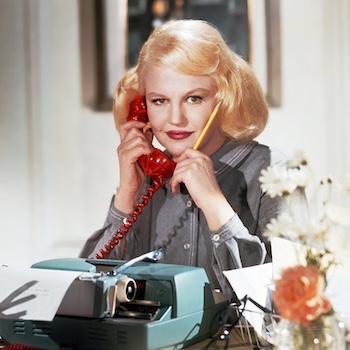
Peggy Lee in the ’70s. Photo: courtesy of the artist
Leiber wrote the lyric for “Tango” to honor the silent film star Ramón Navarro, who’d recently died. After the melody is stated, the music fades into the background and Lee recites a dark description of the dangers of the tango. She then sings what is essentially a vivid description of a silent film set. The music is not tango, per se, but owes something to Astor Piazzola and again, to Kurt Weill. “The phonograph is playing an old tango, over and over it plays, over it plays, over it plays…”
“Professor Hauptmann’s Performing Dogs” harkens to ragtime, circus, and vaudeville. Sgt. Pepper is in there, too. The lyrics are clever and the arrangement keeps things moving. The notes say it is: “A treatise on the dehumanizing mechanisms of fascism in contemporary America…” I did not get that message from the tune. But after I read the note about it, I listened again and found that the final stanza actually delivers the message. It will take me a while to decide whether or not Lee was born to be an ironical circus barker.
“The Case of MJ” alludes to Truman Capote’s short story, “Miriam.” It is based on another theme from Stoller’s “Suite Allegro” and evokes a similar cubist dreamscape. For a visual equivalent, think of montages in the best noir films. The lyrics are ambitious. They mean to carry a lot of psychological weight, and they are evocative when they stick to symbolism and imagery. But the sporadic inclusion of Lee saying: ”How old were you when your father went away?” grounds it in a too-specific event that edges the song toward pretension.
“I Remember,” explain the notes, was inspired by Haiku poetry. “I remember when you loved me” is the complete thought. Pining for a lost love is oft-covered territory for Lee. But, unlike tunes in standard song form, such as “I’m a Fool To Want You” or “Black Coffee,” this is an incantation. Stoller creates a faintly exotic, slightly chromatic sound, dreamily delineated by marimba and other light percussion instruments. This is another song that evoked a cinematic vision for me: Lee looking out a rain-spattered train window, passing slowly by.
“Say It,” like “Ready To Begin Again,” was written for The Madwoman of Chaillot to be Countess Aurelia’s plea to the young Pierre, with whom the songwriters imagined she would have an affair. Any psychotherapist would have a field day parsing the lyrics. The protagonist says right at the beginning that neither she nor he love each other, then spends the rest of the song telling him to say he loves her — “Say I love you, even though it isn’t true.” Each listener will have to grapple with that edge of perversity, because words and music are so deeply embedded. The song is beautiful, evocative, and pitched perfectly for Lee’s voice and style.
“Longings For A Simpler Time” was written for a musical version of Jeff Weiss’ play, The International Wrestling Match. Leiber’s clever lyrics cleverly delineate the pleasures of nostalgia. The melodic line also evokes nostalgia, but occasional odd twists undercut the reassuring premise of “the good old days,” an assumption that is upended by the final line: “We’re longing for a simpler time that never was.” Johnny Mandel provides a perfect arrangement here, as he does on the previous 7 songs on the album.
These last 7 tunes here are “demos” — they did not get the complete productions of the first 10 songs. As such, they’re more bare-boned, but certainly presentable.
“I Ain’t Here,” another piece from The International Wrestling Match, was conceived to be performed by a Black maid ironing clothes, “with a defiantly inverted take on her invisibility in the world of her white employer.” It’s a medium slow bluesy tune that doesn’t need a lot of frills and doesn’t have them. Leiber’s meat and potatoes is vernacular writing, so this tune paints a realistic picture. You wouldn’t necessarily think Lee’s voice would work here, but it does.
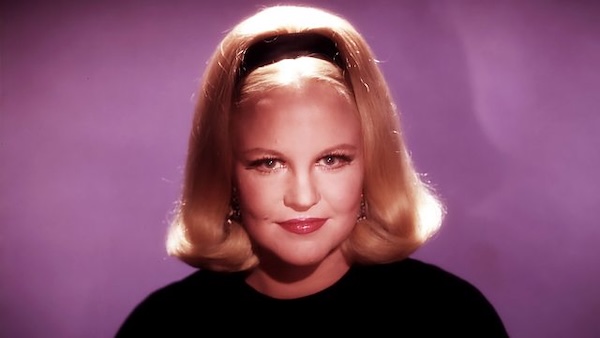
Singer Peggy Lee — her capacities as a storyteller meet the moment.
“The Best Thing,” credited to Dino, Sembello, Leiber, Stoller, is a disco-R&B hybrid. Apparently, it landed Billy Eckstine on the U.S. R&B charts for the last time.
“Love Me or Leave Me,” the old Donaldson-Kahn standard is “updated” here into a light latin disco feeling; mid-up tempo, with a prominent bass line and drumming. Weird, but kind of ok.
“Crazy Life” is a tune by Gino Vannelli, who later hit with “People Gotta Move.” The notes call this “a jazzy romantic pop ballad,” which I guess it is.
“Daddy, What I Do,” written by Leiber and Stoller, is kind of cool. It’s a parody of the kind of dance crazes Americans have always liked, going back to 1910’s “Grizzly Bear” through “The Twist.” The Coasters originally recorded the tune as “The Slime,” which Atlantic Records nixed, so they recut it as “The Climb.” It became a hit in France, where the French mistook the track for a real dance craze and recorded eight cover versions. The offhand, satiric quality of the tune is well limned by Lee.
Leiber and Stoller had written some gospel tunes early on, with the Honey Bears, a vocal quintet. They gave the song “Saved” to Lavern Baker who, like many early R&B artists, had to walk a line between the sacred and the secular. She succeeded with this song, which made it into the Top 40 in 1961. The version here is pretty rockin’, with Lee going full bore with the assistance of some solid gospel piano.
“Don Juan” was introduced in Leiber and Stoller’s musical revue, Smokey Joe’s Café. It’s medium tempo, R&B, funky-ish, with a straightforward message: “Don Juan, your money is gone and when your money is gone, Don, your baby is gone.” The tune and lyrics fit in the classic Leiber and Stoller groove. Not sure if this fits Lee, but I can sure hear Aretha doing it.
At first glance, the pairing of Leiber and Stoller and Peggy Lee seemed unlikely, but the collaboration yielded some compelling music. The large cast of musicians assembled here for the updated recordings of tunes from fifty years ago are first-rate, and Peggy Lee still convincingly inhabits a wide range of material. I found much of this music fascinating and it was no chore to give the first 10 songs multiple listenings.
Steve Provizer writes on a range of subjects, most often the arts. He is a musician and blogs about jazz here.
Loved Mirrors since it was released. Sure wish it would come out as a CD.
Jean-They tell me that unfortunately, this won’t be available on CD.
Didn’t “Tango” have to do with Navarro’s being murdered by a pick-up?
There’s no specific allusion to his death in the song.