Concert Review: Bach’s Goldbergs, Reimagined by A Far Cry
By Jonathan Blumhofer
Simone Dinnerstein and A Far Cry brought warmth, virtuosity, and strikingly inventive instrumental color to an expanded version of Bach’s keyboard masterpiece at Jordan Hall.
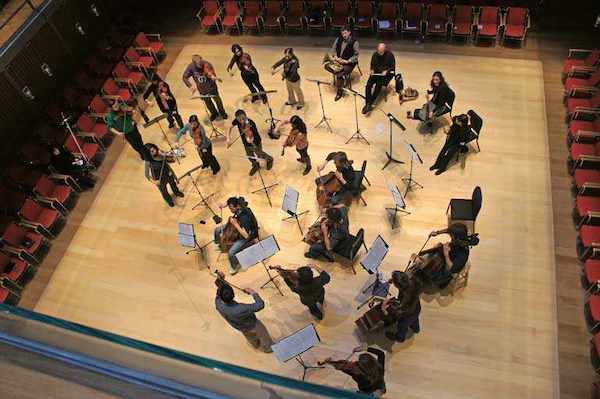
A Far Cry in action. Photo: courtesy of the artist
“I personally think they will have a much shorter life since they use color devices as a material,” William Schuman told Robert Hines in 1967. “When a composer uses timbre in this way, he/she eventually ends up writing works that are exotic.” The composer in question was Bartók, whose string quartets, in Schuman’s opinion, were clearly inferior to Beethoven’s.
That dig aside—and time has hardly borne out Schuman’s prediction—he was making a provocative suggestion: that sonority is separable from musical content. Any number of composers would surely disagree and, to be sure, the American symphonist was staking out an aesthetic position; later in that same interview, he described himself as a “romantic” who “never permitted [himself] the luxury of being misunderstood.”
Johann Sebastian Bach (who Schuman ranked, expectedly, among the top tier of giants in the field) was no romantic. Nor did he worry too much about being understood. That was a good thing: Leipzig congregants grumbled about the length and complexity of his music for the Thomaskirche, and wide popular acceptance didn’t arrive until some eighty years after his death.
Would a greater focus on extended sonic techniques have hastened or further delayed the latter? Who knows—but given the depth and versatility of Bach’s music (the composer himself repurposed various of his works for different instrumental combinations), one might argue, contra Schuman, that timbre was a not-insignificant ingredient in the Baroque master’s toolbox.
Either way, there’s a good long history of updating Bach to fit modern sensibilities and, occasionally, the results provide not just variety but fresh understanding. That’s what happened in A Far Cry’s concert at Jordan Hall on Saturday night, which featured a revision of the 2016 arrangement of the Goldberg Variations by members Alex Fortes and Sarah Darling.
Local audiences have had multiple opportunities to hear this work over the last couple of seasons in its standard version, and anyone worried that the addition of a string orchestra to the Goldbergs would result in a too-easy night for the keyboardist need not fear: in this setting, most of the score’s vertiginous hand crossings remain, and the soloist is active in nearly all of the thirty variations.
This weekend’s pianist was Simone Dinnerstein. She’s an old friend of the Criers, who were celebrating the start of their 20th season, and her contributions—warm, clear, understatedly virtuosic—charted a middle course between Víkingur Ólafsson’s hypnotic, probing account of 2024 and Yunchan Lim’s flashier interpretation from last year.
The orchestra’s part runs a gamut from echoes and sustains of the piano lines to realizations of implied harmonies, melodic doublings, and, occasionally, echoes of a jazz combo. Even as the instrumentation limits opportunities for literal improvisation on the repeats of each variation, it builds in the equivalent through changes to the orchestration: suffice it to say, Fortes and Darling approach their materials with considerable freedom and invention.
Throughout, there’s a marvelous sense of the music in conversation with itself, among the players, and across musical history.

Pianist Simone Dinnerstein. Photo: Lisa Marie Mazzucco
Indeed, the ghost of Bartók hovers above No. 5’s mix of harmonics, snap pizzicatos, and sul ponticello articulations; the section sounds like a surprise visit from that composer’s Fourth Quartet. For its part, No. 27 offers a bit of Webernesque Klangfarbenmelodie. Sometimes the orchestration enhances the elemental nature of Bach’s materials: No. 12’s scales and arpeggios, for instance, point a clear arrow toward Beethoven.
Where Fortes and Darling might have gone further in their approach is suggested by their absorbing reinvention of No. 28. Here, with Dinnerstein plucking the strings inside the piano’s body and the Criers delivering a delicate blend of col legno, pizzicato, and more, the music took on a dreamy, slightly eerie sheen: Bach meets The Banshee.
Nothing else quite approached this movement for ingenuity or effect. Nevertheless, the setting’s considerable strengths open up the Goldbergs’ sense of space and ably illuminate the music’s canonic significance. Saturday’s performance embraced those aspects with irresistible openness and joy.
So persuasive were those qualities that even the arrangement’s most questionable device—having the orchestra sing while playing in two of the variations—came across as more than just a clever gimmick. Instead, it helped underline a message of universal community that’s shared and passed down across time and place. Given all that’s going on in the world right now, that seemed an especially worthwhile point to take home.
Jonathan Blumhofer is a composer and violist who has been active in the greater Boston area since 2004. His music has received numerous awards and been performed by various ensembles, including the American Composers Orchestra, Kiev Philharmonic, Camerata Chicago, Xanthos Ensemble, and Juventas New Music Group. Since receiving his doctorate from Boston University in 2010, Jon has taught at Clark University, Worcester Polytechnic Institute, and online for the University of Phoenix, in addition to writing music criticism for the Worcester Telegram & Gazette.
Tagged: A Far Cry, Alex Fortes, Goldberg Variations, Jordan Hall, Sarah Darling