Book Review: Sofonisba Anguissola and the Art of Attribution
By Kathleen Stone
In a revised study of the celebrated 16th-century painter, Michael W. Cole traces how family support, artistic training, and scholarly revision shaped her legacy.
Sofonisba’s Lesson by Michael W. Cole. Princeton University Press, 392 pages, $68.
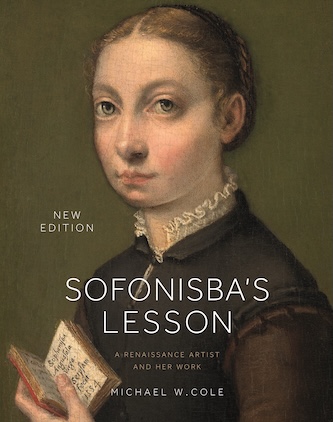
In 1506, the first Italian edition of Boccaccio’s On Famous Women appeared. Today we are aware that he was just a few decades too early to celebrate the Renaissance painter Sofonisba Anguissola, who made a name for herself in the 16th century. When she was young, her parents ensured that she received a well-rounded education that included the fine arts, and they did the same for her sisters. Additionally, they arranged for her to apprentice to two local painters, Bernardino Campi and Bernardino Gatti, a bold step at a time when women rarely trained outside the family home. Later, Sofonisba was invited to Spain to be a lady-in-waiting to the Queen and later an official painter in the court of King Philip II. As she elevated her reputation beyond what many painters, men or women, could hope for, Sofonisba climbed onto the platform Boccaccio had unknowingly prepared for her.
Art historians and museum curators have studied Sofonisba’s life and work for years and produced numerous exhibits and books. Michael Cole, a professor of art history at Columbia University, published one of those volumes in 2019. He has now revised it to reflect new scholarship, including Cole’s updated views on which pictures really were painted by Sofonisba, and which bear erroneous attributions.
The revised Sofonisba’s Lesson works at two levels. As a portrait of Sofonisba and her accomplishments, it educates the reader on the social and religious context of 16th-century Italy and reflects on what it must have been like to be a woman artist at the time. Cole is particularly sensitive to the nuances of opportunities then open to women. The book also brings readers into the scholarly pursuit of investigating and authenticating works of art. In closely detailed explanations, Cole presents us with a series of detective stories, each revealing how scholars do their research and decide questions of authorship — and how they can get it wrong.
Here’s one example of the process: a painting shows Sofonisba’s teacher, Bernardino Campi, painting her portrait. She is at the center of the picture, with Campi in the left foreground. When the picture came to modern scholars’ attention, they focused on her simple, dark clothing and lack of jewelry. It was in notable contrast to how women of the time were usually portrayed; they wore more colorful attire and eye-catching jewelry. Scholars opined that Sofonisba did this in order to display herself as an accomplished artist rather than as a clothes horse. She painted the picture in order to put her teacher and herself on equal footing. Also, her attire accorded with earlier self-portraits in which she wore simple, dark clothing.
Over time, varnish on the painting turned yellow and, in 1996, conservators decided to do something about it. In the cleaning process, they discovered that the dark paint on Sofonisba’s dress had been applied during the late 19th or early 20th century. Under that comparatively recent layer was a dress of dark red, shot through with gold threads. And Sofonisba was, in fact, wearing earrings.
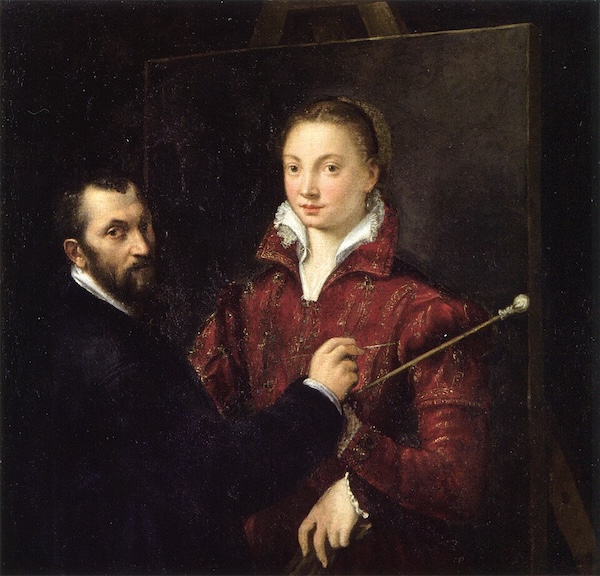
Bernardino Campi Painting Sofonisba Anguissola. Possibly by Sofonisba Anguissola (1550s). Oil on canvas, 111.0 x 109.5 cm (43 3/4 x 43 1/8 in). Pinacoteca Nazionale, Sienna, Italy. Photo: Wikimedia
This new information led to the question of who actually painted the picture. In the picture, Cole informs us, Campi looks to be about 40 years old, 10 years older than he was when Sofonisba left his workshop. Why, scholars wondered, would she show herself with Campi a decade after she had left his workshop. On top of that, it was after she had studied with a different teacher, had connected with Michelangelo, and had become an art teacher herself. Another complication: in the case of a double portrait, where an artist is shown painting another’s portrait, the artist in the picture was typically the artist who painted it.
There is a psychological component to the arrangement as well. If Sofonisba had painted the picture and placed herself in a red dress with jewelry, “it would involve a remarkable level of self-awareness, showing herself as though she were being regarded by a man,” Cole writes. “It seems far more likely that the painting is by Campi, and that it shows the difference between the way Sofonisba presented herself and the way she was presented by a close male contemporary who wished to attach himself to her celebrity.” Campi is now generally accepted as the painting’s creator but, because Cole has so carefully instructed readers on how attributions can be made and unmade, we realize that even this conclusion might be challenged. Indeed, Cole writes that his catalogue of works, included in the book, could be revisited in the future; even seven years from now, “it might look different still.”
We are given another example of scholarly detective work with one of Sofonisba’s best known paintings, The Chess Game. Three girls are shown playing chess, with a household servant off to the side. The girls are thought to be Sofonisba’s sisters, but exactly which ones (she had five sisters) was debated for years. Cole explains that scholars compared the appearance of the girls playing chess with stand-alone portraits of Sofonisba’s sisters and used those portraits and contemporaneous documents to determine who is in the picture and their ages. It is now generally accepted that the three sisters shown are Lucia (maybe 17), Europa (six or seven) and Minerva (10 or 12).
From the painting’s title, one might assume that Sofonisba captured her sisters mid-game, but more likely she invented the details of the scene. The clothing the girls wear is more elegant than their noble, yet financially struggling, parents could have afforded. Also, the inscription written on the side of the chessboard identifies Sofonisba as the painter; it informs us that she worked from “true effigies” of three of her sisters and of the maid. As much as the painting seems to capture the girls in the midst of a game, the reference to effigies suggests Sofonisba drew on previously painted images of the girls when she constructed the outdoor scene.
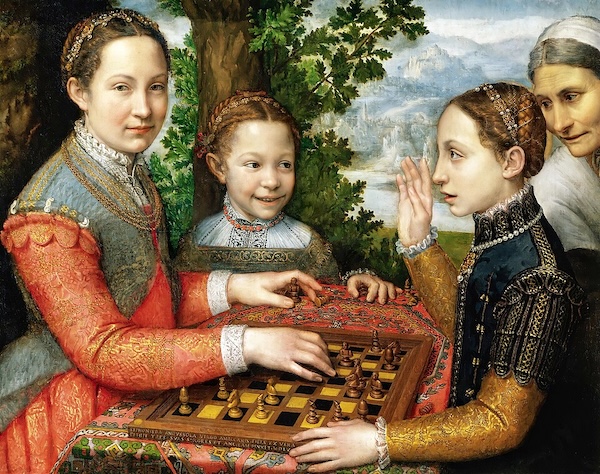
Sofonisba Anguissola, Portrait of the Artist’s Sisters Playing Chess (Depicting Europa (left), Minerva (middle) and Lucia (right) Anguissola playing chess), 1555, Oil and tempera on canvas, 72 × 97 cm, National Museum in Poznań, Poland. Photo: Wikimedia
Cole adds a historical point about the expression of emotion in the 16th century. Self-composure was the goal, and it was understood that young people had to learn how to tamp down their emotions and project control. It is not surprising, then, that Europa, the youngest sister, is the only one in the picture who shows real emotion. Minerva, the middle girl, may be about to say something, but she maintains a quiet demeanor. Lucia, the oldest, has learned the skill of self-composure. She has just won the game but, if she is pleased, she keeps that to herself. We see only the hint of a smile as she turns toward the viewer.
In choosing to show her sisters playing chess, Sofonisba may have wanted to make the point that girls and women were capable of such brainy pursuits. At the time, the game was assumed to be for men, but here girls, even a young one, are enjoying an opportunity to play. That, of course, reflected the values of her forward-thinking family.
The book’s title suggests that Sofonisba benefited from what she learned –her “lessons” lifted her into the art world, as well as into a level of society that her impoverished family could not otherwise have entered. At the same time, Sofonisba provided a lesson for other ambitious women, showing that they, too, could succeed in realms beyond the domestic. As Cole writes, “The women and men who looked back at Sofonisba Anguissola in the sixteenth and seventeenth centuries saw not just a famous individual but also an example, a model of what a woman with the right inclination, skill, and parental support could become. She showed that a life devoted to painting was a real possibility for women, and she showed what such a life might look like.”
Kathleen Stone is the author of They Called Us Girls: Stories of Female Ambition from Suffrage to Mad Men, an exploration of the lives and careers of women who defied narrow, gender-based expectations in the mid-20th century. Currently she is at work on a second book about women in the skilled manual trades. Her website is kathleencstone.com.