
At the DC/DOX Film Festival: Paradise Crowded, Justice Delayed, Borders Wired
By Neil Giordano
DC/DOX spotlights documentaries that confront the human cost of tourism, policing, and surveillance—alongside bold experiments in nonfiction form.
Last month, the DC/DOX documentary film festival, just a few blocks away from the UFC circus at the White House, celebrated a saner vision of America. The event, a successor to the long-running AFIDocs, has grown into a major industry event, with more than a hundred films and shorts. The assembled highlights range from traditional vérité fare to films that are more formally experimental in subject and style.
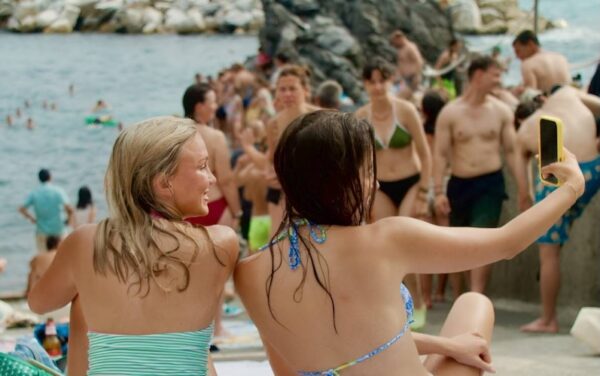
A scene from The Siege of Paradise. Photo: DC/DOX
With urgency and more than a little humor, The Siege of Paradise looks at the extremes of contemporary tourism. The Cinque Terre, a remote spot on Italy’s northwest coast renowned for its landscape of terraced cliffs and vineyards, has become overrun with millions of annual visitors. Similar to the crush of outsiders vacationing in Barcelona, the logjam has changed the identity of the Italian location. Irish filmmaker Gar O’Rourke examines all sides of the problem. We see people flood the five small villages (Monterosso al Mare, Vernazza, Corniglia, Manarola, and Riomaggiore) via cruise ships, ferries, and trains, eager to enjoy the gorgeous vistas and crystal-clear waters. Families roam the narrow, crowded streets, buying tacky tchotchkes, an American “influencer” idly posts photos of her breakfast, contributing to the feeding frenzy. She is more of a symptom than a cause, really, since the region has been positioning itself to rake in profits for decades.
The documentary’s greatest strength is turning the camera on the local residents and asking how they have coped and adapted. A restaurant owner struggles to keep staff because no one can afford to live in the area. A winemaker attracts tourists, but watches with frustration as his invalid wife struggles to navigate the village’s busy, narrow streets. The mayor of one town sets out the crucial trade-offs: there’s environmental costs as well as the wholesale transformation of the local economy. The film’s gorgeous vistas are eye-filling. But we are also shown warning signs. For instance, there’s the epidemic of key lockboxes, which signals the the Airbnb-ing of the town’s housing stock. The next generation of “residents” will live elsewhere, a safe distance from hometowns overrun by selfie sticks and T-shirt shops.
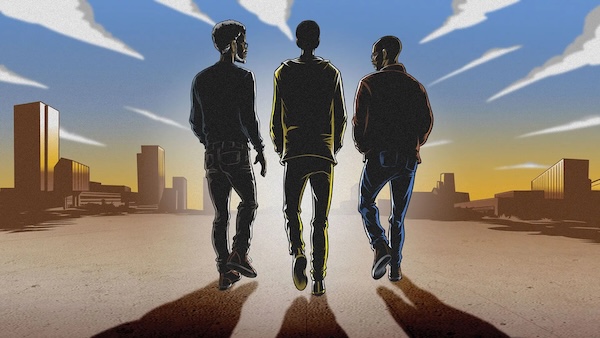
A scene from When a Witness Recants. Photo: DC/DOX
In When a Witness Recants, filmmaker Dawn Porter (John Lewis: Good Trouble) takes on the troubling and now too-familiar history of American racial injustice and police misconduct. The film revisits the case of a 1983 shooting in a Baltimore middle school — recreating parts of the crime through animation. Based on the testimony of two coerced witnesses, the police and court system wrongly arrest and convict three teenagers––Alfred Chestnut, Andrew Stewart, and Ransom Watkins. Based in part on a 2021 New Yorker article, the doc features commentary from Baltimore native Ta-Nehisi Coates, who was eleven years old at the time of the crime. He provides a compelling description of the close-knit Harlem Park neighborhood. The gross injustices and racism in the area–empowered by illegal decisions made by the police, prosecutors, and judge––are predictable. It took 37 years for the three men to be exonerated and released.
Much of the story is reminiscent of 2023’s Murder in Boston, which was about the Charles Stuart case in Mission Hill and police coercion of young Black men. But where When a Witness Recants stand out is in its final act. Throughout the doc, the three men, now in their 50s, tell their own stories, along with one of the witnesses, Ron Bishop, who was coerced into testifying against them. The four men agree to be filmed together. At this point, the film enters strikingly unsettling territory — the cost of injustice has rarely been exposed so rawly and honestly.
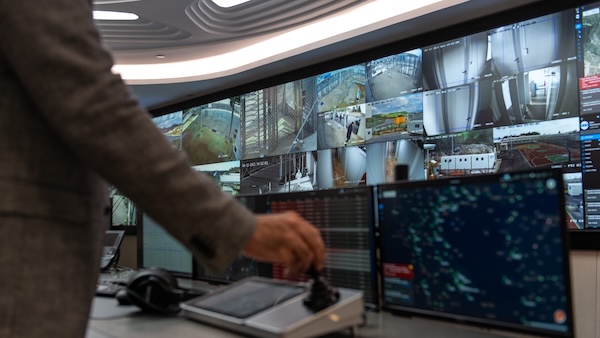
A scene from The Sandbox. Photo: DC/DOX
Three films—a feature and two shorts—confront the new realities of immigration and the refugee crisis in the United States and worldwide. The feature The Sandbox, by human-rights lawyer turned filmmaker Kenya Jade-Pinto, specifically explores the new-fangled Orwellian technological arms race that has taken over immigration enforcement. Starting at the US-Mexico border, we see the ways in which drones and various multi-pronged sensors have become a staple of Border Patrol tactics. A peek into an industry expo displays the new ways the government can track and apprehend people crossing the border, including robot dogs and tethered night-vision cameras. What makes this increasingly sophisticated surveillance terrifying is the glee with which the buyers and sellers talk about what the machinery does in purely nonhuman terms—as if people are just blips on a screen to be picked off.
This callous amorality continues when the doc travels to Greece and the Mediterranean. Greek refugee camps are filled with biometric scanners, there to create a database of the apprehended refugees. What will this information be used for? When asked, a government official has no idea; in fact, he seems not to have even thought about its repercussions. Like so many in charge, he is enamored with the technology, defending it blandly as a way to prevent “bad things” from happening in the refugee camps. Elsewhere in the film, we finally witness acts of empathy: activists help track boats that are danger in the Mediterranean; a group gathers the remains of dead refugees in the Texas desert in order to identify and repatriate them to their families south of the border. The takeaway, despite these signs of humanity, are clear: technology that is supposed to be about protection is leading us into a dystopian future.
Along those disheartening lines, two short films were alarming because of what what they could not show. Notes on Courtwatch examines a group of activists who document the hearings and goings-on in downtown Manhattan’s immigration court. Access to the courtrooms is verboten; the camera is used to evoke the impenetrability of the place, peering up at the tinted-glass edifice. These images are juxtaposed with a soundscape of testimonials from lawyers and activists who condemn the limits placed on them to advocate for refugees and other protected-status families who warily attend court dates. (Now that the Supreme Court has ruled to allow the suspension of Temporary Protected Status, some of the families glimpsed in this film will likely be deported.)
A second short, Water Cooler, is even more chilling. It is an observational glimpse of ICE and DHS agents in the hallways of a courthouse in California, chatting mostly about personal matters––days off, brunch, online shopping. I was reminded of Frederick Wiseman’s Missile, in which Air Force rookies are trained to fire ICBMs and then are given break time to have a barbecue and talk about sports. In this film, the ICE agents pause from their frivolity to occasionally shuttle detainees to court and points unknown. In fact, the camera is prohibited from entering a stairway where the detainees are initially delivered. It seems to be a relay point, its window blocked out by agents so we can only hear snatches of anguished pleading from behind the closed door. The banality of evil, indeed.
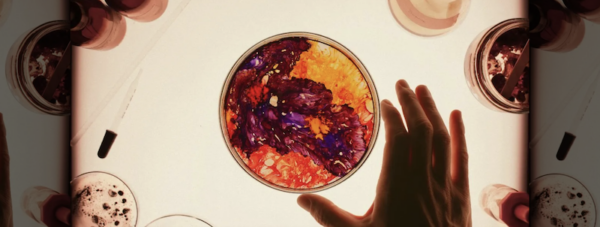
A scene from Phenomena. Photo: DC/DOX
Moving into more experimental territory, three films explored science, humanity, and the nature of the documentary itself. The enjoyable and visually striking Phenomena, directed by Australian filmmaker Josef Gatti, is a semi-educational study of the physical world. Part Koyaanisqatsi visual poem, part middle-school science film, Gatti divides up what we know (and don’t know) about modern physics, along the way illustrating the mathematical patterns that make up everything, from electromagnetism to quantum mechanics. Even if you don’t learn something new, you’ll be entranced by the visual and sonic set pieces. In Every Contact Leaves a Trace, multimedia artist Lynne Sachs examines the nature of human connection. A blend of memory-play and visual niceties, Sachs gathers all of the business cards she’s collected in her lifetime. She then tries to weigh the importance of each of the links the contacts represent. Some are discarded quickly; some lead to discursions about love, professional ambition, family, and even hairstyles. Interestingly, Sachs includes her tween niece and nephew in the film, and their reactions and questions occasionally guide a sequence. Will they ever be handed business cards in our increasingly digital age?
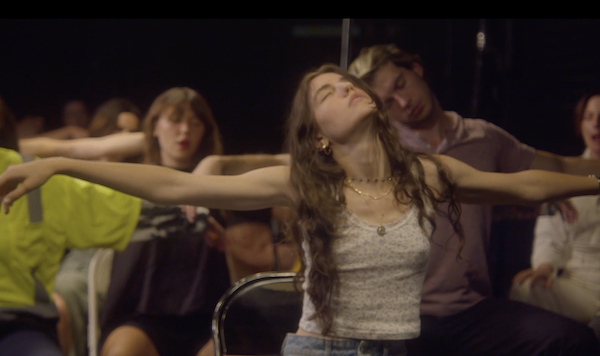
A scene from The Whole World Is a Lie. Photo: DC/DOX
The confounding The Whole World Is a Lie calls into question the entire business of making a documentary, sometimes in revealing ways. Actor-turned-filmmaker Charlie Birns wanted to make a film dedicated to the Method acting workshop that changed his life. (It was taught by Tony Greco at the Gene Frankel Theatre in New York — Philip Seymour Hoffman was among its famous pupils.) But Birns runs into multiple obstacles, mainly from the other actors and from the teacher. They ask him why he’s making the film and he can’t come up with an answer. His aim seems to be to examine the sense of transcendental “oneness” that comes after we discover something that has great meaning in our lives. Birns then brings in talking heads—including philosophers, Eastern mystics, and even psychics—to explore the nature of how humans experience transformations that lead to profound change.
But this move ends up derailing the narrative. It becomes a meta-film: even Birns’s crew are not sure of what they are doing on this shoot. Some begin to question the nature of reality. Has Birns set the film up to be a disaster, its conflicts reflecting his own life’s journey? Birns’s father (who coined the doc’s title) becomes a key participant in the next chapter of the drama, which leads to reenactments of the family’s past, first with actors and then with Birns’s father playing himself. It should not be surprising that the film was produced, in part, by Robert Greene, whose own compelling films blend nonfiction and reenactment. But the ambitious tangle here may only speak to other documentary filmmakers in search of a cautionary tale.
When a Witness Recants will premiere on HBO later in 2026. The other films continue on the festival circuit and are awaiting distribution.
Neil Giordano teaches film and creative writing in Newton, MA. His work as an editor, writer, and photographer has appeared in Harper’s, Newsday, Literal Mind, and other publications. Giordano previously was on the original editorial staff of DoubleTake magazine and taught at the Center for Documentary Studies at Duke University.
Tagged: "Every Contact Leaves a Trace", "Notes on Courtwatch", "Phenomena", "The Sandbox", "The Whole World Is a Lie", "Water Cooler", DC/DOX, Dawn Porter, Gar O’Rourke, Josef Gatti, Kenya Jade-Pinto