
Book Review: “The Trust Spiral” — A Provocative but Flawed Overview of What’s Wrong with the Media
By Dan Kennedy
Walter Lippmann defined objectivity as the fair-minded pursuit of the truth, but all too often it has degenerated into false equivalence. Tara Henley tries to have it both ways.
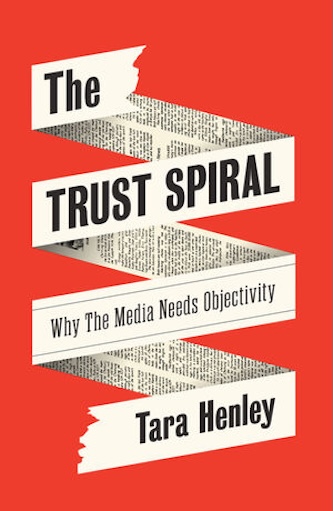
The Trust Spiral: Why the Media Needs Objectivity by Tara Henley. Polity, 128 pages, $25 (cloth)
On November 21, 1954, Palmer Hoyt strode to the podium at the University of Arizona to accept the John Peter Zenger Freedom of the Press Award. Hoyt, the editor and publisher of the Denver Post, was being honored for his courage in standing up to Joseph McCarthy and his anti-communist witch hunt — a notable exception to the timidity shown by much of the press in tangling with the Republican senator from Wisconsin.
Hoyt used the occasion to call out publishers who had enabled McCarthy’s campaign of lies and character assassination. As quoted in Bill Hosokawa’s 1976 book, Thunder in the Rockies, an authorized history of the Post, Hoyt told his audience, “It is true that the number of newspapers critical of McCarthy has grown during the last year or two. But there are still many of them who are his supporters, his apologists, even his devotees.” Moreover, he denounced McCarthy’s journalistic toadies for being “as short-sighted as they are self-destructive.”
The larger target of Hoyt’s disdain was the notion of journalistic objectivity, or at least a certain definition of that much-used and much-abused term. The limits of objectivity were laid bare by McCarthy’s cynical exploitation of the press’s belief that it should just report the facts — that is, Senator McCarthy said this — while letting news consumers decide for themselves what was true and what was false. As the media scholar Matthew Pressman described objectivity in an essay for Time magazine, “As practiced in the 1940s and ’50s, it turned journalists into stenographers: they simply reported what powerful people said and did, without providing context or analysis.” It was McCarthy, Pressman added, who prompted reform, explaining, “From the 1960s on, journalists routinely included analysis and interpretation in their reports — not ‘just the facts.’”
Now the Age of Trump is upon us, marked by authoritarianism, fear, and corruption on a level that exceeds even the worst days of the McCarthy era. And once again, the press — rebranded as “the media” to encompass television and the internet — is being questioned, scrutinized, and criticized. Rising majorities of survey respondents say that they distrust journalism, with Donald Trump and his supporters decrying anything that fails to conform to their warped version of reality as “fake news” and anti-Trump observers demanding that the media speak louder and carry a big stick.
Into this maelstrom strides Tara Henley, a Canadian radio journalist who has written a slim book titled The Trust Spiral: Why the Media Needs Objectivity. It’s not without its virtues; Henley’s lament over how woke politics have warped newsroom decision-making and how opinion has permeated news coverage has value, especially coming from someone whose own political views might be described as center-right. She is no fire-breathing right-winger, and she has taken an admirably sober-minded approach. But she also oversimplifies, leaving out crucial context that would show that what ails the media is more complicated than she would have us believe. (Disclosure: In 2024 Ellen Clegg and I were guests on Henley’s podcast, Lean Out, to discuss our book, What Works in Community News: Media Startups, News Deserts, and the Future of the Fourth Estate.)
Take, for instance, the matter of declining trust in the media. Henley cites Gallup survey data showing that just 28 percent of Americans say they have “a great deal” or a “fair amount” of trust in the media to report the news “fully, fairly, and accurately,” a number that drops to 8 percent among Republicans.
That’s true, and disturbing, as far as it goes, but it ignores how the media have changed in recent decades. As the Pew Research Center found last year, the public has a great deal of trust in the media they actually use. More than 60 percent of Democrats and Democratic leaners said they trust the big three network newscasts as well as CNN and PBS. The New York Times, the Associated Press, NPR, the BBC, and MS NOW came in at 50 percent or above as well. On the Republican side, more than 60 percent trusted Fox News, with no other news source garnering more than 40 percent.
In other words, the demise of trust has more to do with media fragmentation than it does with an actual overall decline. The Pew study also underscores another phenomenon that Henley doesn’t mention: the rise of asymmetric polarization, with conservatives seeking shelter in their own ideological bubble to a far greater extent than liberals.
Then again, surveys themselves can be problematic, as Henley acknowledges. At one point she writes, “Audiences would like us, to the best of our ability, to gather the facts and the range of perspectives and to trust people to make up their own minds about what it all means.” Elsewhere, though, she cites a Stanford University study “finding that the public often prefers partisan alignment over truth in news.” In other words, people like opinionated news, especially when it conforms to their views.
Her principal example of wokeism run amok is former New York Times editorial-page editor James Bennet. As with her treatment of media trust, Henley’s description of what happened to Bennet is incomplete. She observes that he was fired in 2020 after he ran an op-ed piece by Republican Senator Tom Cotton calling for the military to crack down on violent Black Lives Matter protesters. The Cotton op-ed sparked an uprising in the newsroom, with journalists claiming on social media that publishing such a piece made them feel unsafe.
Overwrought? In retrospect, yes. But just days before, Cotton had called on the military to grant “no quarter” to violent protesters. In other words, to kill them. A number of experts, including conservatives, said that would amount to a war crime, yet apparently no one at the Times asked Cotton to explain himself — a lapse of basic editing. Moreover, Bennet later admitted that he hadn’t even read Cotton’s piece before it was published. Finally, in 2017 Bennet sloppily inserted a line into an editorial that erroneously linked rhetoric by former Republican vice presidential candidate Sarah Palin’s political-action committee to a mass shooting that seriously wounded then-congresswoman Gabby Giffords and killed six. Palin sued the Times for libel, leading to years of litigation that proved futile for her but embarrassing for the Times. Given all that, the Times’s leaders may have reasonably concluded that they’d seen enough.
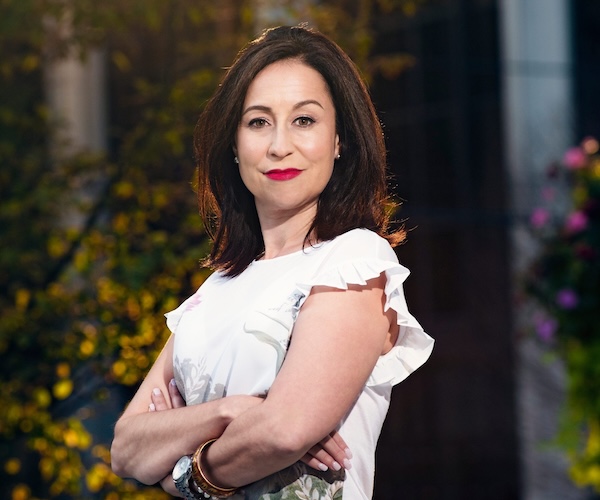
Canadian journalist, author, and podcaster Tara Henley. Photo: courtesy of the artist
In a similar vein, Henley endorses Uri Berliner’s celebrated 2024 essay in The Free Press charging that NPR had moved far to the left. Berliner, then a top editor at NPR, made some worthwhile arguments, but he grounded them in examples that were intellectually dishonest — for instance, by mischaracterizing the Mueller investigation into the 2016 Trump campaign’s Russia ties and by leaving out crucial context in criticizing NPR’s coverage of the great Hunter Biden laptop caper.
In general, Henley is more sympathetic to conservative media critics like Bari Weiss, the founder of The Free Press, than to liberals like Jay Rosen and Margaret Sullivan. She dismisses arguments that the media should be tougher on Trump and instead decries the “erosion of journalistic norms and standards.” Among other things, she argues unpersuasively that coverage of Trump, #MeToo, COVID, and the racial reckoning were all marred by liberal bias.
Henley is on more solid ground in discussing how the decline of the news business has harmed media credibility by depriving young journalists of training opportunities and by creating a class of bitter, resentful knowledge workers who realized they would never enjoy the salaries and prestige that their older colleagues took for granted. Henley might have noted, too, that at a time when advertising revenues have cratered and news organizations have become increasingly dependent on revenue from their audience, there is a strong temptation to give that audience what it wants. The most outspoken members of the audience for elite outlets like the Times and NPR are liberals who take to social media and badger news outlets for not bashing Trump hard enough.
Henley’s ostensible mission is to make a case for objectivity, but it’s a little difficult to discern exactly what she’s calling for. Boiled down to its essence, objectivity, as originally conceived of more than 100 years ago by Walter Lippmann, is nothing more than a fair-minded, rigorous pursuit of the truth. Journalists like former Washington Post executive editor Leonard Downie Jr., who liked to boast that he did not vote lest it taint his blessedly neutral, unbiased brain, have fallen for the caricature of objectivity rather than the real thing.
Henley approvingly cites a 2023 address at Brandeis University in defense of objectivity by Martin Baron, another former Washington Post executive editor (and former Boston Globe editor), but she leaves out what to my mind was the most important part: “Objectivity is not neutrality. It is not on-the-one-hand, on-the-other-hand journalism. It is not false balance or both-sidesism. It is not giving equal weight to opposing arguments when the evidence points overwhelmingly in one direction. It does not suggest that we as journalists should engage in meticulous, thorough research only to surrender to cowardice by failing to report the facts we’ve worked so hard to discover.”
To be fair, Henley does not endorse mindless balance, and she quotes Tom Rosenstiel, co-author of The Elements of Journalism, as saying that he doesn’t even like to use the word objectivity because it is so poorly understood. So if we take objectivity as Lippmann defines it, and as Baron defends it, then we can all stand up and cheer at Henley’s bottom line:
This all makes the need for the grounding ethic of objectivity more necessary than ever. In times this chaotic, some stability can be found in its guiding ethos of public service — and its orientation towards curiosity, humility, fairness, and thoroughness, coupled with, crucially, a sincere and sustained attempt to remain politically neutral.
In a memo to his managing editor, Palmer Hoyt laid out some basic principles for how the Denver Post should cover Joseph McCarthy and the victims of McCarthyism. Among other things, Hoyt wrote that “we should remind the public in the case of a wild accusation by Senator McCarthy that this particular senator’s name is synonymous with poor documentation and irresponsible conduct and that he has made many charges that have been insupportable under due process.”
That’s objectivity as fearless truth-telling, and it’s something we should all support.
Tara Henley offers a useful argument for how the media can regain public trust in an age of intense polarization. At a time when too much of what passes for news consists of opinionated talking heads on cable, ill-informed podcasters, and click-obsessed social media influencers, Henley wants us to get back to the basics of reliable, fact-based journalism. Despite my quibbles, the journalism that Henley wants — call it objective, or just call it fair and truthful — would lead to a better-informed, less polarized society.
Dan Kennedy is a professor of journalism at Northeastern University, where he co-leads the project What Works: The Future of Local News and co-hosts its twice-monthly podcast. His blog, Media Nation, is online at dankennedy.net.
Tagged: "The Trust Spiral", "The Trust Spiral: Why the Media Needs Objectivity", journalistic objectivity, news media