Theater Review: “Cats: The Jellicle Ball” and “Masquerade” – What a Bold Concept Can and Can’t Do for Andrew Lloyd Webber
By Christopher Caggiano
Two productions set out to reinvent Andrew Lloyd Webber’s back catalog. Only one of them succeeds.
A confession: I’ve never been a big fan of Andrew Lloyd Webber. I will concede that there’s a good deal worth admiring in his early work with Tim Rice—Jesus Christ Superstar, Evita, even Joseph and the Amazing Technicolor Dreamcoat. But after the pair parted ways, Lloyd Webber seems to have surrounded himself with a series of mediocre collaborators who can’t find it in themselves to tell Sir Andrew when something isn’t working.
Which makes his recent spate of flops all the more galling. Bad Cinderella. Love Never Dies. The Woman in White. Stephen Ward. (Stephen Ward? Anyone?) Sure, School of Rock ran 1,309 performances—but the score was basically just four-chord pop rock. Hardly what you’d expect from a man whom some claim to be among the most eminent composers of our time.
In the absence of any new inspiration, Lloyd Webber has lately been reduced to reimagining his earlier work. A dark, video-forward Sunset Boulevard. (Read my review.) A gimmicky, blood-soaked Evita. An itinerant Phantom of the Opera. A ballroom-inspired Cats. What’s next? Aspects of Love on Ice?
Two of those reimaginings are currently running in New York, and I had a chance to catch both. Cats: The Jellicle Ball transplants the kitty competition into New York’s ballroom culture and is playing on Broadway. Masquerade, the immersive Off-Broadway revival of Phantom of the Opera, does its best Sleep No More impression on 57th Street. The productions represent two very different bets on what a Lloyd Webber reimagining can accomplish. Only one of them pays off.
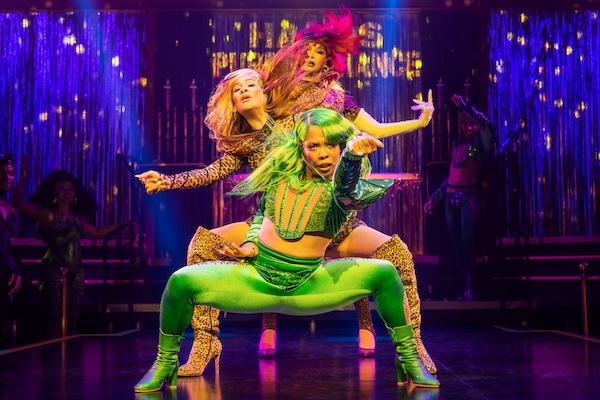
(Top to Bottom) Leiomy as ‘Macavity,’ Kya Azeen as ‘Etcetera,’ and Dava Huesca as ‘Rumpleteazer’ from the production of Cats: The Jellicle Ball. Photo: Matthew Murphy and Evan Zimmerman for MurphyMade
Cats: The Jellicle Ball already made a considerable splash in its Off-Broadway run at PAC NYC – way downtown by the Freedom Tower – where it was easily one of the buzziest productions of the previous season. I caught it there and had a blast. A Broadway transfer seemed inevitable, and the production has lost none of its electricity at the Broadhurst. If anything, it’s better.
The production relocates the Jellicle competition from its traditional junkyard setting to New York’s ballroom culture: the Black and Latino LGBTQ+ underground scene of vogueing, house culture, and competitive ball categories. Directed by Zhailon Levingston and Bill Rauch, with choreography by Arturo Lyons and Omari Wiles, the show opens with a knowing nod to Gillian Lynne’s original choreography, rendered in silhouette before transitioning into something altogether its own.
The ballroom concept gives Cats what the original has always lacked. Subtext. Emotional weight. A sense of history, and of stakes. Ballroom culture carries with it decades of struggle and joy. It’s a community that created its own world when the mainstream world wouldn’t have them. It’s where they learned to thrive with breathtaking style and defiance.
Layered onto Cats, that history turns what was always a somewhat arbitrary competition into a contest worth investing in. This version of Cats is a masterclass in what a bold production concept can do for thin material. At a certain level, yes, it’s lipstick on a pig. But it works, although the fact that it took all of this to make Cats dramatically compelling is its own quiet indictment of the original.
To understand how this differs from the Cats you may have endured before, consider the stakes of a ball. Each number has its own competition category (“virgin vogue,” “runway,” “realness,” “old way/new way”) and the main character of each song doesn’t automatically win. Mungojerrie and Rumpleteazer, for instance, characteristically steal the trophy when they don’t win their mini competition, although the prize is quickly returned to the rightful winners.
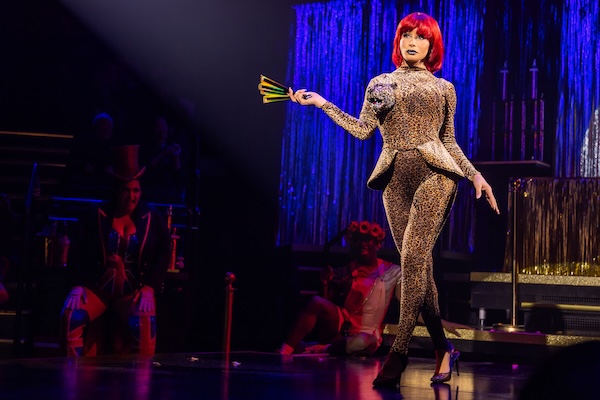
Leiomy as ‘Macavity’ from the production of Cats: The Jellicle Ball. Photo: Matthew Murphy and Evan Zimmerman for MurphyMade
A word about the lyrics: don’t worry about them. This might as well be a dance revue, and that turns out to be an unintentional gift. At intermission, my neighbor confessed he couldn’t make out a word. I told him he wasn’t missing much. (With due respect to T.S. Eliot, Old Possum’s Book of Practical Cats (1939) consists of doggerel he composed to amuse his godchildren. It was only later that anyone considered publishing them.) At one point the performer playing Skimbleshanks broke into Spanish, which is perfectly fine, since the lyrics aren’t carrying any meaning in any language.
The disastrous 2019 film of Cats proved definitively what happens when you take these songs literally. (Dancing cockroaches? I still wake up screaming.) Here, mercifully, no one is taking the words seriously. The third-person construction that makes so many of the numbers feel oddly distancing actually works in this context – the title character of each song is busy voguing up a storm while everyone else narrates, which is more or less how a ball works anyway. And if something important is happening, don’t worry: the lyrics will repeat it about fifteen times.
The casting here is half the show. André De Shields presides over the evening as Old Deuteronomy – Broadway royalty in full effect. His entrance goes on a bit longer than it should, but I did enjoy the nipple-tweaking moment with Rum Tum Tugger. Speaking of whom, Sydney James Harcourt brings a strong and welcome note of humpy stud boy to Rum Tum Tugger. Dudney Joseph, Jr. as Munkustrap serves ably as the evening’s emcee, accompanying the curtain call with a rousing improvised rap introducing the cast. And keep an eye out for Mr. Mistoffelees. Robert “Silk” Mason is possibly the fiercest performer on the runway stage: lithe, impossibly limber, with a deadpan nonchalance that seems to challenge the entire world.
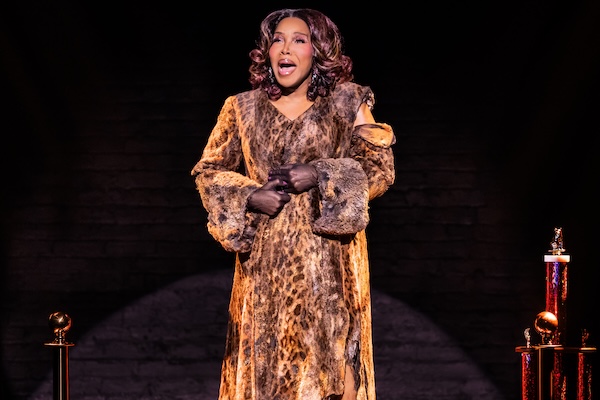
“Tempress” Chasity Moore as ‘Grizabella’ from the production of Cats: The Jellicle Ball. Photo: Matthew Murphy and Evan Zimmerman for MurphyMade
But the casting choices that linger are the ones that root the production in history. Junior LaBeija – a pioneer in NYC ballroom, House of LaBeija member for over fifty years, and a celebrated emcee known from Paris Is Burning – plays Gus the Theater Cat, a piece of casting that is quietly perfect and genuinely moving. Leading into his number, a slideshow of drag and ballroom history figures makes the tribute explicit, a touch added between the Off-Broadway and Broadway runs that pays real dividends. Ken Ard, meanwhile, who played Macavity in the original Broadway run of Cats, turns up here as the energetic DJ Griddlebone, a little wink to those who know.
One casting caveat. “Tempress” Chasity Moore as Grizabella was consistently and distractingly sharp throughout “Memory.” A pity, since it’s the number the whole evening builds toward.
I mean, look, it’s still Cats. And all that that entails. (Pun not intended.) But what Levingston, Rauch, and their extraordinary company have pulled off here is no small feat. Minute for minute, it’s the most fun to be had on Broadway right now.
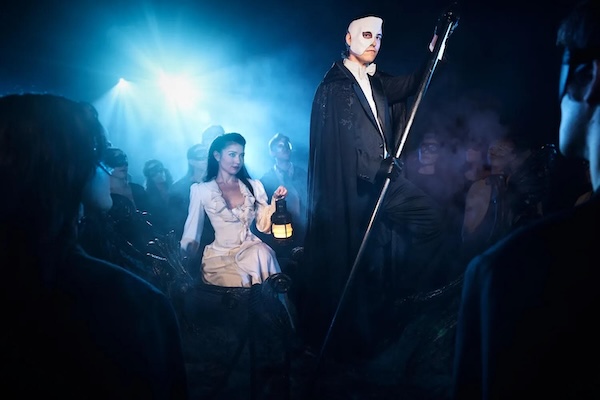
Riley Noland and Clay Singer in a scene from the production of Masquerade. Photo: Oscar Ouk
Masquerade arrives at its bespoke venue on 57th Street with an ambitious proposition: an immersive, site-specific reimagining of Phantom of the Opera that puts the audience on its feet and moves them through the story rather than planting them in seats. The model, inescapably, is Sleep No More—the long-running immersive Off-Broadway phenomenon that turned a Chelsea warehouse into a labyrinthine world you navigated on your own terms.
Tony Award-winning director Diane Paulus, who spent three years developing the project with Lloyd Webber, borrows liberally from that playbook, with one key difference: rather than letting you wander freely, Masquerade escorts you through the show in linear fashion, so you don’t miss anything. Having once given up on climbing six flights of stairs at the fictional McKittrick Hotel, I appreciated the consideration.
The ambition behind Masquerade is clear enough. By putting the audience on its feet and moving them through the Phantom’s world, the production hopes to generate the sense of menace and unease the original struggles at times to sustain from a fixed distance. It also takes a swing at humanizing the Phantom, showing us, through Madame Giry, how she took him in and protected him as a child. It is an attempt to complicate our relationship with a character who has always been more archetype than person.
Neither gambit quite lands. The immersive staging, rather than heightening the Phantom’s menace, actually diffuses it. Having him weave through the crowd—touching people on their shoulders—transforms what is supposed to be a terrifying figure into something closer to a haunted house actor. The staging approach also plays havoc with the plot’s internal logic.
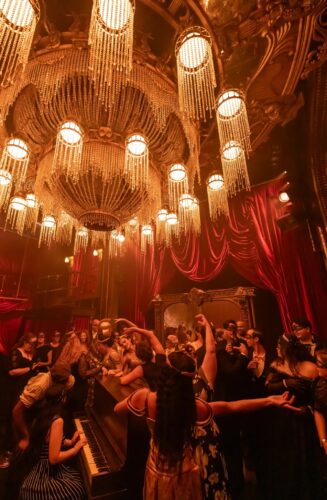
A look at the chandelier in a scene from the production of Masquerade. Photo: Oscar Ouk
During “Point of No Return,” the Phantom reveals himself to the crowd in a relatively small space, with Raoul, Firmin, and Andre standing mere feet away, and they do absolutely nothing. Also, at the very end, cast members surround the Phantom and smile at him beatifically. Never mind that we’ve just watched this guy murder a stagehand. Do we really want to feel any tenderness for this man? It’s not like he’s a well-drawn antihero like Sweeney Todd. The freak show backstory doesn’t resolve that basic problem; it just adds running time.
What’s left, then, is essentially fan service. Most people in attendance have probably seen Phantom before, and that familiarity is the only reason that the stripped-down storytelling holds together at all. They’re not here to be surprised. They’re here to be pandered to.
The production makes some significant alterations to the source material, not all of them welcome. The most substantial is an extended backstory sequence built around a freak show, complete with a fire eater and a woman hammering nails into her sinuses (I left the room). This is apparently meant to illustrate how the Phantom (his name is Eric, should you wish to know) survived a childhood of abuse by joining a carnival.
Two songs have been added to accommodate this new material: a creepy barker number for the freak show, and “Learn to Be Lonely,” a ballad written for the closing credits of the 2004 film that was a snore then and remains one now. On the more defensible end, “Masquerade” has been moved to the top of the show to set the tone for the immersive evening ahead, which is a reasonable call, even if it means front-loading the production’s most thematic number.
As before, the lyrics for the show don’t so much progress as circle. A character states an idea, repeats it, and arrives at the end of the song more or less where they started. Seriously: take any of the primary songs, follow the lyrics, and note the lack of progression. As Oscar Hammerstein II taught Stephen Sondheim, a theater song should represent a journey, with the characters in a different place at the end.
None of which matters much, for the same reason it doesn’t matter in The Jellicle Ball: the words aren’t adding a great deal on any level. The immersive staging renders the confrontation scene largely incomprehensible, but since the audience has likely been here before, they already know what’s happening.
It’s worth pausing here to note the contrast between The Jellicle Ball and Masquerade. Both productions are built on the same premise: take a Lloyd Webber warhorse and reinvent it through a new conceptual lens. In The Jellicle Ball, that lens brings the material to life in ways the original never managed. The ballroom concept gives Cats something to be about. In Masquerade, the immersive staging has the opposite effect: it enervates rather than elevates, draining the story of the tension by pulling the audience too close. Proximity, it turns out, is not the same thing as intimacy.
There is genuine talent on display here. At the performance I attended, Telly Leung brought real commitment to the Phantom, and his performance is terrific, though his diminutive stature works against the looming menace the role demands. Tia Karaplis is imperious as Madame Giry, as required. And Haile Ferrier as Christine is a glittering new talent with a crystalline soprano, which was especially powerful in “Wishing You Were Somehow Here Again,” a dull song that Ferrier somehow hits out of the park.
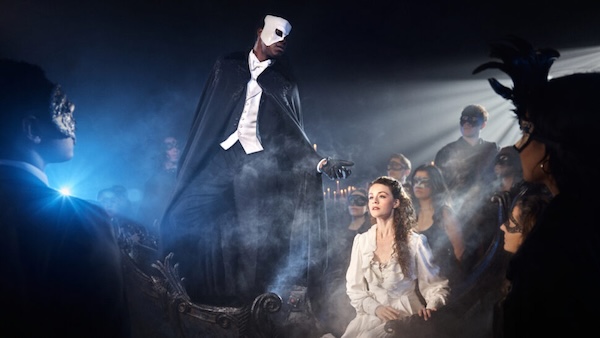
Kyle Scatliffe and Eryn LeCroy in a scene from the production of Masquerade. Photo: Oscar Ouk
The production also has its visual moments. The graveyard scene is genuinely arresting, with some audience members positioned on a balcony overlooking the crypt, and the rest surrounding Christine at her father’s grave below. When the Phantom appears backlit above, both his and Christine’s shadows project onto the crypt wall. It’s a haunting image.
The rest is more uneven. The production (scenic design by Scott Pask, production design by James Fluhr) mixes luxurious curtains and furnishings with bare set pieces that would look at home in a college black box. The show spends far too long in the Phantom’s lair: we were still hanging out there nearly an hour in. And the connective tissue between scenes—prerecorded dialogue piped through the sound system as you move through corridors—gives the whole thing the feel of a theme park attraction.
One more grievance. I was told the dress code was strictly black tie, which I absolutely despise, but I complied, arriving in a tux on an 84-degree day. Only to find the audience peppered with people in polo shirts. Hey, if you’re going to be pretentious, at least be consistent. And the 11,000 steps that my phone logged didn’t help lighten my mood.
Two productions, two very different results. Cats: The Jellicle Ball demonstrates what’s possible when a bold creative vision is brought to bear on weak material. Masquerade demonstrates the opposite: that concept alone isn’t enough. Lloyd Webber’s back catalog turns out to be a mixed bag. Some of it, it seems, was just waiting for the right idea. And some of it was always going to be Phantom.
Christopher Caggiano is a freelance writer and editor living in Stamford, CT. He has written about theater for a variety of outlets, including TheaterMania.com, American Theatre, and Dramatics magazine. He also taught musical-theater history for 16 years and is working on numerous book projects based on his research.
Tagged: "Cats: The Jellicle Ball", Andrew Lloyd Webber, André de Shields, Arturo Lyons, Bill Rauch, Chasity Moore, Diane Paulus, Junior LaBeija, Ken Ard, Masquerade, Omari Wiles, Robert "Silk" Mason