Book Review: In Search of Clarity and Love — Albert Camus’s Notebooks Chronicle the Making of a Mind
By Robert Israel
Albert Camus’s notebooks shed light on the painstaking efforts of a major 20th-century writer to archive his thoughts — his struggle to make his vision clear, his prose lucid.
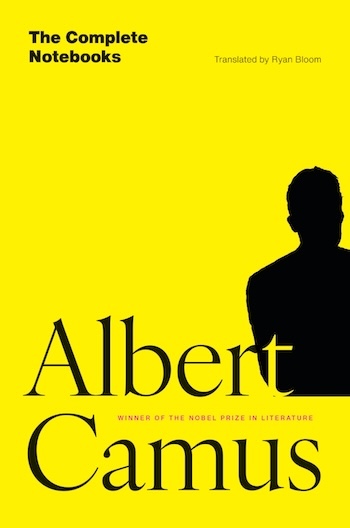
The Complete Notebooks of Albert Camus, translated by Ryan Bloom. University of Chicago Press, 704 pages, $45.
 In 1959, a year after winning the Nobel Prize for Literature, French writer Albert Camus (1913–1960) wrote: “At 22, unless one is a genius, one scarcely knows how to write.” Camus was looking back at his youth when he made that statement, but there is no false modesty here. As evidenced by this newly published single edition of his notebooks, he was being true to himself.
An important way to make reading Camus’s novels, stories, or essays more satisfying is to peruse this long but rewarding book. The writer considered his notebooks — a 700-page volume, many entries consisting of single sentences or paragraphs with occasional lengthy reflections — a key to understanding his artistry. He began creating them in his early 20s; he may not have considered himself a “genius” at the time, but Camus knew he needed to put down these brusque meditations as a way to explore his wealth of ideas. As he matured and became a literary celebrity, the notebooks became the place where he could turn for solace or reassurance. He wasn’t happy to pay the price of celebrity. After learning he had won the Nobel Prize, Camus experienced panic attacks: “[I’m] frightened by what’s happening to me, what I didn’t ask for,” he wrote.
During his short lifespan of 47 years — Camus died in an automobile accident in 1960 — he published plays, novels, short stories, journalism, and philosophical tracts. From the start, he intended his notebooks to be published and directed a secretary to type them up. He edited several early volumes, ever self-conscious about what this form of expression said about his talents and development as a writer. The notebooks contain conversations he heard on the street, reflections on his travels, and drafts of passages for his fiction that he’d later import, verbatim, into his books. Nothing went to waste.
The notebooks reveal Camus to be a voracious reader. There are snippets of material copied down from other writers — Herman Melville, William Faulkner, André Gide, Goethe, and Nietzsche — and notations on how these passages affected his thinking and helped him formulate his ideas about rebellion. He was affected by tuberculosis — it kept him from serving in World War II — and compensated by pushing himself feverishly to produce. He drew inspiration from this line by Nietzsche: “Within a superabundance of life-giving and restoring forces, even misfortunes have a sun-like glow and engender their own consolation.”
While Camus’s notebooks are highly personal, they are not confessional. He grew up in poverty in Mondovi, Algeria, but he does not mention his deadbeat father, who left the family in dire straits. Nor does he share his thoughts about his illiterate mother, who raised him. During World War II, Camus joined the French Resistance, but he does not describe his associations with those who fought alongside him against the Nazi occupiers. He does not include drafts of the numerous (mostly unsigned) editorials he wrote for Combat, the Resistance newspaper (these can be found in Camus at Combat: Writing 1944–1947). There are also no mentions of his role as editor in chief of that clandestine publication.
Lack of autobiographical and journalistic detail aside, what one does find in the notebooks are examples of the commandingly lyrical quality of his prose. Many entries celebrate physical and spiritual love. That said, readers seeking juicy tidbits about Camus’s romantic life will be disappointed: he does not kiss and tell. We know from biographies that he was married twice (first to actress Simone Hié and then to pianist Francine Faure) and that he pursued extramarital affairs. These erotic liaisons remain private: there are no descriptions of Camus’s assignations, though hints appear here and there. Consider this notebook entry from 1937: “How unbearable, for women, is the tenderness which a man can give them without love. For men, how bittersweet this is.” In another entry, Camus writes: “Late roses in the cloister of Santa Maria Novella, and the women on a Sunday morning in Florence. Their uncorseted breasts, their eyes and lips leave you with a beating heart, a dry mouth, and glowing loins.”
One of Camus’s early essays is entitled “Love of Life,” which expounds on the line “There is no love of life without despair of life.” The notebook supplies many intense observations based on this existential paradox — fleeting perceptions of nature, society, and existence. He frequently jots down intoxicating sensations: “In September, the carob trees breathe a scent of love over all Algiers,” Camus wrote in 1938, “and it is as if the whole earth were resting after having given itself to the sun, its belly still moist with almost-flavored seed.”
The Complete Notebooks of Albert Camus is saddled with a cumbersome design — translator Ryan Bloom’s numerous footnotes are printed in irritatingly small type. But that is a small price to pay for an important addition to Camus’s canon, as it sheds light on the painstaking efforts of a major writer of the 20th century to archive his thoughts, his struggle to make his vision clear, his prose lucid.
“Every summer morning on the beach feels like the first morning of the world,” Camus wrote in 1941, when World War II was raging, “and every evening like its solemn ending. Evenings on the sea know no restraint. The sunbaked days on the sand dunes were overwhelming.… you feel drunk after walking a hundred yards along the burning sand.… The terrible innocence of games on the beach and bare bodies in the bounding light.”
He knew only too keenly that a “slimy universe of pain” was all around him, but Camus remained determined to celebrate life, infinitely grateful — even though it was an awful burden — to pursue truth through writing dedicated to upholding personal and collective liberation.
“To be able to write,” Camus wrote. “I have been happy for a whole week.”
Robert Israel, an Arts Fuse contributor since 2013, can be reached at risrael_97@yahoo.com.