
Concert Review: David Byrne’s Boch Wang Show Mingles Spectacle with Connection
By Paul Robicheau
At a time when the world’s aflame, David Byrne ignited creative camaraderie and delivered a dazzling experience that lingers in mind and spirit.
David Byrne at the Boch Wang Theatre. Photo: Paul Robicheau
Anyone who caught David Byrne’s wondrous American Utopia show in its pre-Broadway run at the Emerson Colonial Theatre in 2019 (Arts Fuse review) — or the concert tour that provided its premise the year before — clearly wasn’t surprised by the wireless prancing of musicians across the Boch Center Wang Theatre stage this past weekend.
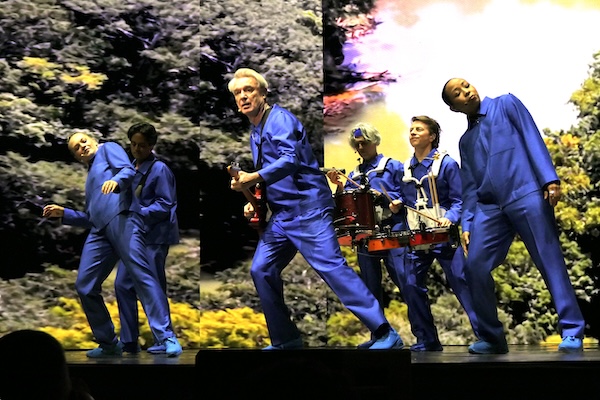
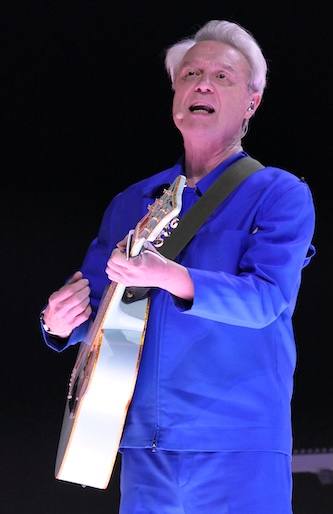
At the heart of the action was Byrne, at a youthful 73, leading his ensemble of seven players and five singer/dancers, all snaking, posing, and pausing through communal, choreographed movements. A few of them, including musical director/percussionist Mauro Refosco, were American Utopia returnees.
David Byrne at the Boch Wang Theatre. Photo: Paul Robicheau
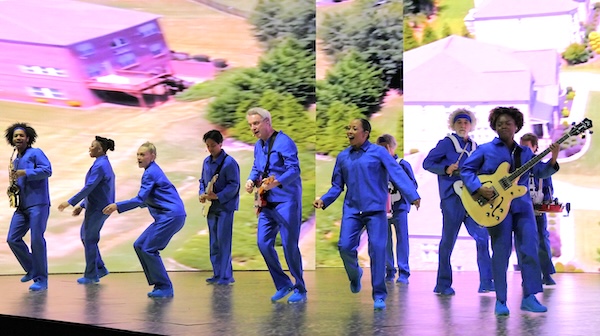
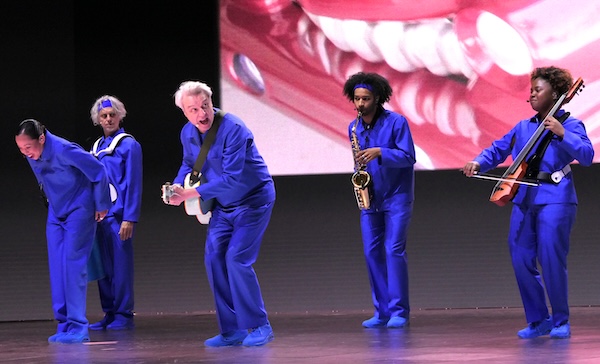
However, whereas the American Utopia troupe wore gray suits within three walls of hanging chains, this group sported royal blue outfits set against video projections and bold colors writ large on three surrounding screens. At times, the stage even reflected the visuals, casting a 3D box that popped with broader possibilities. That was even an advantage for balcony viewers when dancers appeared to be floating in green-screen space, literally atop rushing-water footage in “Slippery People.”
Granted, nearly everybody at the Wang was up and dancing not long into Friday’s transcendent 100-minute show (part of Byrne’s practically sold-out three-night stand), especially when he dropped one of 10 tunes from his former band Talking Heads. Even if the show operated as a dance-conscious theater production as much as a concert, it was about his music, including five songs from the charmingly offbeat new album Who is the Sky? that were also woven through the 21-song set.
The show built slowly, starting with Talking Heads’ contemplative “Heaven,” Byrne backed only by synthesizer, electric cello, and violin, a stripped-back opening similar to how he began that band’s famous Stop Making Sense tour/film with a solo “Psycho Killer.” That first hit materialized late in the show, performed on tour for the first time in decades, as an intense escalation of sparse musical juxtaposition. But that could be said for the approach to much of the night’s music, as the untethered musicians locked into elemental parts on portable instruments, particularly the four percussionists who combined to fill in rhythms like a New Orleans second line or marching band.
In turn, the visuals in the first half leaned toward a more traditional patchwork, like videos of New York City streets in the new “Everybody Laughs” (where Byrne and company observed “Everybody’s goin’ through garbage, lookin’ for inspiration”) and the early, red-hued Heads infusion “Houses in Motion,” accompanied by spookily blurred street lights. A new song about T-shirts posted crowd-cheered slogans like “Well-behaved women seldom make history,” “Make America Gay Again,” “No Kings,” and “Boston Kicks Ass.”
David Byrne at the Boch Wang Theatre. Photo: Paul Robicheau
A photo of a vacant store oddly backed “(Nothing But) Flowers,” a buoyant tune given a somewhat tepid delivery. But love song “This Must Be the Place (Naïve Melody)” — here set in a misty forest rather than the lamp-lit darkness as in Stop Making Sense — proved a masterstroke aided by choreographer Steven Hoggett. Byrne used one hand to spin bassist Kely Pinheiro like a mannequin as each singer/dancer paired with an instrumentalist, eventually resting their heads on shoulders. When they sang “And you’ll love me ’til my heart stops,” the stage went black for effect. That was also among a few songs where keyboardist Daniel Mintseris wove eerie synth lines that nodded to the late Bernie Worrell, and each musician earned their own musical and/or visual breaks through the show.
Solid colors eventually broke up the onscreen palette a bit too much with bright white or orange light, though show and lighting designer Rob Sinclair saved his most striking work for the second half. The performers’ first names moved about the backdrop of a starlit sky like magnets on a fridge to match their shifting positions onstage in “Independence Day,” a song from Byrne’s 1989 solo debut Rei Momo refashioned into a country tune with a thumping beat and Ray Suen on fiddle. And the water-washed “Slippery People” featured a babble rap breakdown by Byrne.
David Byrne at the Boch Wang Theatre. Photo: Paul Robicheau
For the new “My Apartment Is My Friend,” the singer invited the audience into a panoramic view of the lofty city space where he spent the pandemic alone, before the set rounded out on a more topical note. The band oddly performed a cover of Paramore’s “Hard Times” (whose front woman Hayley Williams made a cameo on Who Is the Sky?) to a black-and-white view of the same apartment, its tone decidedly upbeat despite such lyrics as “I still don’t know how I even survive.”
And the set came to a closing climax with “Life During Wartime” (timely lines like “This ain’t no fooling around” eventually giving way to a jarring collage of current street demonstrations) and “Once in a Lifetime,” which likewise broke from a solid backdrop into a kaleidoscopic orange barrage of rolling static lines that sharply contrasted with the strobe-flashed blue suits of performers across the stage front.
“This world can be very confusing, cynical — terrible times,” Byrne returned to tell the crowd in one of his commentaries (fewer than in the narrated American Utopia). “In spite of all that, as people, we love being together.” And with that, the band encored with a gospel-styled “Everybody’s Coming to My House” (singing “I’m never gonna be alone”) and the Heads rave-up “Burning Down the House,” afloat again in fiery orange. At a time when the world’s aflame, a night in Byrne’s house ignited creative camaraderie and delivered a dazzling experience that lingers in mind and spirit — well worth the trip beyond Utopia.
Paul Robicheau served more than 20 years as contributing editor for music at the Improper Bostonian in addition to writing and photography for The Boston Globe, Rolling Stone, and many other publications. He was also the founding arts editor of Boston Metro.