
Opera Album Review: In a New Recording, Faust Is Damned Again — Early-Modernist Style
By Ralph P. Locke
Ferruccio Busoni’s century-old (or -young) Doktor Faust, inspired by Christopher Marlowe and other pre-Goethe sources, offers a fascinatingly hellish ride.
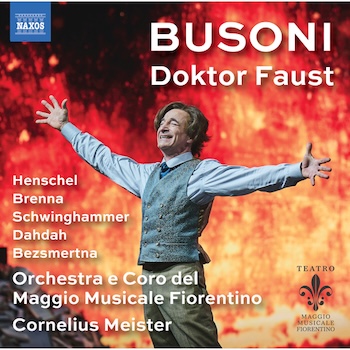
Doktor Faust, Ferruccio Busoni
Dietrich Henschel (Faust), Daniel Brenna (Mephistopheles), Wilhelm Schwinghammer (Wagner & Master of Ceremonies), Joseph Dahdah (Duke of Parma & A Soldier), Olga Bezsmertna (Duchess of Parma), and others.
Chorus and Orchestra of the Maggio Musicale Fiorentino, cond. Cornelius Meister.
Naxos 660531-33 [3 CDs] 157 minutes.
 Some operas float around the edges of the repertory because they are peculiar or problematic, and require special advocacy. That’s certainly the case with Ferruccio Busoni’s Doktor Faust, a work about all kinds of Faustian themes—notably the human desire for love and the equally human striving for knowledge and power—that the great pianist, composer, essayist, and teacher thought of as his magnum opus but left unfinished, after eight years of work on it, when he died in 1924 at age 56. Within a year of his death, it began making the rounds of numerous German theaters in a version completed by his student Philipp Jarnach.
Recordings of an unstaged 1959 London performance of the Busoni work have circulated on several labels and give a good sense of how engaging the work can be, though the more complete of the two recordings excised two important passages and the other edited the work down to less than half its length: 74 minutes. The conductor on those recordings is Adrian Boult, and the remarkable singers include Dietrich Fischer-Dieskau, Richard Lewis, and Heather Harper, all in superb early-career form.
In 1982, Antony Beaumont wrote a new completion that helped the work gain new attention. A recording conducted by Kent Nagano, and starring Dietrich Henschel, offered the work with both completers’ final scenes, so the listener can choose which one to listen to. I found that recording inert, on the whole, as did Stephen Chakwin in American Record Guide (May/June 2000). There was also a recording conducted by Tomáš Netopil, with fine singers, that solved the problem of the final scene by condensing it greatly.
Here we have a new recording of the Jarnach version, again featuring Dietrich Henschel. To judge by photos in the booklet and a video trailer, and a somewhat brief review by Alan Altman of the DVD release of the same recording (American Record Guide, July/August 2024), the production was imaginative, playing with questions of identity by having the characters often hold up a photo of Busoni in front of their faces.
(The DVD is Dynamic 37998; the BluRay: 57998. YouTube also has a video of Doktor Faust from Zurich, starring Thomas Hampson, staged in a more traditional manner and superbly sung.)
The conductor this time around is Cornelius Meister, whose work in recordings of other operas I have found very effective (Henze’s Der Prinz von Homburg, and two one-acters by Martinu). I was equally impressed by his recording of a Dvořák dramatic cantata, The Spectre’s Bride.
Busoni’s Doktor Faust is, in no matter what version, a strange and challenging one. It begins and ends with long spoken passages by the Poet, which is to say Busoni, since he wrote the libretto himself, basing it, not on Goethe’s two Faust plays, but on earlier treatments of the story, including puppet plays and Christopher Marlowe’s famous drama Doctor Faustus. We get only a glancing reference to Gretchen and her brother Valentin, but there’s a long scene involving the Duke and Duchess of Parma, plus their Master of Ceremonies. The latter role is sung here by the same bass who sang the role of Wagner, Faust’s student, in the opera’s first scene. Several other roles in the work are likewise assigned to a single singer (perhaps by the composer, though this isn’t explained), suggesting parallels between them, at least in the fevered mind of the main protagonist. (Perhaps Thomas Mann had caught a whiff of Busoni’s opera, by reading a review of a performance: his dark, disturbing novel Doktor Faustus, like the Busoni, draws on the original Volksbuch version of the Faust legend and on elements from Marlowe’s play.)
The musical style is, in one sense, immensely varied, including a Gregorian-chant-like melody in the opening Symphonia (depicting Easter and springtime), a polonaise-style cortège in the scene in the court of Parma, and a five-minute “symphonic intermezzo” in sarabande rhythm. The Polonaise and Sarabande have sometimes been recorded on their own, in reverse order, as “Two Studies from Doktor Faust” — for example, as extra works in the history-making 1969 2-LP set (still available in other formats) containing Busoni’s mammoth piano concerto, with soloist John Ogdon and conductor Daniell Ravenaugh.
In another sense, though, there is a grayness to the work: the vocal lines leap about in ways that allow the text to be heard clearly but rarely coalesce into memorable melodies. The harmonic language fluctuates between tonality and a free atonality familiar from the works of Schoenberg before he developed the twelve-tone method.
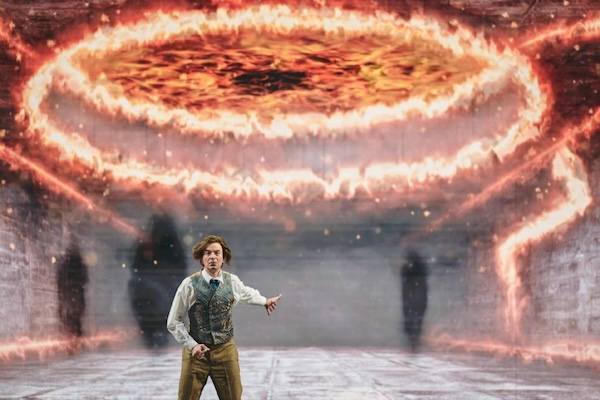
A scene from the Teatro del Maggio Musicale Fiorentino production of Doktor Faust. Photo: Michele Monasta
All of this requires a committed performance in order to come across effectively and, fortunately, that’s what it gets here. Baritone Henschel sounds much more involved than in the recording conducted by Nagano, and tenors Joseph Dahdah (from Lebanon) and Daniel Brenna (a Wagnerian tenor from the US) and bass Wilhelm Schwinghammer are smooth and characterful in their respective roles. Olga Bezsmertna, from Ukraine, as the Duchess of Parma, provides the one bit of feminine relief to the ear in a cast consisting otherwise entirely of men. She is less gloriously at ease than Heather Harper (in the Boult recording) but greatly preferable to Hildegard Hillebrecht (in a studio recording with Fischer-Dieskau, conducted by Ferdinand Leitner, first released in 1970).
The booklet offers a somewhat dense essay translated from Italian and an excellent synopsis (with track numbers—hooray!). For the sake of people who are listening by means of streaming or digital download, these items can also be found on the Naxos website. A libretto in German and good English can likewise be found on the website.
The essay should have explained in more detail what decisions were made in this production. For example, the opening words of the Poet are spoken by a series of male and female voices, disturbingly off-mic, while a pianist is heard in the echoey distance playing some music that it took me a while to recognize as Liszt’s Paganini Etude known as “La Campanella.” Who made this decision, and what is it meant to imply?
Oh well, the main thing is that this curate’s egg of an opera is available in a new performance, with a fine new cast (the recordings seem to come out every decade or so), and it is cogently conducted. We can each now decide how much effort we want to put into getting to know it, how much to admire it as a major achievement by a distinctive figure in European musical life, how much to bewail the fact that Busoni did not live to complete it himself, and how much to admit that it was probably never going to be the great artistic triumph of which he dreamed.
Ralph P. Locke is emeritus professor of musicology at the University of Rochester’s Eastman School of Music and Senior Editor of the Eastman Studies in Music book series (University of Rochester Press), which has published over 200 titles over the past thirty years. Six of his articles have won the ASCAP-Deems Taylor Award for excellence in writing about music. His most recent two books are Musical Exoticism: Images and Reflections and Music and the Exotic from the Renaissance to Mozart (both Cambridge University Press). Both are now available in paperback; the second, also as an e-book. Locke also contributes to American Record Guide and to the online arts-magazines New York Arts, Opera Today, The Boston Musical Intelligencer, Classical Voice North America. His articles have appeared in major scholarly journals, in Oxford Music Online (Grove Dictionary), and in the program books of major opera houses, e.g., Santa Fe (New Mexico), Wexford (Ireland), Glyndebourne, Covent Garden, and the Bavarian State Opera (Munich). The present review first appeared in American Record Guide and is included here, lightly revised, by kind permission.
Tagged: "Doktor Faust", Chorus and Orchestra of the Maggio Musicale Fiorentino, Cornelius Meister, Daniel Brenna, Dietrich Henschel, Ferruccio Busconi, Naxos, Olga Bezsmertna