
Film Review: “Bitter Christmas” — Seven Characters in Search of a Screenplay
By Peter Keough
The pain of others is a gift to filmmakers in Pedro Almodóvar’s latest film.
Bitter Christmas. Directed by Pedro Almodóvar. At the Alamo Drafthouse on November 24 and in the suburbs.

From left: Bárbara Lennie and Victoria Luengo in Bitter Christmas. Photo: Cannes Film Festival
Pedro Almodóvar has reached the point in his career where he wonders whether the years of parasitically drawing on his life and the lives of others to create his fictions have been worth the sacrifice. He explored this dilemma before in his masterful Pain and Glory (2019), which seemed like an elegant and conclusive exorcism of his guilt and regret. Here, as in that earlier film, he uses the film-within-a-film device both to approach the theme and to distance himself from it.
And then some: not only is this a film about a frustrated filmmaker trying to make a film, but the film he’s making is about a former filmmaker who might herself be inclined to make another film. The two narratives blur into one another, and the result can seem like the cinematic equivalent of the M. C. Escher lithograph Drawing Hands. At a certain point, one longs for the relative straightforwardness of a raunchy farce like Women on the Verge of a Nervous Breakdown (1988) or a generic gem like The Skin I Live In (2011).
Film #1 begins ominously in 2004 on a dark and stormy night that triggers an agonizing migraine for Elsa (Bárbara Lennie), a former filmmaker turned successful commercial director. She asks her lover, Bonifacio, a.k.a. Beau (Patrick Criado), a firefighter and part-time stripper, to take her to the ER. Cut abruptly to 2026 and film #2, where Raúl (Leonardo Sbaraglia), a renowned auteur in a rut, hammers out the screenplay for the preceding scene on his laptop. And so it goes with sometimes metronomic regularity as the connections between the two stories and their characters grow stronger and threaten to explode into melodrama.
Back in 2026, Raúl’s work on the new screenplay meets with obstacles. Mónica, his dedicated assistant for the past two decades, is resigning to help out a friend whose son is suffering from a serious illness. She tells Raúl he can entrust her duties to his faithful live-in boyfriend, Santi (Quim Gutiérrez), whose long-suffering devotion seems to be a model for Elsa’s Beau. Santi caters to Raúl’s many mental health complaints, which appear to serve as a template for Elsa’s migraines and panic attacks. These, she tells her psychiatrist, have been brought on by the anniversary of her mother’s death. Not so coincidentally, Raúl’s mother died in the year in which his movie is set—a tragedy that triggered his own ongoing psychological and creative crisis.
To mitigate Elsa’s misery, her shrink offers her tranquilizers (the film’s drug of choice) and advises her to take a vacation. Elsa readily agrees and takes a villa on Lanzarote in the Canary Islands, significantly leaving behind the ever-servile Beau, about whom she has said, “at some point I am going to make him suffer.” Now she no longer needs the boy toy’s doting companionship, as the beauty and tranquility of the surroundings leave her anxious to start making movies again. All she needs is a story.
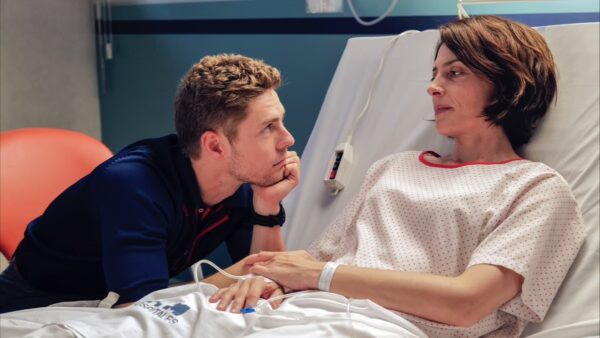
Patrick Criado, left, and Bárbara Lennie in a scene from Bitter Christmas. Photo: Sony Pictures Classics
So does Raúl, and both characters find one in someone else’s misfortune. In a telling scene, Raúl exits a screening of Peeping Tom (1960), Michael Powell’s unsparing allegory of the sadistic nature of cinema, and takes a call from Mónica, who tells him that her friend’s son has died. You can see the wheels spinning as Raúl offers his condolences while doubtless trying to figure out how this development might jump-start his screenplay.
Though a film about writing the rough draft of a screenplay is in danger of resembling a rough draft itself, Bitter Christmas taps into enough of Almodóvar’s strengths to nearly overcome this sketchiness. One of these strengths is his love of the music of Chavela Vargas, whose classic song inspired the film’s title. If nothing else, the film is as much a tribute to the late Latin American chanteuse as is the 2017 documentary Chavela, in which Almodóvar appears. Renditions of her songs “Las simples cosas” and “La Llorona” lie at the heart of two of the movie’s most affecting moments. And, though most scenes take place in sleek, stylish interiors that verge on the claustrophobic, Almodóvar at times breaks up this tasteful sameness with a stunning exterior shot that combines the sublime and the absurd. In one aerial shot, two tiny, gaily colored blankets on the black sand of a Lanzarote beach look like postage stamps on an album page.
Raúl’s cavalier theft of his friend’s most intimate experiences inevitably backfires. Though Mónica’s rage at his betrayal at first comes off as an overreaction, her assessment of the screenplay’s moral failings is witheringly accurate—and applicable, to a certain extent, to the movie as a whole. Raúl admits she is his best critic. Undaunted, he takes the rejection as a reason to return feverishly to his laptop. One suspects that Almodóvar will do so as well.
Peter Keough writes about film and other topics and has contributed to numerous publications. He was the film editor of the Boston Phoenix from 1989 to its demise in 2013 and has edited three books on film, including Kathryn Bigelow: Interviews (University Press of Mississippi, 2013) and For Kids of All Ages: The National Society of Film Critics on Children’s Movies (Rowman & Littlefield, 2019).
Tagged: "Bitter Christmas", Bárbara Lennie, Chavela Vargas, Film within a film, Leonardo Sbaraglia, Pedro Almodovar, autofiction