
Film Review: “Zi” — Kogonada Gets Lost in Hong Kong
By Noah Goldstein
Zi, directed by Kogonada. Screening at the Brattle Theatre in Cambridge through November 24.
Michelle Mao, Haley Lu Richardson, and Jin Ha bring chemistry to a visually beguiling but narratively adrift experiment in memory and time.
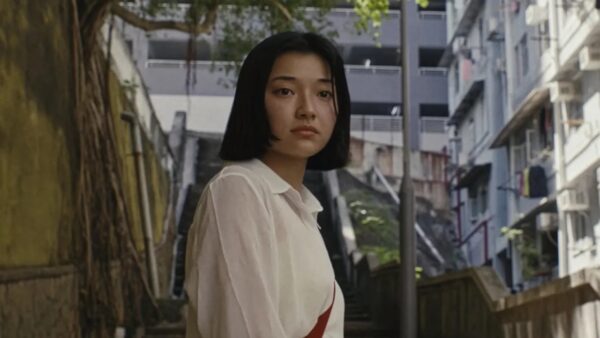
Michelle Mao in Zi by Kogonada. Photo: courtesy of Sundance Institute/ Benjamin Loeb
What’s a wayfaring indie darling to do after a studio job gone sour? For Kogonada, who broke out at Sundance in 2017 with Columbus but more recently stumbled with the Columbia-produced A Big Bold Beautiful Journey, the answer seems to be to buy a plane ticket to Hong Kong.
It’s in those zigzagging, clothesline-filled alleyways that Zi, the director’s return to low-budget filmmaking, unfolds—a film as perplexing as it is, at times, entrancing. Reportedly shot over three weeks with a skeleton crew and no real script (a fact that becomes apparent about 10 minutes in), it boasts visuals that are nuanced and often lovely to look at. The plot, however, is so underdeveloped that Zi would probably have been better off without one.
Such an impressionistic turn is relatively unsurprising for Kogonada, who originally gained prominence as a video essayist with a passion for deconstructing the works of virtuosos like Terrence Malick and Jean-Luc Godard. Clearly well-versed in all things cinematic, he gives us a titular protagonist, played by an amicably open-minded Michelle Mao, who is a professional violinist and seemingly evokes the leading lady in Agnès Varda’s Cléo from 5 to 7. Like Corinne Marchand’s singing starlet in that film, Zi anxiously waits to hear the possibly troubling results of recent medical tests. She likely has a tumor—one that, as we will find out, somehow distorts her perception of time—but for now she’s been left alone to wander aimlessly through her hometown’s winding streets.
Well, she might not be so alone. Everywhere she goes, Zi seems to be accompanied by visions of a future—or maybe past—self. Cinematographer Benjamin Loeb frames her from behind in tight, boxy handheld shots as she heads to her parents’ gravesite in the hope of setting herself straight, but frantic cuts between starkly contradictory angles make it abundantly clear that she just can’t shake this torment.
This anxiety, compounded by a fear of no longer being able to picture her parents’ faces as she stands at their final resting place, leads Zi to a breakdown. Luckily, a friendly stranger named Elle (Kogonada muse Haley Lu Richardson) happens by and tries to comfort her; unfortunately, we’ve seen her in a vision too, so her appearance offers scant narrative relief. Only after much convincing does Zi allow Elle to walk her home.
Unlike Richardson’s fully developed character in Columbus, whom she played with wonderful nuance, Elle is a shallow collection of backstories: born in Arizona, a failed dancer in New York, and now a Hong Kong expat who seemingly spends her days recording the city’s sounds on an iPod. The figure spends considerable time explaining all this, but the camera is more interested in a strange man who has been seen repeatedly looking down at Zi from above. We know the two will eventually meet, and they do when Elle drags her new friend to see someone who might help: her ex-boyfriend—and current stalker—Min (Jin Ha, Pachinko).
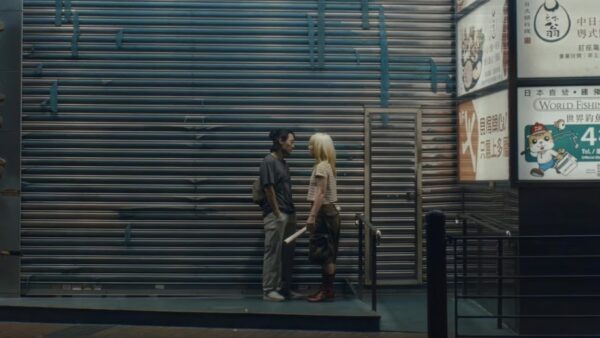
A scene from Zi. Photo: courtesy of Sundance Institute/ Benjamin Loeb
Min seems to know more than he’s willing to let on, but he does provide Zi a respite from anxiety as the trio decides to hit the streets, thus avoiding a discussion of the test results. The three attempt to move the minimal story forward in scenes that feel as if they were improvised; the upshot is a film that often plays more like a strange, unsatisfying crossover between a travel vlog and an experimental mood piece.
Still, a few silver linings save the film from being an outright disaster, making it more of a well-intentioned artistic misstep. Mao, Richardson, and Ha generate genuine chemistry, and their honest performances offer some satisfaction—even if that earnestness sometimes seems to stem from actors and characters alike having little idea what’s going on.
As the trio flounders through the former British colony, Zi‘s richly textured soundscape supplies the coherence its erratic narrative lacks. Sound designer Eugenio Battaglia deserves full credit for this: he blends breath and urban noise with some of Ryuichi Sakamoto’s most ethereal music — including original compositions. “The fusion binds the characters to surroundings that they otherwise seem to drift through.
The film is dedicated to Sakamoto, and it might have benefited more from his artful restraint. Sparse as its narrative is, the picture strains for significance, piling emphatic moments onto an ill-defined philosophy. Kogonada is plainly interested in memory—you’d be hard-pressed to find a festival-favorite auteur who isn’t—but gives that interest little compelling shape. Instead, the film’s emotional climaxes, from romantic tensions boiling over to an impromptu John Denver performance, insist so loudly on being felt that they leave little room for feeling.
Kogonada’s willingness to experiment after his foray into big-budget filmmaking is admirable, though a longer sabbatical might have helped him find a clearer direction. Still, his collaboration with Loeb retains the quiet attentiveness and striking imagery of their previous work. That merit offers reassurance that a better considered-follow-up will see the director back on form.
Noah Goldstein is a student at Tufts University pursuing a dual degree in Film and Media Studies and Cognitive Brain Sciences. He covers the film and music beats for the Tufts Daily and occasionally writes on sports.
Tagged: Benjamin Loeb, Eugenio Battaglia, Experimental Cinema, Haley Lu Richardson, Hong Kong, Independent film, Jin Ha, Kogonada, Michelle Mao, Ryuichi Sakamoto, film reviews