
Musician Interview: Daniel Lanois Talks Bob Dylan, Neil Young, and the Flea Market Find That Changed His Life
By Lauren Daley
From recording U2 in a castle to making music with Dylan in a kitchen, Daniel Lanois looks back on a life spent chasing extraordinary sounds.
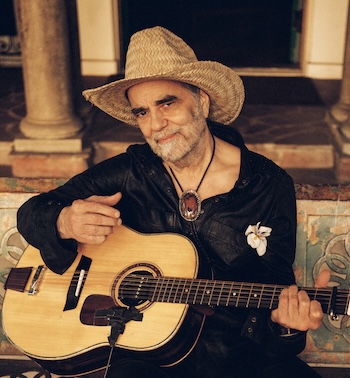
Daniel Lanois in Los Angeles, April 2026. Photo: Marthe A. Vannebo
When I reach Daniel Lanois, he’s in a Jeep Grand Wagoneer somewhere outside Boston, and he’s riding high.
“We’re doing a show tonight. We did one last night; it was a lot of fun. We got another tonight. My guitar playing’s gotten pretty good. My steel guitar playing even better,” Lanois tells me with a laugh. “So I’m feeling good. I’m in the saddle.”
With the acclaimed producer/musician in the Wagoneer are bandmates Jim Wilson (bass, vocals) and Jermaine Holmes (drums, vocals). They’ll pull into the Groton Hill Music Center in Groton on Nov. 15.
Together, the Daniel Lanois Trio “has got some grooves that make Barry White jealous,” Lanois, 75, tells me with a laugh.
In conversation, Lanois laughs easily. He sounds a little like fellow Canadian Neil Young when he talks. I’m not surprised when he tells me he and Neil are on the same wavelength.
“We’re both Canadian, so the humor was there,” he tells me of their work on Young’s Le Noise. “A lot of things didn’t have to be discussed — a side glance is enough.”
The seven-time Grammy winner and 15-time nominee is an auteur whose sound is as distinct as Wes Anderson’s visuals. You recognize a Lanois record within seconds: the haunted sound of Bob Dylan’s Time Out of Mind and Oh Mercy, and of Neil Young’s Le Noise.
The Le Noise film has the look of a Lanois track come to life — noir all day, moody, intense close-ups.
His records — Willie Nelson’s Teatro, U2’s The Joshua Tree, Emmylou Harris’ Wrecking Ball, and Peter Gabriel’s So, among them — bear his distinct fingerprints.
I’m no gamer, so when I stumbled upon the soundtrack for Rockstar Games’ Red Dead Redemption II (2018) — Lanois produced it and sang some tunes — I literally stopped in my tracks on a walk and stood on the side of the road, just listening.
It hit like Dylan’s Pat Garrett and Billy the Kid set in a ghost town.
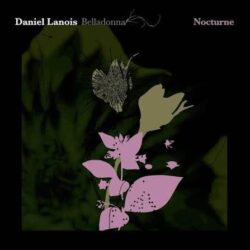
The Daniel Lanois Trio is touring now in support of Lanois’s moody new instrumental album, Belladonna Nocturne (2026), his 14th studio album, billed as a “thematic sequel” to his 2005 release Belladonna.
And then there is his recent work with Nelson’s son Micah Nelson, a guitar genius and producer also known as Particle Kid. The Ocean Floor is due out in February. The first single, “Even the Birds,” just dropped.
I called the Canadian Music Hall of Famer to talk about Dylan, Young, the Nelson family, recording with U2 in a castle, and more.
 Arts Fuse: First, I’m so excited about the news that you and Micah Nelson are teaming up. I love him. What sparked this collaboration?
Daniel Lanois: Well, the initial track was an email exchange for a little bit of fun, and it got somewhere pretty quick. Micah said, “Boy, I like what you’ve done. You’ve made it sound like the ocean floor.” I thought, “Well, that’s a great title for a song and an album.” [laughs] We just kept going. Micah is an outstanding talent.
AF: You must’ve known him since he was a kid, working with Willie.
Lanois: Yeah, it’s family business a little bit because I made a nice record with Willie, Teatro. I thought, “Well, I like those people.” To continue with the creative force there appealed to me. Micah has a fabulous imagination. We had a really nice exchange — philosophical, largely. I just like everything about him. He’s a special thinker and a great friend. I thought: Why don’t we make music together and see what happens?
AF: You’re touring now in support of Belladonna Nocturne.
Lanois: That’s largely about the more exotic instrumental part of what I do, which is always on the go, by the way. I’m in the recording studio all the time. Delights come my way unexpectedly all the time.
AF: I’m a huge Dylan nerd. I love both Time Out of Mind and Oh Mercy. But Time marked a major vibe shift for Dylan, ushering in the distinct sound of his next era: that haunted, old-man-in-a-dark-suit-with-a-cane vibe.
Lanois: We started Time Out of Mind in the Teatro in Oxnard, California. That’s why Willie Nelson’s record is called Teatro, by the way. It’s the name of a theater in a little town called Oxnard. Oxnard is an agricultural basin where a lot of the American strawberries come from. [laughs] We were hunkered down there for a while, about four or five years, in my shop, and I invited Bob Dylan to stop in. He loved Oxnard because nobody recognized him. The theater had been closed down for a long time, so we put some life back in it. Bob loved the fact that there were old movie posters in there. It was as if somebody had locked the door decades ago, and everything was still intact: the popcorn machine; you could get wax lips, licorice cigars, and Groucho Marx glasses out of the vending machine. I just fell in love with the place, and so did Bob. We did the beginnings of Time Out of Mind there. Then Bob said, “Well, Daniel, it came to me that we should record in Miami.”
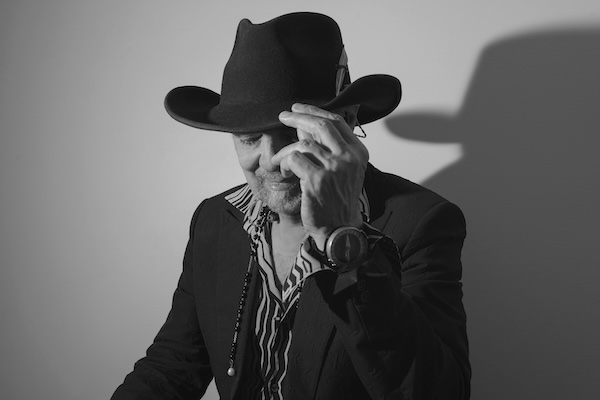
Daniel Lanois. Photo: Phil Crozier
AF: [laughs] Classic.
Lanois: I said, “Okay, Bob, that sounds great. Let’s go to Miami.” [laughs] I didn’t ask why, and it’s probably best not to. [laughs] But it was a fabulous gathering. Bob was very involved in inviting specific musicians. You want to talk about vibe — dripping in vibe.
I took responsibility to bring in the drummers. I brought in Brian Blade and Jim Keltner. I knew it was going to be a blues-based record, so I built myself a little insurance policy. I built some grooves, with a drummer friend of mine, that would likely fit the songs.
The reason I did that is, with the blues, you don’t want to be operating within the obvious clichés. You have to find something special. So I had about a dozen of these nice little grooves, drums and percussion, on half-inch tape, which gave me the flexibility to do varispeed if the tempo needed to be a little slower or faster.
Bob was not entirely hip to this, of course, and it’s probably best that he wasn’t. It was just a little insurance policy, or a little trick, or a reassurance, that we could get to one of those grooves — I knew that they were spot-on.
AF: That’s fascinating.
Lanois: But most importantly, Bob really delivered fantastic songs. We had a lot of huddles in the parking lot because he didn’t like to discuss plans in front of everybody. We’d slide out to the back of the parking lot and decide on time signature and keys and all that stuff.
That record has a lot of depth of field, to use a photographic term. Part of the reason is we had 11 people in the room. So if somebody’s far away, they sound far away.
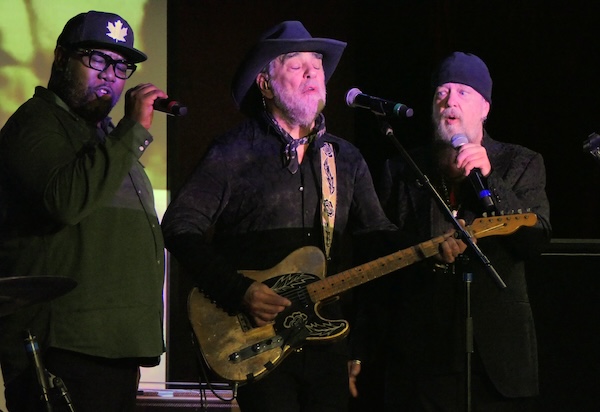
Jermaine Holmes, Daniel Lanois, and Jim Wilson at City Winery. Photo: Paul Robicheau
AF: One of my favorite tracks from those sessions, “Red River Shore,” ended up getting cut. That’s such a fantastic song.
Lanois: I don’t know. That was Bob’s choice. We’d cut that as a demo back in Oxnard. I was sad to see it go a little bit. Listen, man, you can only put so much on one album. But I’m glad it resurfaced on the extras records.
AF: It was first released in ’08 on The Bootleg Series Vol. 8. But it must’ve been amazing when the original record was nominated for a Grammy in 1998. You took your mom.
Lanois: I sure did take my mom to the Grammys. [laughs] My mom and I are backstage with Tony Bennett and Bob Dylan. I’m speaking with Bob about this and that; I look over, and Tony Bennett’s rubbing my mom’s feet. My mom was good-looking, and Tony’s Italian. What can I tell you? It made quite a splash back in Canada with her sisters. “He was rubbing your feet?!” But my mom had very nice feet, so there you go. No surprise.
AF: You first connected with Bob for Oh Mercy (1989). What was that record like for you? Bob wrote in Chronicles that it could get contentious.
Lanois: Well, it was a very private record. I appreciated that. I was hunkered down pretty well in New Orleans, so Bob was pleased to be stepping into an already-existing arena. He felt reassured for having stopped into [my] Neville Brothers session. He realized I had something going on that was unusual. He loved what he heard. He’s a fan of the Nevilles.
In fact, we cut a version of Bob’s “With God on Our Side,” and Bob loved their version.
He said, “Well, what do you think, Dan? You want to work together?” I said, “Sure. Why don’t you come back to New Orleans in the springtime? Don’t worry too much; just bring your songs and yourself.” I’d rented a beautiful house, and we made the record in the kitchen. [laughs]
AF: I love that you record in different places — an old theater, a castle, a barn, a kitchen.
Lanois: Well, there’s a term, “studio-itis.” People are comfortable in non-studio settings. What’s wrong with the kitchen? Everybody sounds good in the kitchen. Why would you leave? [laughs]
AF: With U2, you recorded at Slane Castle.
Lanois: Right on the River Boyne, where the Battle of the Boyne was fought, so it was a historically significant place and a beautiful setting. We had a connection with Lord Henry Mountcharles, the owner of the castle. He said, “Yeah, come on in.” So we all lived in the castle and made a record. Not bad, eh?
AF: We were talking about bootlegs earlier — what did you think of the ’23 release, The Bootleg Series Vol. 17: Fragments – Time Out of Mind Sessions?
Lanois: Let me put it to you this way: I got a call from Wen Wenders, a German filmmaker. He said, “Dan, I got the remix of Time Out of Mind, and my heart just sank. Why would anybody even consider revisiting a classic? It’s not fair to anybody.”
And the only thing I can say is, I think Bob had sold his catalog by then, and whoever owned the catalog decided: We better get our money back. I say that diplomatically. When music falls into the hands of lawyers and accountants, you might get something like it happening. OK? Diplomatically put.
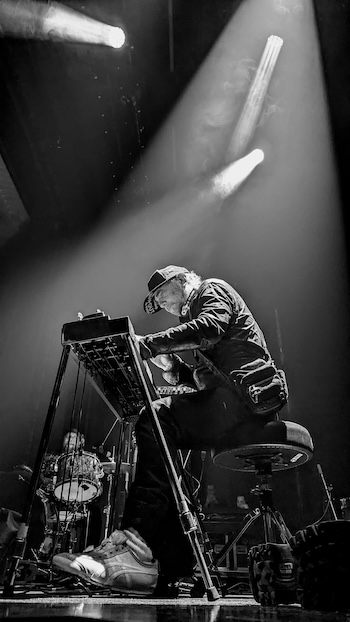
Daniel Lanois. Photo: courtesy of the artist
AF: What sparked the Neil Young album and music film Le Noise?
Lanois: Neil called me. I was making films in those days with a friend, Adam Vollick. Neil said, “Dan, would you record me doing 10 acoustic songs, but film me?” I said, “Okay, no problem.” We talked about maybe going to Taos. I said, “Well, why don’t you stop in at my little hacienda in LA and see how it goes?” He waltzed in, fell in love with the setup, and we never went to New Mexico. [laughs]
AF: You’ve loved production since you were a kid. Tell me a bit about your childhood in Canada and your early love for music.
Lanois: I fell in love with music at 9. I wanted to play the clarinet and couldn’t afford it, so I bought a $1 penny whistle, and that was it: the beginning of the avalanche.
I never played sports. I found my way into a fascinating, mysterious world by developing my own skills as a player, but more importantly, by expanding my imagination.
I was by myself a lot as a kid. My mom was [a] single mom, working, so I took to the whistle and never looked back. Then came the little flea market tape recorder. It came with a spool of tape, microphone, speakers, everything, in one little box. I plugged it into the wall and pushed “Record.” I wound back and played it—and there it was. I thought, “That’s it. That’s going to be me.”
I never knew what a record producer was. I still don’t know what that means. Listen, man, I’ve been called a lot of things—including that—and I didn’t mind being called anything as long as I was doing beautiful work, helping people, and hopefully making masterpieces.
Interview has been edited and condensed. Lauren Daley is a freelance culture writer. She can be reached at [email protected]. She tweets @laurendaley1 and Instagrams at @laurendaley1.
Tagged: Belladonna Nocturne, Bob-Dylan, Brian Eno, Daniel Lanois, Daniel Lanois Trio, Emmylou Harris, Grammy Awards, Groton, Groton Hill Music Center, Le Noise, Massachusetts, Micah Nelson, Neil Young, Oh Mercy, Particle Kid, Peter Gabriel, Red Dead Redemption II, Soy Bomb, Teatro, The Ocean Floor, Time Out of Mind, U2, music interviews, music production