Book Review: Marina Abramović — The Art of Remembering
By Margherita Artoni
In Long Life, Short Stories, Marina Abramović turns memories, images, and personal histories into an exploration of identity—and of how a life becomes art.
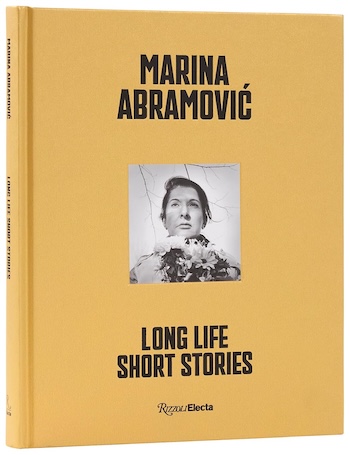
Marina Abramović: Long Life, Short Stories by Marina Abramović. Rizzoli Electa, 224 pages.
Few artists have bound life and art as tightly as Marina Abramović. For more than five decades, she has made the body an instrument of endurance, vulnerability, and confrontation, testing the boundaries between performer and spectator. In Long Life, Short Stories, she revisits that relationship through memories, images, and drawings gathered into a personal archive. The book asks a question central to her practice: what remains when an experience ends, and how does remembering it shape the person who lived it?
Early in the volume, Mexican artist Hugo Huerta Martin describes it as “a kind of diary.” Its fragments preserve individual moments without forcing them into a continuous chronology. Yet remembering is never simply an act of preservation: it always involves selection and interpretation. To give an experience verbal or visual form is already to transform it. The diary becomes an instrument of self-representation—a space in which Abramović can revisit, and revise, the relationship between her life and her artistic identity.
This process extends a central tension in Abramović’s practice: the relationship between presence and representation. In Rhythm 0 (1974), she placed her body at the audience’s disposal, probing the potential for violence when spectators were given power over a passive performer. In Balkan Baroque (1997), her repeated cleaning of bloodied bones became a meditation on war, collective memory, and historical responsibility. In The Artist Is Present (2010), sustained eye contact made attention itself the focus of an encounter. These works unfolded through duration, bodily presence, and the presence of others. A book, by contrast, deals with the absence of encounter. Its images and narratives cannot recover the event, but they can reshape its meaning. Long Life, Short Stories thus turns from the immediacy of experience to the work of remembrance: shaping what survives.
Abramović’s work belongs to a broader history of performance art in which bodily exposure carries ethical stakes. Yoko Ono’s Cut Piece (1964) tested the relationship between audience participation and vulnerability. Chris Burden’s Shoot (1971) confronted viewers with the implications of witnessing physical danger. Gina Pane explored pain as both bodily experience and cultural expression, while Tehching Hsieh made duration and self-imposed discipline the substance of his performances. Despite the differences among them, these practices made the body a site where artistic form meets social responsibility. Within this history, Abramović has made endurance, attention, and exposure the defining features of her work.
Understandably, the visual material in Long Life, Short Stories shifts the focus from the performing body to the artist’s image. The cover features Portrait with Flowers (2009), a photograph by Marco Anelli, making portraiture the threshold to a book about memory and personal experience. The flowers invite associations with beauty, transience, and mortality. More fundamentally, the photograph crystallizes a tension: an artist known for testing the limits of physical presence appears in a medium that fixes her image for posterity.
The Hero (2001) gives remembrance a personal and historical dimension. A tribute to Abramović’s father, Vojo, a wartime national hero, the work connects family history with public narratives of courage and sacrifice. Its title frames a father as both an intimate figure and a collective ideal. Within a volume devoted to recollection, the work suggests that self-representation involves remembering not only one’s own life but also the people and histories that shaped it.
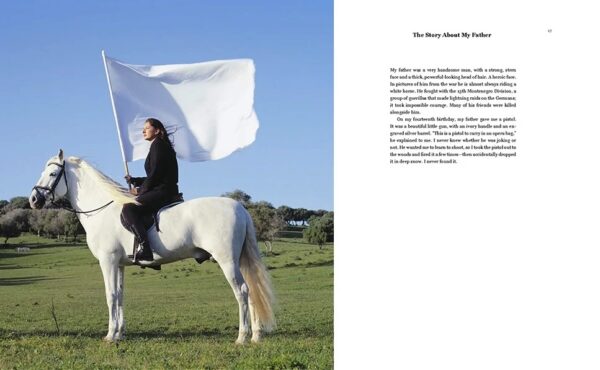
Pages from Long Life, Short Stories. Photo: Rizzoli Electa
A different register emerges in Portrait with Maracas (2006). Abramović appears between two maracas decorated with skulls, placing her image within a symbolic field of rhythm and mortality. These objects complicate our perception of the artist, presenting identity as something constructed through symbols and props. Delusional Theatrical Performance (1994) raises a related question through its title: when does self-presentation become staging? Together, these works suggest that the book’s images do more than illustrate its stories: they help construct the self those stories recall.
Art historian Kristine Stiles’s 2008 essay “Cloud with Its Shadow: Marina Abramović” examines the relationship between the artist’s biography and her practice. This relationship offers a useful framework for reading Long Life, Short Stories: personal history acquires artistic significance not simply by being recounted, but by being given form. Retrospective narration selects, arranges, and interprets lived experience. The diary thus becomes another medium through which Abramović transforms life into art.
Amelia Jones complicates this relationship in her 2011 article “‘The Artist Is Present’: Artistic Re-Enactments and the Impossibility of Presence,” which questions the assumption that performance offers unmediated access to an authentic self. Even an apparently direct encounter requires interpretation; presence does not guarantee transparency. Long Life, Short Stories introduces a further layer of mediation, filtering experience through retrospective narration. Its archive preserves traces of the past while reshaping how they can be encountered.
The book’s artistic significance lies in how it explores this tension between preservation and reconstruction. For an artist whose performances depend on presence and duration, the diary gives fleeting experiences a lasting, if altered, form. Remembering becomes not merely a source of material for art, but an artistic act in its own right. The performing body returns as image and narrative—not to reproduce the original experience, but to shape its afterlife.
Margherita Artoni is a contemporary art critic and curator working between Italy and the United States. She began her career collaborating with Flash Art and currently writes for Segno, Juliet, Artribune, Exibart, Inside Art, ArteIN, part of cult(ure), The Arts Fuse, and Whitehot Magazine.
She has directed galleries in Turin — including NEOCHROME and EDGE Art Space — and in New York at TEAM Gallery. Her curatorial work has included exhibition programs with international artists such as Rashid Johnson, Theaster Gates, Ali Banisadr, Angel Otero, Tim Rollins & K.O.S., Laura Owens, and Mika Tajima.
Tagged: Long Life Short Stories, Margherita Artoni, Marina Abramović, Performance Art, art books, autobiography, book review, contemporary art, memory and identity, portraiture