
Classical Album Review: The NSO Makes a Stirring Case for William Grant Still
By Jonathan Blumhofer
Gianandrea Noseda leads sumptuous, finely wrought accounts of the composer’s Second and Fourth Symphonies, revealing music that deserves a wider hearing.
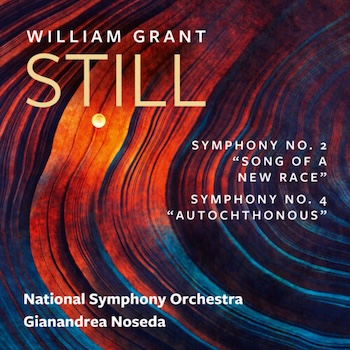 The shameful gutting of the Kennedy Center by the Trump administration means that the National Symphony Orchestra is, at present, homeless. But thankfully—miraculously, even—the institution has lived to see another season. What’s more, the ensemble continues releasing recordings on its in-house label. The latest, a pairing of two William Grant Still symphonies, marks a high point in the group’s ongoing advocacy for neglected 20th-century American composers.
While Still was recognized as the country’s preeminent Black symphonist during his long lifetime (he died at 83 in 1978), posthumously, he’s been more of a footnote than a presence on concert programs. That omission is hardly explainable on the merits of his music, which is, as a rule, as engaging as it is well written. One can only hope that the NSO’s finely wrought accounts of Still’s Symphonies Nos. 2 and 4 with music director Gianandrea Noseda can help rectify this imbalance.
True, No. 2 has its quirks, most notably a four-movement structure that includes three conspicuously slow sections. The result is a somewhat limited dramatic scope, which is surprising given the work’s subtitle (“Song of a New Race”) and its aim of presenting, as the composer styled it, the African American “man of today.”
Then again, Still wrote the symphony for the Philadelphia Orchestra, and its sound world reflects that ensemble’s famous silky warmth. At any rate, the music itself has plenty of natural appeal, especially in the opening movement’s rocking lyricism and the third’s blend of fresh syncopations and bluesy turns.
Noseda’s account captures the charm of the third movement very well, and the NSO’s larger reading is well balanced and well directed. If Still’s Second offers perhaps too much of a good thing, it makes for a perfectly enjoyable listen.
So does the Symphony No. 4, which delivers a portrait of postwar America, circa 1947. As such, the effort makes for an interesting contrast with Copland’s contemporaneous Third Symphony: that one, with its Technicolor peroration and stentorian pronouncements, lacks something of the subtlety of Still’s effort, which nevertheless traffics in a similar spirit of “can-do” optimism.
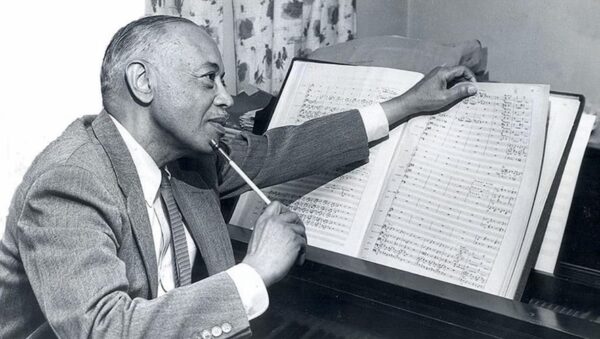
Composer William Grant Still. WilkiMedia
As in the Second, the composer’s lyrical gifts are well showcased here, especially in the opening pair of movements; the second begins as a kind of lament that eventually grows into something powerfully determined and striving. As in the “Song of a New Race,” the Fourth’s third movement is breezy, with periodic walking bass lines and copious syncopations.
The most striking part, however, is the long, meditative finale. In it, Still aimed to capture “the warmth and the spiritual side of the American people, their love of mankind.” Intentionally or not, the shadow of Bruckner often seems to hover over the proceedings, and, if the music has a tendency to run a little long, the composer’s faith in the inherent goodness of his countrymen—or his understanding that they often take a while to get the point and need it reinforced—is touching.
Throughout, the NSO’s playing is urgent and sumptuous, with Noseda and his forces making terrific advocates for this fare. Let’s hope they’ve got another release in the offing (or already taped) featuring Still’s remaining three symphonies: this is music worth hearing, especially when played with such care and understanding.
Jonathan Blumhofer is a composer and violist who has been active in the greater Boston area since 2004. His music has received numerous awards and been performed by various ensembles, including the American Composers Orchestra, Kiev Philharmonic, Camerata Chicago, Xanthos Ensemble, and Juventas New Music Group. Since receiving his doctorate from Boston University in 2010, Jon has taught at Clark University, Worcester Polytechnic Institute, and online for the University of Phoenix, in addition to writing music criticism for the Worcester Telegram & Gazette.
Tagged: American composers, Black composers, Classical Music, Gianandrea Noseda, Kennedy Center, National Symphony Orchestra, Recording reviews, Symphony No. 2 “Song of a New Race, Symphony no. 4, orchestral music