November Short Fuses — Materia Critica
Compiled by Arts Fuse Editor
Each month, our arts critics — music, book, theater, dance, television, film, and visual arts — fire off a few brief reviews.
Books
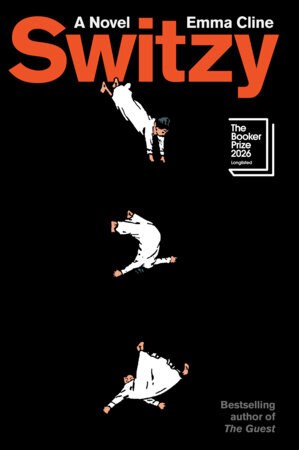
Emma Cline’s third novel, Switzy, follows a man to an appointment in Switzerland, where a woman he calls Ghoul will help him die.
David Hastings is more fortunate than many people with dementia who want to end their lives. He can afford a full-time caretaker. A wealthy friend gave him a sinecure when he could no longer work and supplies a private jet when David decides to enlist Ghoul’s services. Money cannot arrest his decline, but it can smooth the arrangements.
Cline, the author of The Girls and The Guest and an O. Henry Award winner, makes the experience of losing one’s mind painfully credible. David’s descent toward emptiness—figured at one point as a slowly descending hotel elevator—unfolds in painful, sometimes repetitive detail, relieved by flashes of wit. Making encroaching oblivion funny is no small achievement.
On the way to his appointment, David recalls fragments of childhood, regrets his failed relationships with family members and pretty much everyone else, and occasionally wonders what life will hold for his caretaker, Cody, after David is gone. He insists on visiting an old friend with whom he once had a relationship and whom he betrayed, weirdly certain he can heal a wound he can no longer articulate. The visit goes badly. David probably doesn’t remember.
Paranoia punctuates his confusion. At one point, he is sure Cody’s “partner” has taken his sweater. At another, he is convinced Cody is stealing his money, though he forgets the suspicion almost as soon as it upsets him.
The novel’s suspense turns on whether David will keep his final appointment. There is paperwork, and plenty of it. At every stage, he is assured that no one will think less of him if he changes his mind. One measure of Cline’s considerable achievement is that, after this punishing journey through David’s confusion and dependence, the reader hopes he won’t.
— Bill Littlefield’s most recent novel is Mercy (Black Rose Writing).
 “Teach the conflicts!” Such was the advice of devoted and perceptive history professors in the 1980s and early 1990s, when feminism, anti-racism, and anti-colonialism were making waves in college education and graduate programs.
How to do this with regard to musical works (e.g., symphonies) is always a conundrum. But operas and Broadway musicals have onstage action, costumes, and singers’ gestures and facial expressions …
I thus hail a new book written expressly to raise the consciousness of teachers who wish to engage students in discussions of how the musical stage reflects and refracts some of the biggest issues of our time.
This short, clear, well-organized book is entitled Teaching Canonic Opera and Musical Theater with Intention: A Teacher’s Guide. The authors, Catherine Coppola and Elizabeth A. Wells (musicologists both), show a keen awareness of what can interest undergraduate students.
Each of the 15 short chapters discusses a single work that raises issues of gender and class (e.g., Don Giovanni, Oklahoma!), “race and presumed whiteness” (Aida, Porgy and Bess, West Side Story), and/or colonialism and “history rewritten” (Madama Butterfly, The King and I, Hamilton).
The authors love and admire each work and are fascinated by how differently it has sometimes been performed and adapted. Rather than bash a show as noxious and outdated, they urge students (or readers) to consider not only the “sensitive topics” that it raises but also the “context(s)” in which it was originally written and performed and—most welcomely—the “counterstories” that, on closer examination, it tells.
In The Magic Flute (a work whose treatment of slavery I discussed here), “Pamina helps Tamino pass the trials,” and both are then accepted into the brotherhood of the wise. (The authors recognize that the Enlightenment promulgated some values that many of us are still happy to endorse.)
Tristan und Isolde gives vivid expression to—indeed, validates—“female anger and desire.”
Grist for many mills here!
— Ralph P. Locke
Experimental Art-Pop
The cover art for Shelf Life.
The tale of a woman who collects cans of food with the same expiration date, Shelf Life (Doyenne) has had three incarnations. Composer Matilda Tjader adapted her story into an opera, performed in Malmö, Sweden, in the fall of 2025, then took it into the studio to make an album.
The project goes beyond the obvious critique of empty consumerism. Shelf Life probes the obsessions and compulsions of a culture that turns everything into a commodity. “The Carrot Woman” compiles creepy samples of collectors describing their lives; “26092025” assembles spoken repetitions of numbers. More intriguingly, the album routes its critique through the body, treating shopping as a way to fend off fears of aging and death. In spoken-word passages, Tjader explores women’s experience of objectification: What happens when you regard your own body as disposable? The result is “a world to unpack/until you no longer can.”
Noise cuts into every melody. Small beeps become rhythmic elements; dissonant field recordings thread through Tjader’s songs like a grocery store’s background din. The wordless vocals of “Inner Monologue At The Shopping Mall” dissolve into a hovering hum. Flute and strings compete with sounds chopped beyond recognition. Tjader splices classical music with SOPHIE’s glitchy art pop; only “The Bar” resembles conventional opera.
Each musical element eventually buckles beneath another. The drums of “W and D” stomp over the melody like Godzilla dancing in a junkyard. The music’s unsteady rattle evokes a body trying to deny its own mortality. Only the unadorned piano and voice of “The Bar” suggest there’s an exit from the store.
— Steve Erickson
Film
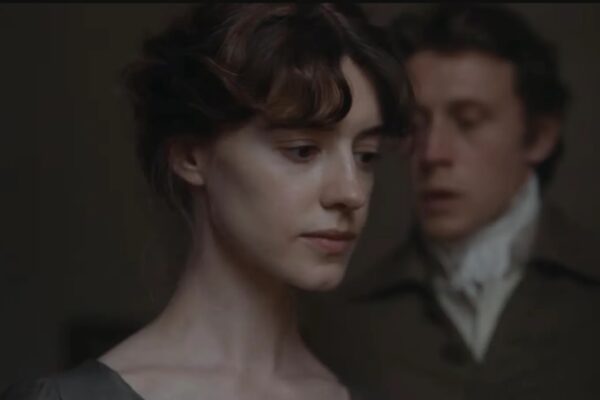
Daisy Edgar-Jones in scene from Sense and Sensibility. Photo: YouTube/Focus Features
We only get a short space here in the Short Fuses, far too little for a review to do justice to as fine and complex a movie as director Georgia Oakley’s new Sense and Sensibility. So, instead, I’ll do a review of just 10 seconds of it.
Daisy Edgar-Jones plays Elinor Dashwood, one of Jane Austen’s greatest and most fully realized heroines. She has fallen in love with Edward Ferras, and he with her. Months after their brief time together, Elinor hears that Ferras is already engaged, and in one quiet scene, she receives a letter from Ferras confirming that it’s true.
It’s in a darkened room by a window, with no dialogue and unobtrusive music. The entire story is told with Edgar-Jones’s eyes. She opens the letter with a combination of eagerness and reluctance. Her eyes devour the letter until she can read no more. She looks up, and we see her resilience collapse into heartbreak. For a fleeting moment, her expression shows her considering what her next steps in life could be—oh well, perhaps another man will come along, and she will feel an even greater love. Then her eyes and body language tell us the idea is rejected almost as soon as it is conceived, and she realizes that the rest of her life will be spent in loneliness and regret. Then, true to Elinor’s character, she straightens slightly and composes herself, resolving to make the best of whatever tragic situation she is given. She takes a breath, folds the letter, and slowly steps out to face her family.
It’s a master class in acting. It’s also Austen’s inimitable narration of internal states come to life. Blink and you’ll miss it—but you won’t want to blink anywhere throughout this beautifully subtle film.
— Allen Michie
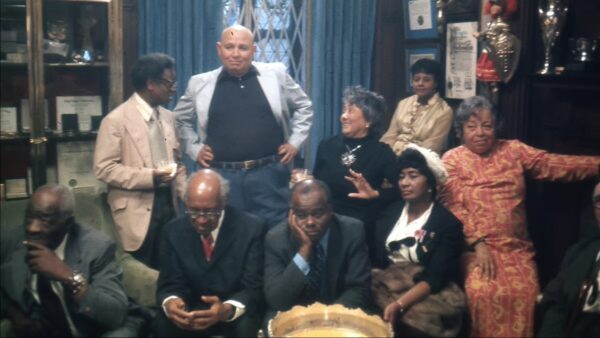
A scene from William Greaves and David Greaves’s Once Upon A Time In Harlem. Photo: William Greaves Productions
Two eras of American Black cultural history uneasily coexist in Once Upon a Time in Harlem (at Coolidge Corner Theatre), a subtly crafted archival collage. In 1972, filmmaker William Greaves invited surviving members of the Harlem Renaissance to Duke Ellington’s townhouse to celebrate the past, reminisce, and speculate on the lasting impact of that serendipitous period of genius that had blossomed five decades before. But Greaves was never able to complete the project, and the footage lay fallow until Greaves’s son restored and assembled it ten years after his father’s death.
With split screens and Altmanesque editing, the filmmakers capture this gathering of legendary figures, including the photographer James Van Der Zee, the painter Aaron Douglas, and the writer George Schuyler. They relive old times and celebrate those giants no longer with them, such as Marcus Garvey, Langston Hughes, Zora Neale Hurston, and Paul Robeson. Highlights include venerable thespian Leigh Whipper (who would die in 1975 at 98) delivering from memory the speech he gave as Ethiopian emperor Haile Selassie to the League of Nations in Michael Curtiz’s Mission to Moscow (1943). Composer Eubie Blake muses on the origins of words like “copacetic” while his lyricist Noble Sissle sings a few bars from “If You’ve Never Been Vamped by a Brown Skin” from their hit 1921 musical Shuffle Along. It was, they all agree, an oasis of creative freedom at a time of fascistic oppression and KKK lynchings. Not that security even there was guaranteed: society editor Gerri Major recalls being spit on by a white patron while taking in a show at the Cotton Club.
Meanwhile, outside Ellington’s stately mansion, what of the renaissance in Black culture then in progress as this footage was being shot? It was the heyday of the Black Arts Movement, with such luminaries as Maya Angelou, Nikki Giovanni, and James Baldwin. Stevie Wonder, Al Green, and Curtis Mayfield dominated the music scene while the blaxploitation genre was revitalizing movies. Greaves himself had shaken up independent cinema with his meta-mash-up Symbiopsychotaxiplasm Take One (1968). Though unacknowledged in the film, these achievements would likely have been impossible without these elders’ struggles and triumphs.
— Peter Keough
Spoken Word
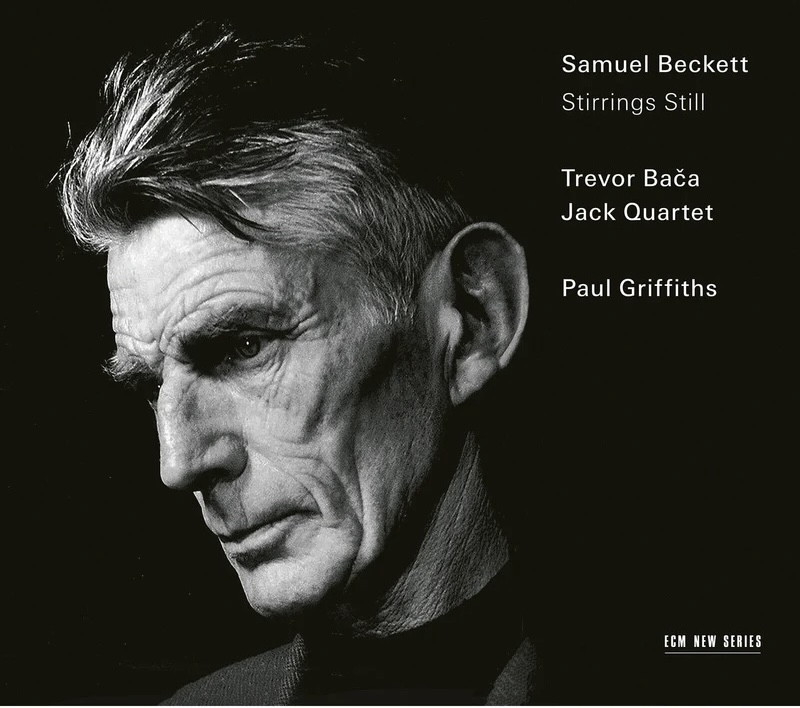
I had the enormous privilege of hearing actor David Warrilow’s consummate renditions of selected works by Samuel Beckett at Boston’s Museum of Fine Arts on April 13, 1989—Beckett’s 83rd and final birthday. Presented by the Poets’ Theatre under the direction of the late Robert Scanlan, the event included the premiere reading of Stirrings Still, Beckett’s final prose piece.
On this excellent ECM New Series recording, British music writer and librettist Paul Griffiths gives a crisp, stiff-upper-lip reading—affecting, but far removed from Warrilow’s ethereally reverberant evocation of a consciousness drifting elegantly if erratically through a void, like a balloon wafting about in slow motion. Griffiths’s restrained emotion sharpens the ache of regret for a life barely lived in this skeletal, elegiac coda—and isn’t most late Beckett a form of neurasthenic elegy? The narrator’s sliver-thin consciousness persists amid “such and much more such the hubbub in his mind so-called till nothing left from deep within but only ever fainter oh to end.” Freud’s death wish taking the form of an exhausted will-o’-the-wisp.
Composer Trevor Bača’s metallic-tinged music, played with cut-and-slash by the Jack Quartet, offers sonic variations on stirrings — still, animated, and edgy. The strings screech (softly and roughly), they swoop, scurry, scratch, shiver, sashay, stab, and squabble. The music mostly enters between large patches of the text, which has been divided into 17 sections. Sometimes, though, the musicians intervene with surprising dramatic inpact mid-sentence, suggesting that the music is there to do more than supply angsty atmosphere: it is tapping into the narrator’s agitated hidden inner life—a stream of consciousness, longing to be damned once and for all, that’s evaporating into fragmented vapors. Nothing new here in terms of language or themes—just a beautiful, if minor, capstone from a major 20th-century writer who never stopped trying to envision the “where never.”
— Bill Marx

Classical Music
Given the excellence of his last couple of Mahler recordings, one expects Sir Simon Rattle’s new account of that composer’s Symphony No. 2 to rank among the greats. Unfortunately, it doesn’t—though the effort (on BR Klassik) is hardly a complete misfire; it just takes some time to get going.
In fact, this performance by the Symphonieorchester des Bayerischen Rundfunks, Rattle’s third recording of the score, is rather of a piece with his first two (those were with the City of Birmingham Symphony and the Berliner Philharmoniker, respectively). As before, we’ve got a flat-footed launch of the opening movement and some fussy manipulations of phrases within it. The huge buildup to that section’s climax, for one, is plenty drawn out and loud, but it lacks the needed visceral impact that Bernstein or Solti mines from it. The second movement positively flies, though it feels a touch breathless as a result.
By the time the third movement arrives, though, the interpretation seems to have settled. That Scherzo is shapely and full of personality. Beth Taylor delivers a beautifully devotional take on “Urlicht.” She and her counterpart, Louise Alder, weave a beautiful tapestry in the finale, where the singing of the Chor des Bayerischen Rundfunks is marked by a rich blend and tonal power.
While Rattle’s phrasing in this last movement echoes some of the quirkier aspects of the opening movement, he keeps the big structural picture well enough in view. What’s more, the Bavarian players deliver some wonderfully refined and resonantly textured playing. Even if the interpretation isn’t on the level of Tennstedt’s or Tilson Thomas’s, then, the ensemble’s performance shines throughout.
— Jonathan Blumhofer

It might be a bit surprising to consider, but Joshua Bell’s new recording of Niccolò Paganini’s Violin Concerto No. 1 marks the first time the Indiana native has committed one of the Italian virtuoso’s concerti to disc. Better late than never, as they say.
The violinist, now 58, remains one of the most compelling and naturally gifted champions of Romantic repertoire, and Paganini benefits from associations with such artists. While Bell’s may not be the most purely songful account of this chestnut on record, it surely comes close. Besides, it’s enchantingly silky, playful, and brimming with personality. It seems that if you treat Paganini’s writing as actual music rather than as a series of etude-like studies, you end up with something quite appealing.
Accordingly, the music’s demands, which remain as fearsome as ever, sound anything but. The sprawling first movement comes across like an extended operatic scene. So does the Adagio. The finale’s reams of artificial harmonics are outstandingly pure, while its “spiritoso” tempo indication is underlined, ultimately suggesting something Paganini’s contemporary, Rossini, might have written had he ever bothered to pen a violin concerto.
As much fun as Bell is clearly having (he contributes his own outstanding cadenza to the concerto’s first movement), the Academy of St. Martin-in-the-Fields is fully in on the action, too. The group revels in its exposition during the Allegro, as well as in subsequent interludes. Its accompaniments in both the concerto and the filler, Paganini’s Cantabile in D, are models of discretion and taste.
Filling out the album are Paganini’s variations on The Carnival of Venice. In Bell’s—and, here, pianist Simon Mulligan’s—hands, the results are delirious and brilliant.
— Jonathan Blumhofer
Jazz Concert
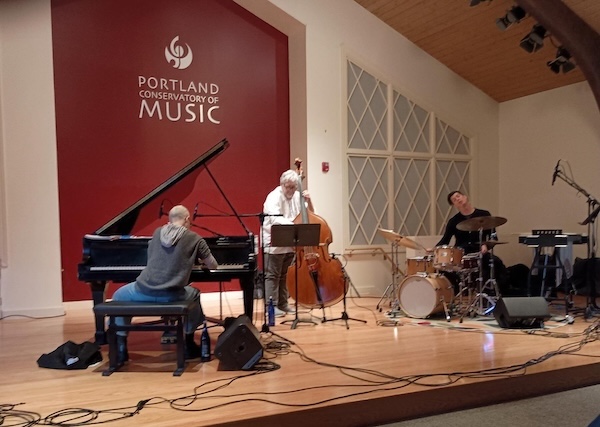
Myra Melford’s Splash Trio at the Portland Conservatory of Music Photo: Steve Feeney
Affiliated with the Portland Conservatory of Music, the longstanding Dimensions in Jazz series brings established and emerging jazz artists to Maine each year.
In a co-presentation with Space, a nearby Portland venue, Dimensions brought pianist Myra Melford’s Splash Trio to the Conservatory’s main room, a former church sanctuary, for a late-afternoon Halloween concert.
The ever-youthful Melford has been a fixture on the progressive jazz scene for decades, earning numerous prestigious awards and working in a wide range of settings. Her Splash Trio, with renowned bassist Michael Formanek and drummer/vibraphonist Ches Smith, has drawn particular attention. All three brought expansive talents and disciplined focus in the pursuit of Melford’s vision.
Melford’s recent music draws inspiration from abstract artist Cy Twombly (1928–2011). She has spoken of responding to the physical energy of his art and seeking to convey it in sound.
Before an unusually large crowd, the trio launched into a 75-minute set that moved between nuanced chamber jazz and full-out improvisational fury. Tangles of piano and vibes gave way to shimmering surges anchored by Formanek’s bass.
Melford sat with her back to much of the audience, while Formanek occupied the center and Smith sat or stood opposite her, alternating between ringing vibraphone flourishes and strikingly bombastic drum passages. All three worked from sheet music. Formanek and Smith often glanced toward Melford, who could signal a shift in dynamics with a nod.
The diminutive pianist moved from one end of the bench to the other as she ranged across the keyboard. Her dramatic gestures—sweeping her right hand away from the keys to punctuate a phrase—echoed the physical energy she admires in Twombly’s art, as though she were tracing an abstract line in sound.
Only one tune, a nimble “Freewheeler,” was introduced by name, but the set represented the trio’s 2025 album, Splash (Intakt, 2025), well.
— Steve Feeney
Tagged: "Sense and Sensibility", Academy of St. Martin-in-the-Fields, BR Klassik, Daisy Edgar Jones, ECM New Series, Emma Cline, JACK Quartet, Joshua Bell, Matilda Tjader, Once Upon a Time in Harlem, Paul Griffith, Shelf Life, Simon Mulligan, Simon Rattle’, Stirrings Still, Switzy, Symphonieorchester des Bayerischen Rundfunks, Trevor Bača, samuel-beckett