Local Author Interview: Katy Doughty Isn’t Giving Up on the Future
By Preston Gralla
In How to Survive the End of the World, catastrophe is only part of the story. There’s also human resilience—and the possibility of making things better.
In this ongoing Arts Fuse series of interviews with Boston-area authors, I talked with Katy Doughty, author of the non-fiction book for young adults, How to Survive the End of the World. The book uses illustrations and text to describe disasters and dangers including climate change, plagues, and AI, and explains how we can stop them and survive them. The Bulletin of the Center for Children’s Books says of it, “the tone is engaging and hardly doom-and-gloom, blending a huge variety of topics with a charming gallows humor.”
Doughty has a BFA in illustration from the Rhode Island School of Design and a Master of Public Health from Boston University’s School of Public Health. She was the Associates of the Boston Public Library’s Writer-in-Residence in 2021-2022, and lives in Boston with her family.
Arts Fuse: What led you to write this book?
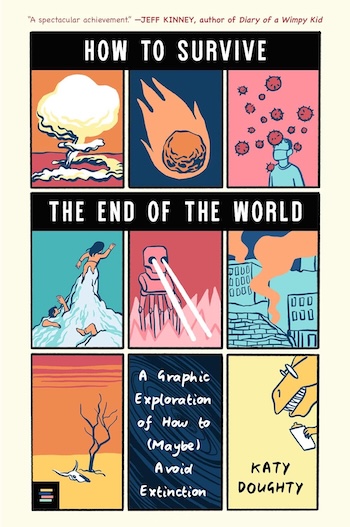 Katy Doughty: I was feeling apocalyptic when I came up with the idea. The seed for it came five days into the COVID lockdown in March 2020. I was reading A Short History of Nearly Everything by Bill Bryson. About 200 pages in, there was this very well-written description of an asteroid strike. I was sitting in a locked-down house, plague around me, reading about an asteroid and I started thinking about the end of the world.
AF: Why write it for a young adult audience?
KD: That emerged less intentionally. By virtue of being a comic artist, my references often skew a little bit younger. I really started leaning into it when I thought about the impact these existential questions would have on a teenage audience, the age where people have all the intelligence and understanding of adults, but less experience. With scary issues like climate change and war and pandemics, adults have less confidence about how to tackle these fears head on. With a much younger audience, you need to put an optimistic spin on it; you have to help and shelter them to a certain extent. But with teenagers, they see what’s happening. You can’t hide this from them.
AF: Given all that, how do you think teenagers are feeling today about their future, the future of the planet, and the idea of having children some day?
KD: There’s data on this. One of the more harrowing statistics is about climate anxiety. Over half of teens believe that for a certain definition of “doomed,” humanity is doomed. There’s a lot of fear and anxiety, which is sometimes treated with the general perception that something’s wrong with the kids’ brains, “Oh, this is an anxiety problem,” “Those kids and their dang phones.” But change is something that inspires existential fear, and they’re seeing that appropriately.
AF: In reading the book I learned so many things I never knew before. One thing that really struck me is the evolutionary history of the bacteria that caused the Black Death. When you were doing research for the book, what was the thing that surprised you the most?
KD: I was pretty delighted to learn about the field of astrobiology, the study of life on Earth and otherwise. To me, it seemed a very sci-fi concept, because when I think of aliens, I think of ET. But there have been studies, legitimate scientists looking into, what are the parameters of life on Earth and how that might extend to other planets. And it’s not in a Star Trek-y, ET sort of way.
AF: What scared you the most in writing the book?
KD: Climate change. It was also the most difficult chapter for me to write because there are so many different fields involved, physics, biology, ecology, economics, and all sorts of things. So it was very in-depth research.
Climate change is also the most immediate real threat. Of course, there are other things as well, like the sun’s going to explode. That’s a final end for humanity, but I’m not going to be around for that. So it scares me less than climate change. Pandemics are also pretty harrowing. I came up with the idea of writing this book during COVID. But in general, there was a mournfulness with researching climate change that I did not feel for other topics.
AF: Do you have any sense how teens are dealing with climate change or not dealing with it? Do you have any sense of whether they’re ready to take action? Do they think, “It’s over for me?” Or do they think, “I’m going to help fight it?”
KD: Youth climate action is a huge movement. They’re structurally disadvantaged legally as non-adults; there’s certain things they can’t do. They often don’t have the monetary resources that adults have, but they are in some ways leaders of this movement.
They have the highest stakes and they organize very creatively. They do things within their school or within their community. The most visible form of this are climate protests, which are very commonly youth-led. But there’s any number of NGOs that are started by young people or powered by young people.
I made a point of interviewing a youth activist for this book who is based in Uganda to see what types of things a young person can do to address climate change. They’re building knowledge about these giant structural issues, like how fossil fuels are embedded in the world economy. But a lot of climate change mitigation can really be done on a local level. How can I save this little ecosystem in my neighborhood? And I think youth today are doing both those things.
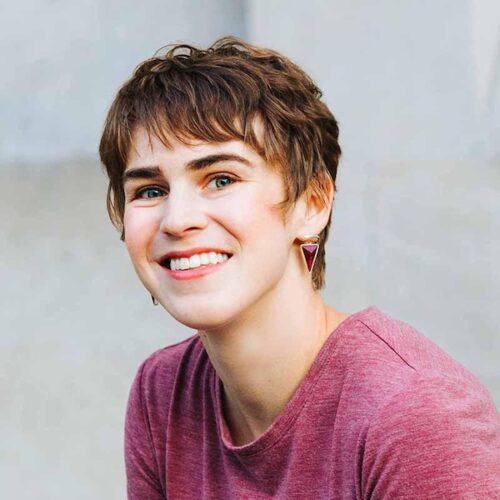
Writer and illustrator Katy Doughty. Photo: courtesy of the artist
AF: You devoted part of the book to showing how colonialism can destroy a culture and a world. I never would have thought of including that in a science-based book. Yet when I read it, I thought, “Of course you have to include it. You’d be doing a disservice if you didn’t.” What led you to put that in the book?
KD: It emerged naturally as I was thinking about what the end of the world looks like. The world did not literally end for the Americas post-colonization, but a way of life did, and that is in some ways the same thing. A scholar who I interviewed, Dr. Lawrence Gross, called the colonization of the Americas an apocalypse. There is a such thing as a post-apocalyptic people, and we are living on their land in North America. We see what a post-apocalyptic world looks like for the people who suffered this apocalypse.
AF: We live in a country that’s increasingly anti-vaccination, disbelieving in climate change, full of conspiracy theories, and that simply doesn’t believe in science. Any ideas on how we can change that?
KD: It’s something I struggle with as a science writer and as a researcher. I don’t have a solution, but I have a notion of where it might lie, which is that appeals to scientific authority alone do not seem to hit. Other things that I attempt to try in this book are emotions and storytelling. Personal connection is also important in building trust and belief in a way that appeals to authority do not.
I work in public health and it’s a huge issue that a lot of people are working on. There’s research that suggests that if a faceless entity, the CDC, says you should take vaccines, that does not always work. But who people do trust is their family doctor that they’ve known for years. So having one-on-one conversations often works. And I hope that storytelling and building empathy does as well, and that’s where writing comes in.
AF: I’m going to ask you to put on your public health hat because we have Robert F. Kennedy Jr., who doesn’t believe in science, in charge of the public health system. What’s your thinking about how that’s affected us today and how long it might take to recuperate from it – or can we even recuperate from it?
KD:I think we can recuperate from it. It’s not just him. He’s the face of a very broad, pretty heterogeneous movement that includes people who are actively trying to do harm, but also people who are genuinely misguided. There were some very interesting, good research projects that had the rug pulled out from under them, and we lost a lot of momentum there. People can quantify how much that set us back in making a new cure for a disease.
The less quantifiable problem is in trust of institutions. There’s a big group of people who don’t trust institutions in general, and ironically, these people are now in charge of these institutions, so now the people who used to trust them don’t.
There’s a lot of things that can be done on smaller levels without giant government institutions, but there is really nothing like federal funding. For an outbreak, for example, the outbreak does not stop in one city. You have to have one city talking to another. You have to have someone who has the bird’s eye view of all of this. Without that, it makes it harder to coordinate across the country, which for these really large-scale threats and pandemics you really do need national coordination.
AF: Do you have any children?
KD: I have a daughter. She’s almost nine months old now.
AF: Given everything you’ve learned in researching this book, what do you think about her future?
KD: Writing this book made me more intentional in my choice to have a child. It’s staking a claim in a future that will be worth living. And my claim is now staked for sure, or her claim, I should say. And now as a parent, I know that I’m more invested in building a future that will last for far beyond me just to make it better for her and to equip her to handle things that I’m still trying to learn how to handle myself, which is, of course, the challenge of parenting.
AF: I was struck by how extraordinary the book’s ending was. You were honest about the problems the world faces and didn’t sugarcoat anything, and yet the hopeful way your wrote about how we can change the world for the better was remarkable. Did you have that ending in mind when you wrote the book? If not, how did it come to you?
KD: I did not have it in mind. It was the last section that I wrote, which of course it sounds obvious now, “Oh, I wrote the end at the end,” but that is not often how I write. The tone and the thesis of this as expressed by the ending was not something I had from the get-go. It’s something that emerged as I dug into the rest of the book.
You mentioned the hopefulness of the book. That’s a huge part of it, and it was not necessarily intentional as I was writing it. But as I wrote, the hopefulness did genuinely emerge. There were so many human stories of people who lived through things that were scarier than what we’re living through now. I could connect with people from the past who had been through what I’m sure felt to them like the end of the world, and we made it as people. There were very dark times in the past, so looking back at those informs how things can improve in the future.
It’s a very dire subject matter, but it’s not meant to be all gloom. There’s a lot of beauty to it as well.
AF: Have you thought about how you will talk to your daughter about these issues as she grows up?
KD: One thing I am hoping to do is to not pass my mourning onto her. Her perception about the world should not be based on how I tell her it used to be or should be. She should form her own perception of how the world is. I don’t want to pass onto her this maybe somewhat nostalgic vision of these wonderful days of yore that she’ll never have. Because she will have some of her own days that are of a different type of beauty that I can’t yet imagine, and I don’t want to take that from her.
Note: This interview has been edited for length and clarity.
Preston Gralla has won a Massachusetts Arts Council Fiction Fellowship and had his short stories published in a number of literary magazines, including Michigan Quarterly Review and Pangyrus. His journalism has appeared in the Los Angeles Times, Dallas Morning News, USA Today, and Boston Globe Sunday Magazine, among others, and he’s published nearly 50 books of nonfiction which have been translated into 20 languages.
Tagged: Boston authors, Climate Change, How to Survive the End of the World, Katy Doughty, Preston Gralla, author interviews, climate anxiety, graphic nonfiction, pandemics, parenting, public health, science writing, young adult nonfiction