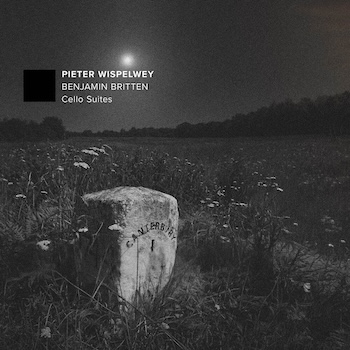
Classical Music Album: Pieter Wispelwey Captures Benjamin Britten’s Fierce Beauty
By Jonathan Blumhofer
On his third recording of Benjamin Britten’s three solo cello suites, the Dutch cellist brings lucid intensity to their knotty arguments and haunting lyricism.
 There’s nothing like a great musician writing something for a great artist who happens to be a close friend. And when that someone is Mstislav Rostropovich, the Russian cellist who served as muse for most of the postwar 20th century’s A-list of composers, that means there’s a pretty impressive catalogue from which to choose.
One of Rostropovich’s most important friendships was with Benjamin Britten, who wrote for him not just a Cello Symphony and Cello Sonata but also, between 1964 and 1971, a set of three solo suites. Not quite so ubiquitous or celebrated as Bach’s, the triptych is nevertheless similarly tight in terms of construction and concentrated in expression. As performed by Pieter Wispelwey, the collection takes on an immediacy that’s, at times, unsettling.
The Dutch cellist is no stranger to this repertoire: he’s already recorded the full series twice before, once for the Globe label and once for Channel Classics. This third time through, his performances are similar, in timings at least, to those in the latter cycle. But, if anything, the present release offers a more lucid, intense approach to these knotty works: Wispelwey’s clearly lived and wrestled with this music and internalized its arguments. As such, he makes for an excellent curator of this fare.
Suite No. 1 is, in some ways, the most approachable of the triptych, with a recurring series of sections labeled “Canto” framing a thoroughgoing exploration of the cello’s technical and expressive capabilities. Here, those songful movements function as touching, beautiful anchors serving to keep the music’s more abstract gestures from running away with things.
The latter range from a knotty fugue to an absorbing “Bordone” (with the cellist maintaining a steady drone while weaving melodic lines above and beneath) and a couple of snappy character pieces in the form of a “Serenata” and a cheeky march. In Wispelwey’s hands, the “Serenata”—which is played entirely pizzicato—takes on fittingly sultry, Iberian colors.
Britten’s writing in Suite No. 2 repurposes a few of No. 1’s most striking concepts: there’s another fugue (this one an even more involved exploration of rhythm and sonority than before) as well as a virtuosic study of right- and left-hand pizzicato as an accompaniment to a bowed melodic line. For the finale, he wrote a chaconne that serves as a fascinating fusion of historical musical reference points and motives heard earlier in the suite.
The present performance—texturally lean, rhythmically taut, strongly directed—is fierce and tragic. Wispelwey’s account of the Scherzo fairly explodes off the page, while the Andante’s pizzicatos chime like funeral bells. His chaconne is sweeping and richly sonorous, punctuated by some Colin Davis-worthy grunts and sighs.
A similarly weighty set of variations comes at the end of Suite No. 3, though this passacaglia’s concluding quotations of four Russian songs feel a bit at odds with the gritty, searching music that comes before. Still, Britten’s inventiveness hardly flags in this 1971 score, especially in the fifth-movement dialogo.
There, Wispelwey navigates the stark contrasts between the voices with aplomb (for good measure, he also gets the mixed-meter episodes in the movement’s second half to bounce agreeably). His larger reading captures much of this final suite’s eeriness and strange beauty, particularly in its rocking Barcarolle and slithering moto perpetuo.
Jonathan Blumhofer is a composer and violist who has been active in the greater Boston area since 2004. His music has received numerous awards and been performed by various ensembles, including the American Composers Orchestra, Kiev Philharmonic, Camerata Chicago, Xanthos Ensemble, and Juventas New Music Group. Since receiving his doctorate from Boston University in 2010, Jon has taught at Clark University, Worcester Polytechnic Institute, and online for the University of Phoenix, in addition to writing music criticism for the Worcester Telegram & Gazette.
Tagged: 20th-century music, Benjamin Britten, Britten Cello Suites, Chamber music, Classical Music, Mstislav Rostropovich, Pieter Wispelwey, album reviews, cello, classical recordings