
Doc Talk: Two Exemplary Lives at The Boston Palestine Film Festival
By Peter Keough
Two compelling documentaries at the Boston Palestine Film Festival trace Edward Said’s intellectual awakening and the unfinished search for justice for Alex Odeh.
The Boston Palestine Film Festival. At the Museum of Fine Arts and the Coolidge Corner Theatre, October 16–25.
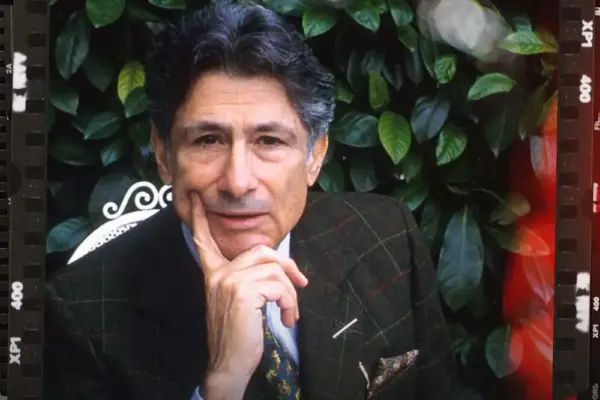
A scene from Maiken Baird’s Edward Said: Between Worlds. Photo: Dogwoof
A bureaucratic dispute epitomizes the dilemma faced by the subject of Maiken Baird’s thorough, engrossing, and conventional Edward Said: Between Worlds (2026; screens October 16 at 7 p.m. at the MFA, followed by a Q&A with producer Sarah Mowaswes), the opening-night film of the Boston Palestine Film Festival. In his application for a US passport, the renowned scholar and activist stated that he was born in Jerusalem, Palestine. When told by the authorities that this was invalid because Palestine no longer existed and that the correct identification was Jerusalem, Israel, Said pointed out that when he was born in 1935, Israel did not exist. So the State Department compromised and left his birthplace listed as just “Jerusalem,” with no national attribution — a special classification, Said muses, probably not applicable to any other city in the world.
In a film composed largely of archival footage and Said’s lucid voiceover drawn from his innumerable interviews, the renowned scholar and activist recalls an idyllic childhood in this prelapsarian Jerusalem. His memories of growing up in his well-to-do bourgeois home are illustrated by home movies taken by his shutterbug father. This all ended with the War of Independence and the establishment of the state of Israel in 1948, when, along with thousands of other Palestinians, the Said family was uprooted from their home and driven into exile.
They were more fortunate than most, as they could continue living in comfort in Cairo, though with an irrevocable sense of bereavement and loss. Edward distanced himself even further from his origins as he entered prep school in New England, began studying literature, and went on to teach it at Columbia, where, as he puts it, he found a home in libraries with the works of authors like Joseph Conrad, Rudyard Kipling, and Herman Melville, seeing in them kindred outsiders observing a society in which they were not quite included.
This relative complacency ended with the Six-Day War in 1967, regarded in the West as a David-and-Goliath struggle, with Israel cast as the former and the Arabs demonized as the latter. Said could no longer ignore the endemic stereotyping of his people as primitives and terrorists that pervaded the media and popular culture, a recognition that compelled him to write his masterpiece, Orientalism (1978). In it, he argues that for two centuries Western science, art, and literature have defined Arabs and the Middle East according to their own imperialistic and paternalistic agendas, resulting in the demeaning caricatures that prevail to the present day.
Said’s renewed sense of Arabic identity also drew him to Yasser Arafat, leader of the Palestine Liberation Organization (PLO), whom he saw as someone who restored Palestinians’ belief in their cultural and national legitimacy. As Arafat’s most prominent American supporter, Said was thrust into the thankless task of defending the PLO throughout its bloody struggle with Israel, seen here in a demoralizing litany of Said’s TV appearances and debates with pro-Zionist opponents.
But his relationship with Arafat would end abruptly in 1993 with the Oslo Accords, signed by Arafat and then Israeli Prime Minister Yitzhak Rabin. Many acclaimed the pact as the definitive resolution of the Palestine-Israel conflict. Said, though, saw it as Arafat’s sellout of the Palestinian cause. Whether Said was right is now largely moot. Rabin was assassinated in 1995; Netanyahu took office the following year and has governed, intermittently but decisively, ever since. The destruction of Palestine that has followed would likely have been unimaginable to Said, who died in 2003.
Rabin’s murder goes unmentioned in Baird’s film. Netanyahu appears only once: in the 1980s, as Israel’s ambassador to the United Nations, he was invited by ABC’s Nightline to debate Said but refused to share a building with the professorial pundit, explaining, “I think he might want to kill me.”
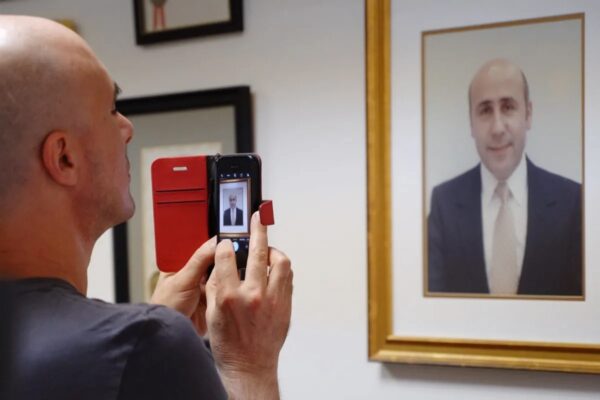
A scene from Jason Osder and William Lafi Youmans’s Who Killed Alex Odeh. Photo: Sundance
But Rabin’s assassination at the hands of an ultranationalist right-wing fanatic inspired by the extremist policies of Brooklyn-born rabbi Meir Kahane figures in the background of Jason Osder and William Lafi Youmans’s taut, haunting, and infuriating Who Killed Alex Odeh (2026; screens October 18 at 2 p.m. at the MFA).
In 1985, Odeh, West Coast regional director of the American-Arab Anti-Discrimination Committee and father of three, was killed by a bomb planted in his Santa Ana, California, office. He was scheduled that day to attend prayer services at a local synagogue as part of his organization’s ecumenical outreach; both the Anti-Defamation League and the American Jewish Committee condemned the killing and mourned the loss of his leadership.
The night before, Odeh had appeared on Nightline to discuss the Achille Lauro hijacking and the murder of hostage Leon Klinghoffer with a member of the Jewish Defense League (JDL), the militant group Kahane founded. The FBI quickly traced the bombing to the JDL, which was also linked to three related bombings. Yet the prime suspects were allowed to flee to Israel—under pressure from Mossad, relayed through the State Department, according to one investigator.
More than 40 years later, the case remains unresolved, its alleged perpetrators still at large. Some continue to seek justice: Odeh’s wife and daughters, and an intrepid Israeli journalist who follows leads the FBI left dormant. In riveting procedural fashion, he tracks down the likely culprits, one of whom—after changing his name—has become highly visible in Israeli politics. But his efforts come to nothing: federal authorities prove unable or unwilling to act on the evidence he has assembled.
In 1996, the FBI offered a $1 million reward for information leading to the killers’ arrest. It remains unclaimed.
Peter Keough writes about film and other topics and has contributed to numerous publications. He was the film editor of the Boston Phoenix from 1989 to its demise in 2013 and has edited three books on film, including Kathryn Bigelow: Interviews (University Press of Mississippi, 2013) and For Kids of All Ages: The National Society of Film Critics on Children’s Movies (Rowman & Littlefield, 2019).
Tagged: Alex Odeh, Boston Palestine Film Festival, Coolidge Corner Theatre, Edward Said, Edward Said: Between Worlds, Israel-Palestine Conflict, Jason Osder, Maiken Baird, Orientalism, Palestinian Cinema, Palestinian Identity, Who Killed Alex Odeh, documentary film, museum-of-fine-arts-boston
