Theater Review: “Slam Frank” – Nobody Is Safe. And That’s the Point
By Chris Caggiano
A satirical musical that offends everyone equally hides its real argument until the final minutes.
Slam Frank is running at New York City’s Orpheum Theatre through November 30.

A look at Slam Frank. Photo: Shawn Salley
A few years ago, someone on Twitter asked, apparently in earnest, whether Anne Frank had ever acknowledged her white privilege. Well-meaning people took that question seriously, and that is what makes this tweet a symptom rather than a joke. A girl murdered for being Jewish had been recast as privileged, a judgment possible only through the kind of context-free hindsight that causes so much trouble these days.
Slam Frank, the musical that the tweet eventually inspired, imagines a progressive regional theater company remaking The Diary of Anne Frank as an intersectional, genderqueer, Afro-Latin hip-hop musical. Andrew Fox wrote the music and lyrics, and Joel Sinensky the book. Sam LaFrage directs the production, which has moved to the Orpheum Theatre from a developmental run last fall at Asylum NYC. In their telling, Anne becomes Anita Franco, a Latina who keeps her diary in Spanish. Her mother, Edith, is a Black feminist slam poet; her father, Otto, is neurodivergent and, ultimately, gay; and her older sister, Margot, barely speaks, but when she does, the show unleashes its most impactful moments.
Whether the show makes good on its outrageous premise has divided critics and audiences alike, and the division seems to turn on a single trait: its determination to offend everyone equally. Some treat this as the achievement and others as an evasion, and both camps have a point.
The effort is admirable, but the satire is so even-handed that for most of the evening its point of view is nearly impossible to locate. Until the show’s message reveals itself, it’s on its surest footing when it aims at the theater. The evening opens with the troupe’s Artistic Director attempting a land acknowledgment, only to discover he has brought the wrong notecards: “Okay, well, whoever they are, they were here first, and we are here now, and shame on us.” The ongoing theatrical jibes and asides have led some critics to conclude the stage is the show’s real quarry. But as the ending makes clear, the theater here is the vehicle, not the target.
Fox’s lyrics have real wit, and an edge to match. Plotting her literary career from the attic, Anita brags that she’ll be in demand when the hiding ends, then hedges: “and if survival’s not the plan, / I’ll be a ghost writer.” It’s a rather grim pun, but it’s a great example of Fox’s ability to pack a punchline and a historical irony into a single line. Edith’s slam poem “Yeast of Edith” builds to a couplet that is funny and appalling at once: “every woman is a Jew / hiding in her own attic.”
The company, led by Olivia Bernábe as Anita, plays every absurdity as though the stakes were real. Commitment can carry a joke only so far, though, because the shock here depends primarily on surprise. I first saw Slam Frank at the Asylum and laughed far more than I did at the Orpheum, when I was mostly bored.
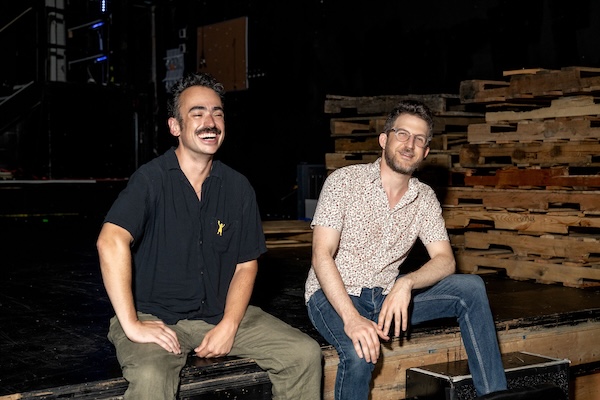
Slam Frank creators Joel Sinensky and Andrew Fox. Photo: Shawn Salley
Once the shock of Slam Frank wears off, what’s left is a show that’s slow to start, repetitive, derivative, and too long. The opening scenes play the Diary’s familiar beats largely straight, with the satire living more in the character descriptions than in the situations. Otto’s running gag, a fresh neurodivergent diagnosis to excuse every lapse, returns more than half a dozen times before it finally pays off. The score leans a bit too much on Hamilton and In the Heights, and for more than just parody. Perhaps the show’s biggest liability is its length. Nearly two hours without an intermission is a long time to sustain comedic outrage, and on a return visit the strain showed.
With this subject, though, the show’s provocations raise a harder question than craft. Margot’s big number, “Safe Space,” is the most incendiary thing in the show: the ensemble enters in what the script calls “garish Jewish noses” and sings about the global wealth and influence a Jewish state will bring, all framed as the troupe’s own staging. I wasn’t offended by anything in Slam Frank, but the first time I saw that number, I wondered why no one was picketing outside.
Objections to the show have arisen, but mostly from outside the theater: editorials and a petition before the Asylum run, and reported walkouts since. Some argue the show crosses into outright antisemitism; others note how heavily it relies on the audience presuming its creators’ good faith. That reliance is a real risk, and the show occasionally strains it, as in a throwaway gag about Kristallnacht that lands with more carelessness than bite.
[Spoiler alert: the following paragraphs discuss the show’s ending.]
Slam Frank‘s ending is where its craft pays off. In the climactic number, Anita starts writing a version of the real Anne Frank’s famous line about people being basically good at heart, then sets it aside and starts over. It’s a simple choice, and it does a lot of work: the diary that drives the whole show is literally rewritten in front of us. What replaces it is the show’s darkest turn. Anita decides her own family is the problem and rats them out to the Nazis.
In the final minutes, the show turns on its own troupe and the two fantasies driving its production. The first is that the past can be judged by the standards of the present. As Anita justifies herself, Margot asks: “What today are you talking about?” Anita has been condemning her family in 1944 by the standards of the 2020s, the same context-free hindsight that produced the tweet. When a gunshot meant for Margot rings out from the booth, she refuses to die on cue, rips off her mic, and walks out. The only character whom the script actually identifies as Jewish declines to keep serving as material for someone else’s lesson.

The cast of the Off-Broadway production of Slam Frank. Photo: Shawn Salley
The second fantasy is that the right art can redeem history. Moments after Margot leaves, Hitler strolls down the aisle, announces that the show has transformed him into a woman (Adeline Hitler), and calls off the Holocaust. The resolution is so tidy that Anita can announce, with relief, that Palestine “isn’t even an issue anymore.” In the troupe’s version, Hitler gets a happy ending for embracing the correct identity.
The finale goes further still. It starts as a feel-good anthem called “Justice,” the kind of rousing closer every message musical has, then slowly curdles into a purge. The company hails Lenin as the hero, a reminder of how the last great revolution in the name of justice turned out, and sings of a world with “just us” once the oppressors are dealt with. Anita’s T-shirt sums it up: “There is only one solution.” It’s a slogan any fascist would recognize.
It’s that last turn that finally brings the evening into focus. All those jokes aimed in every direction weren’t about any one target. They were building to a portrait of how the urge to sort people into innocent and guilty ends, whatever the politics behind it.
The show’s sharpest version of that portrait seems to be aimed at the left, where the ruthless policing of allies can grow so exacting that almost anyone can end up on the wrong side of the line. In the finale, the company promises a reckoning for “a redneck, a woman, a poor man, a TERF, or a Jew.” By the end of that list, nobody is safe. A culture that asks whether a murdered Jewish girl acknowledged her privilege is already doing the sorting.
So does Slam Frank make good on its outrageous premise? Yes and no. The even-handedness that hides its argument for most of the evening is also what lets that argument land at the end. The cost is the wait. On a second viewing, with the surprise gone, that wait is a long one.
Christopher Caggiano is a freelance writer and editor living in Stamford, CT. He has written about theater for a variety of outlets, including TheaterMania, American Theatre, and Dramatics magazine. He taught musical theater history at the college level for 16 years and is an active member of the Outer Critics Circle.
Tagged: Andrew Fox, Anne Frank, Austen Horne, Chris Caggiano, Joel Sinensky, Off-Broadway, Olivia Bernábe, Orpheum Theatre, Sam LaFrage, Slam Frank, The Diary of Anne Frank, antisemitism, identity politics, musical theater, satire