
Arts Commentary: Superman, Spider-Man, and the American Art of Slugging Nazis
By Michael Marano
William Nicholas Love’s punch heard round the internet belongs to a long comic-book history of fighting homegrown fascism—from Captain America to “The Clan of the Fiery Cross.”
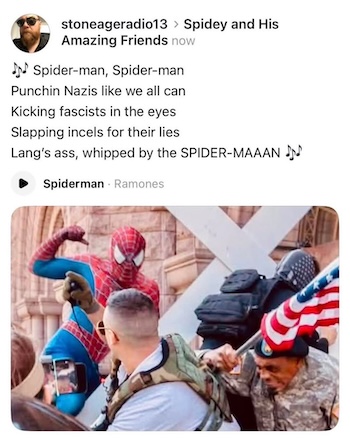
One of the many memes created and circulated online within hours of William Nicholas Love slugging Jake Lang, this one with lyrics set to the tune of the 1960s animated Spider-Man TV show
We live in a world in which a Minneapolis guy named William Nicholas Love can dress as Spider-Man, punch Nazi Jake Lang in the face, and become an overnight meme sensation. So great is our cultural starvation to see a real superhero clock a fascist.
(Worth noting: Lang is not green, but he is most assuredly a Goblin.)
Flipping the political coin on comic-book wish fulfillment, the Avengers and the Justice League are, in their most basic forms, the nocturnal-emission dreams of far-right oligarchs: the extra-special “wish-upon-a-star” desire of Peter Thiel and the tech-bro totalitarians whom Gil Durán calls “the Nerd Reich.” Both superhero teams are private militias raised by billionaires to impose their will and personal ideas of justice on the streets of America.
Kinda like the January 6 riot, in which Lang took part: a “will be wild” event for which some participants had sweatshirts printed with “MAGA CIVIL WAR, January 6, 2021,” modeled after—or stolen from?—the logo created for the Marvel film Captain America: Civil War. Love saw it as his friendly neighborhood duty to slug Lang, who saw it as his election-denying duty to be recruited by a billionaire, the way Tom Holland’s Spider-Man was recruited by Tony Stark to fight Captain America in Captain America: Civil War.
Maus creator Art Spiegelman wrote that superhero comics were Jewish American writers’ and artists’ response to rising fascism in 1930s Europe: “They created the American Übermenschen who fought for a nation that would at least nominally welcome ‘your tired, your poor, your huddled masses yearning to breathe free…’”
Nazi-punching is the most basic DNA strand of the American superhero, even when that strand mutates into cancerous forms. Upon seeing the appropriation of Captain America iconography by Lang’s fellow insurrectionists, Neal Kirby—son of Jack Kirby, co-creator, with Joe Simon, of Captain America—said, “Captain America is the absolute antithesis of Donald Trump…. Captain America has stood as a symbol and protector of our democracy and the rule of law for the past 79 years. He was created by two Jewish guys from New York who hated Nazis and hated bullies.”
The original America Firsters, of whom Trump and a passel of his Quest for Fire-ish acolytes are the modern embodiment, had no such love for Captain America, the Hitler-slugging hero who appeared on newsstands eight months before the United States entered World War II. According to Simon: “We [at the comic-book company] were inundated with a torrent of raging hate mail and vicious, obscene phone calls [from the Nazi-sympathizing American Bund and the America Firsters]. The theme was ‘death to the Jews.’”
Comics fan Mayor Fiorello La Guardia, who read the Dick Tracy strip over the radio to New York’s children during a newspaper-delivery strike, eventually called Simon and said, “The city of New York will see that no harm comes to you.”
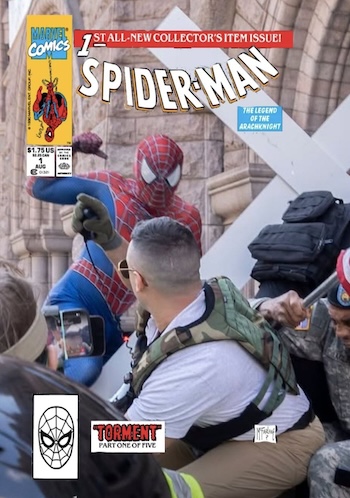
Another meme of Love slugging Lang, this one mocked up to look like a classic layout of a Spider-Man cover from the 1990s.
For all its anti-Nazi sentiments, the fetishization of force at the core of superhero mythology has, let’s face it, fascist overtones. I interviewed the “woke” director of The Odyssey, Christopher Nolan, on the set of The Dark Knight, asking him about scenes in Batman Begins that seemed borrowed from the—at least partly proto-fascist—“mountain films” of Weimar Germany.
Nolan said, “I wouldn’t want to align myself with Leni Riefenstahl [the Triumph of the Will director who starred in and made a number of mountain films]. There are various fascist aspects to a masked vigilante running around with a symbol on his chest. There are very dangerous aspects to the character, and everything we try to do with [The Dark Knight] is explore those aspects. We constantly ask ourselves the question, in writing the film and making the film, ‘Why is Batman a hero? Why is he a good guy?’
“And that’s one of the reasons I think there are certain directions you could take—and some of the fans would like to see you take—with this character that are very dark and very intense. But there always has to be this guiding idea of heroism. Batman is a good guy. And that’s an important question to continually ask. There are certain aspects of the [Batman] mythology that have, in the past, been co-opted by various disreputable, horrible aspects of humanity. It’s a very important question: ‘Why is he a hero?’”
The possibility of the Dark Knight being a fascist was batted around in Darwyn Cooke’s 2000 graphic novel Batman: Ego. Batman: Ego was also a partial basis for Matt Reeves’s 2022 film The Batman, in which Batman, early in his career, ditches his fascist-flirting notions of being vengeance incarnate and beats the shit out of thinly disguised neo-Nazi incels and January 6ers who are out to overturn the results of an election and disrupt the rule of law.
The interplay between fascism and superhero mythology has been an uncomfortable ideological waltz since World War II. In 2022, Gerry Conway, co-creator of the Punisher—Spider-Man’s ally in the current hit movie—was so disgusted by the far-right appropriation of the Punisher logo that he launched a fundraising drive called Black Lives Matter: Skulls for Justice. Through the program, Conway and other artists created T-shirts adorned with the Punisher logo and the Black Lives Matter slogan, with proceeds going to charities associated with Black Lives Matter.
“For too long,” Conway said, “symbols associated with a character I co-created have been co-opted by forces of oppression and to intimidate Black Americans…. [T]his character and symbol were never intended as symbols of oppression. This is a symbol of a systematic failure of equal justice. It’s time to claim this symbol for the cause of equal justice and Black Lives Matter.”
In 1974, the year the Punisher was introduced in the pages of The Amazing Spider-Man, a 23-year-old social worker and comic-book fan named Jon LeRoy bitch-slapped Marvel to remind the company of the anti-fascist bona fides it had earned when it first published Captain America. In a letter to editor Roy Thomas, LeRoy pointed out that Marvel, “which plays such a valuable role in the values acquisition of youngsters,” was accepting classified-ad dollars promoting an oh-so-subtly named Minneapolis outfit called “Adolf’s,” which sold Nazi paraphernalia. The store was then located a 10-minute drive from where Love would eventually slug Lang.
In a symbolic turn of events that would never work in fiction, the former location of Adolf’s now hosts a theater with a “Black Lives Matter” sign in the window.
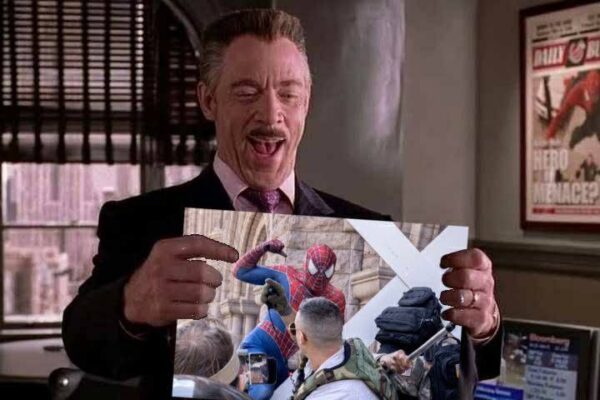
A meme of JK Simmons as newspaper editor J. Jonah Jameson, who is always demanding new dramatic photos of Spider-Man, getting the shot he’s always dreamed of.
Because Adolf’s hawked symbols denoting power and the exertion of coercive force—like the Punisher emblem co-opted by the far right, the Captain America iconography taken up by the insurrectionists, and the bat on Bruce Wayne’s chest. Or, for that matter, the spider on Love’s chest.
Or, for that matter, Love himself?
Superheroes wear symbols and are symbols.
One defining way superheroes, as symbols, confronted far-right bigotry after World War II—as a form of social engineering, as an organized attempt to play “a valuable role in the values acquisition of youngsters”—took place over several weeks in the spring of 1946. During that period, Donald J. Trump was born to an immigrant charwoman and a sociopathic father who had been arrested during a 1927 Klan rally in New York, an antecedent to what Lang tried to instigate in Minneapolis.
The text of the flyer announcing the 1927 Klan rally at which Fred Trump was arrested connects directly to the superhero anti-fascist project that unfolded while Fred’s favorite son took his first breath.
According to The Washington Post, the flyer stated that “Native-born Protestant Americans” were being “assaulted by Roman Catholic police of New York City.” It continued: “Liberty and Democracy have been trampled upon… when native-born Protestant Americans dare to organize to protect one flag, the American flag; one school, the public school; and one language, the English language.”
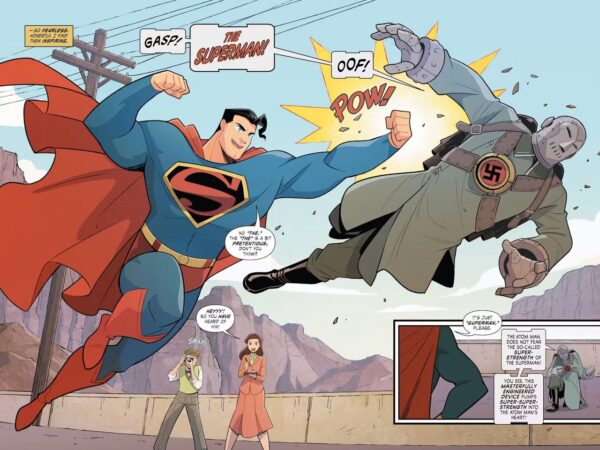
Superman punches the Nazi Bad Guy Atom Man in the opening pages of Superman Smashes the Klan.
This is exactly the rhetoric used by villains confronted by Superman on the radio show The Adventures of Superman once World War II was over and Superman no longer fought threats from Nazi Germany—like the stinkin’ Kraut mad scientist Der Teufel and his creations: the dreaded Atomic Pistol and the supervillain Atom Man, whom Der Teufel injected with liquid kryptonite.
The Adventures of Superman, with a listenership of 4 million people on 200 stations coast to coast on the Mutual Network, was an ideal platform for reaching children as 12.2 million of their fathers, uncles, cousins, and brothers returned from the war. These were men who had confronted real bastards bent on world conquest, not Lex Luthor puttering around in a lab. The ideologies represented by the threats these veterans faced were taking root on U.S. soil, even at higher levels of government.
In the 1940s, Georgia Governor Eugene Talmadge wanted to grant clemency to Klan members convicted of flogging African Americans, much as Demi-Dicked Donny has pardoned Lang and his neck-bearded buddies. At a proceeding, Talmadge likened the poor, sweet, innocent Klansmen to St. Paul and said, “Some of them thought they were doing the right thing. I have seen some pretty good people get misguided and cut the fool.”
Despite local preachers comparing the Klan to “the despicable Gestapo,” Talmadge admitted that he himself had whipped at least one Black man, using the same kind of flogger wielded by the Klansmen.
Georgia later named a very pretty bridge leading into Savannah after Talmadge.
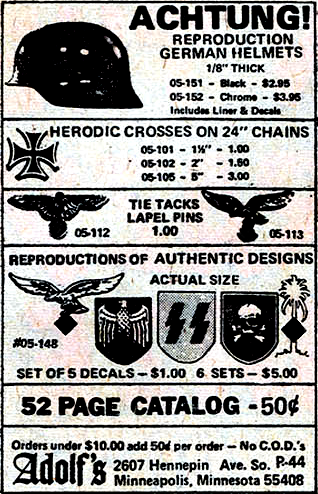
The ad for Adolf’s Nazi paraphernalia store in Minneapolis that appeared in Marvel comics in 1974.
In 1945 and 1946, the makers of The Adventures of Superman grappled with threats to truth, justice, and the American way greater than Der Teufel and Atom Man—threats such as Talmadge. Following a suggestion from executives at Kenyon & Eckhardt, the advertising firm that managed Kellogg’s sponsorship of The Adventures of Superman, producer Robert Maxwell coordinated with the Child Study Association of America, Big Brothers, and the National Conference of Christians and Jews to confront homegrown bigotry and antisemitism head-on. Maxwell called the campaign “Operation Intolerance.”
Despite the national Klan’s forced dissolution in 1944 over unpaid taxes—one of the few heroic acts performed by the IRS—the Klan was on the rise again by 1946. Its resurgence culminated in a large May 9 rally at Stone Mountain, Georgia, where pediatrician and Klan Grand Dragon Samuel Green proclaimed, “We are revived!” At the same time, The Adventures of Superman was broadcasting the serial “The Hate Mongers Organization,” which ran from April 16 through May 20, 1946.
“The Hate Mongers Organization” concerns a far-reaching plot to sow discord throughout Metropolis. The scheme involves arson; the beating of minors so severely that they require life-saving brain surgery; the planned desecration of a synagogue; the attempted assassination of a Methodist reverend; and other terrorist acts intended to thwart the establishment of Unity House, a joint effort by leaders of multiple faiths to bring together children of all beliefs and backgrounds.
The plot’s first incident is a mini-Kristallnacht. On a street implied to be multiethnic through the names of its businesses—the Community Market, Miller’s Bakery, Spinelli’s Shoe Repair, and Klausen Brothers’ Butcher Shop—it is the Jewish-coded Hoffman’s Drug Store that is targeted: its windows are smashed, and it is set afire. The Catholic priest helping to establish Unity House remarks on the use of violence to sow hatred: “It’s the Nazi method!” Jimmy Olsen replies, “We licked the Nazis, so I guess we can lick this!”
The organization behind the attacks is the Guardians of America, led by a man named Frank Hill, who is revealed to be Franz Hiller, a draft dodger and Nazi agent. When the Bowery Boys–ish street kids Hiller recruits for his terror campaign learn the truth, they become enraged: their fathers and brothers had been killed or injured in the European theater. They change course and raise funds for Unity House.
Although “The Hate Mongers Organization” tackles far-right sentiment festering in the United States, it still places a foreign agitator at the center of the bigotry. Less than a year later, The Adventures of Superman framed the sowing of bigotry in terms of privilege and class in the serial “Knights of the White Carnation,” which ran from February 26 through March 17, 1947.
(The title riffs on the Knights of the White Camelia, a white-supremacist organization made up of Confederate veterans. The organization disbanded in 1870 but was resurrected in 1939 by George E. Deatherage, who called for Nazi-like rule in the United States. Deatherage, like Trump, tried to stage a coup to overturn the results of the 1940 presidential election. History might not repeat itself, but it sure does rhyme.)
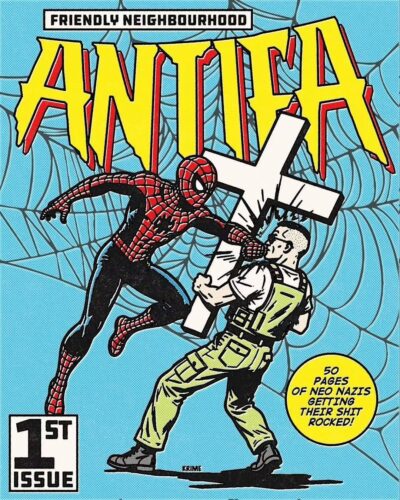
“Antifa” comic book cover made by the artist called “Krime.”.
In “White Carnation,” rich bastard Vincent Kirby, “from an old and aristocratic Metropolis family,” tells his organization of other rich guys—the Knights of the White Carnation, “dedicated to the preservation of Americanism”—that the lineup of starters on the Metropolis High School varsity basketball team includes an unacceptable number of “foreigners.” You know: kids with names like Pulaski, Kelly, Risutti, and Kaplan.
Kirby spouts lines of shit that precisely mirror the replacement theory currently advocated and acted upon with taxpayer money by Stephen Miller, scion of Jewish refugees from a shtetl called Antopol, in what is now Belarus. The “foreign” boys are framed for throwing a playoff game, and riots are nearly incited by pamphlets spouting rhetoric that has since become Trumpian and Millerian:
“The athletes who sold you out last night, and discredited you and your school, are foreigners. These foreign boys and their families have different ideals from yours. They will do anything for money, and unless they are stopped, they will ruin our great country. It’s up to you to show them they don’t belong in our schools. Don’t delay. Act now.”
The attempt to impose Miller-esque replacement theory on high-school athletics spirals into a conspiracy involving kidnapping and attempted murder. It is thwarted by the combined might of The Daily Planet, the Metropolis police, a few private eyes, and, of course, Superman.
“The Hate Mongers Organization” and “Knights of the White Carnation” are the first and third installments of an anti-fascist trilogy on The Adventures of Superman. It is the trilogy’s second installment that made a profound and lasting social impact.
With “The Clan of the Fiery Cross,” which ran from June 10 through July 1, 1946, the producers of The Adventures of Superman built on the work of Stetson Kennedy, a folklorist, writer, and friend of Woody Guthrie—a man known for wielding a “machine that kills fascists.” The extent of Kennedy’s involvement in the creation of the “Clan” serial has been disputed over the decades. However, Kennedy did publicize a number of secrets about the workings of the real Klan, specifically to strip away the mystique that had led magazines covering the Stone Mountain rally to call the event “haunting,” “mysterious,” and “awesome.”
Kennedy said of making the Klan’s inner workings public: “The law offices, state, county, FBI, House Un-American Activities Committee, they were all sympathetic with the Klan. The lawmen were, ideologically at least, close with the Klansmen. The court of public opinion was all that was left.”
The makers of The Adventures of Superman wanted to further that demystification. Part of the effort involved scaling back Superman’s superpowered deeds in order to place resistance to bigotry more squarely in the hands of Metropolis’s ordinary citizens.
As with “Knights of the White Carnation,” “The Clan of the Fiery Cross” begins with strange happenings in youth-centered sports. A Little League team, sponsored by the aforementioned Unity House and managed by Jimmy Olsen, is heading to the playoffs because of star pitcher Tommy Lee, a great kid whom everyone likes except teammate Chuck Riggs. Chuck and Tommy get into a tussle, and Chuck goes home to gripe about it to his uncle Matt. Matt Riggs suggests that something more sinister lies behind the boys’ conflict than first appears, and he urges Chuck to attend a meeting of “100 percent Americans” to address it.
Of course, the meeting is held by the Clan of the Fiery Cross—so named to avoid legal action from the real Klan. Its credo could be pasted directly into the flyer promoting the rally that Daddy Trump was busted for attending: “One Race, One Religion, One Color.”
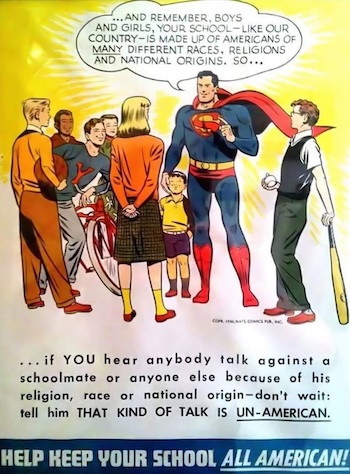
Superman Poster from 1949
It is as events escalate from this point that the storytelling genius of “The Clan of the Fiery Cross” reveals itself. The radio serial presents Tommy as a great, all-American kid—which he is. Only after several episodes, during which young listeners have built empathy for Tommy, is it revealed that Chuck and his uncle Matt resent him because he is Chinese American.
The makers of The Adventures of Superman, advancing a message of tolerance and of accepting people “on the basis of their character, not the color of their skin,” let children listening to the show know and like Tommy for his character before hinting at his ethnicity. This preempted any prejudice the audience might have held. Three Charlie Chan movies were released in 1946 alone, all full to the gills with racially problematic portrayals of Chinese Americans. Tommy, a kid without any of those problematic racial signifiers, drives home the message of “The Clan of the Fiery Cross” through the medium of radio. Tommy, simply by being Tommy, undermines the rhetoric of both the real and fictional Klan.
The other storytelling element of “The Clan of the Fiery Cross”—also present in “The Hate Mongers Organization” and “Knights of the White Carnation”—is that Jimmy Olsen and the other teenage boys are placed in serious, no-bullshit danger. When watching the 1950s Superman television show starring George Reeves, no one who saw Jimmy tied up with dime-store clothesline by crooks in a warehouse really thought he was about to get his ticket punched like Joe Pesci in Goodfellas.
These Superman radio serials place teenage boys in real peril. They are beaten, abducted, threatened with tarring and feathering, and left with broken arms as they nearly drown in fast-moving rivers. Their skulls are fractured—to the point that the aforementioned Catholic priest waits by a child’s bedside in case he is needed to administer last rites. They are placed in the crosshairs of snipers.
How does this fit the message of these serials?
These boys, fighting fascism on U.S. soil in 1946, are about 16 years old. About a year earlier, 18-year-old boys had died fighting bigotry and fascism in Europe. Kids’ sports and local youth centers placed the threats of bigotry and racism in contexts children could understand. Putting teenage boys in physical danger as they confronted bigotry emphasized that it was their generation’s duty to face the threat.
Writer Avery Corman, author of Oh, God!, Kramer vs. Kramer, and the memoir My Old Neighborhood Remembered, said in a recent interview that growing up during World War II made you “a teenager on the home front” and that “everything about that war was around you, all the time.” Every movie included a newsreel about the war, perhaps alongside a Max Fleischer Superman cartoon. Children participated in air-raid drills and material drives, collecting glass, rubber, paper, and scrap metal. Comic books urged children to support the purchase of war bonds. These radio serials were a mobilization: a call to muster for teenagers who might not yet have been shaving to join the fight against an intolerant threat to America.
“The Clan of the Fiery Cross,” in depicting the decking of fascists, delivered a literal punch in the face to homegrown fascists. During the run of the 1947 serial “The Adventure of the Monkey Burglar”—the storyline that immediately preceded “Knights of the White Carnation” and in which Superman teams up with Batman and Robin—Willard Johnson, vice president of the National Conference of Christians and Jews, presented Superman and the makers of the show with an Award of Distinguished Merit.
Johnson praised the program for “promoting fair play and good sportsmanship among Americans of different races.” He continued: “I sincerely believe that Superman has demonstrated how, when people work together and understand each other, they can drive out Un-Americanism and develop a feeling of brotherhood among all races, creeds, and colors.”
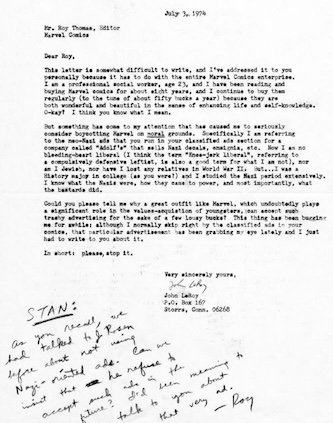
The letter from John LeRoy to Marvel comics editor Roy Thomas urging Marvel to no longer run ads from Adolf’s.
Bud Collyer, who played Superman and Clark Kent on the show and later advocated for tolerance on behalf of the Anti-Defamation League, accepted the award as Superman “with sincere gratitude, and also with our assurance that we will continue our efforts to root out and expose all that is Un-American.”
The bigotry Superman fought was considered un-American then, rather than the “patriotism” that modern fascists—and the Klan organizers with whom Daddy Trump shared a cell—now use to frame it. The right-leaning Veterans of Foreign Wars and the liberal American Veterans Committee gave The Adventures of Superman producer Robert Maxwell citations for fighting bigotry.
On the other hand, the world-class, truly shitty evangelical antisemite—and good friend of Father Coughlin—Gerald L. K. Smith, who called Huey Long a true “Superman,” said that the hero Superman was “a disgrace to America.” Smith founded, among other pus-ridden ventures, the Christian Nationalist Crusade and the America First Party.
Klan Grand Dragon Samuel Green, who had led the Klan revival at Stone Mountain, received a call from the Atlanta bureau chief of the Associated Press shortly after the first episode of “The Clan of the Fiery Cross” aired. The bureau chief said, “Superman’s really on your trail… sounds to me like Superman’s got a pipeline into your klaverns [enclaves] somehow. You’d better watch your step.”
Green said he would like to get his hands on the “rat” who had leaked the Klan’s secrets. The bureau chief replied, “You’d better make it snappy—Superman just flew over your Imperial Palace to case the joint.”
The Atlanta branch of the Klan led a phone and letter-writing campaign against the local Mutual affiliate for broadcasting The Adventures of Superman. It also attempted to organize a boycott of Kellogg’s Pep cereal, the show’s main sponsor. To no avail. “The Clan of the Fiery Cross” demystified the Klan so effectively that it reportedly contributed to a dramatic membership decline and a resulting drop in revenue from lost dues.
The legacy of “The Clan of the Fiery Cross” has lasted into the 2020s in the form of the pretty wonderful graphic novel Superman Smashes the Klan, loosely based on the radio serial. The book was written by Chinese American MacArthur Fellow Gene Luen Yang and illustrated by the Japanese duo Gurihiru, the shared name of collaborators Chifuyu Sasaki and Naoko Kawano.
Asked during the first Trump junta why he chose to write Superman Smashes the Klan, Yang said that “the ideas driving the Klan seem to be making a resurgence.” He cited the Charlottesville Unite the Right rally and the murder of nine people by white supremacist and neo-Nazi Dylann Roof, who opened fire at Emanuel African Methodist Episcopal Church in Charleston, South Carolina. The anti-Chinese rhetoric that accompanied the advent of COVID-19 also shaped Yang’s approach.
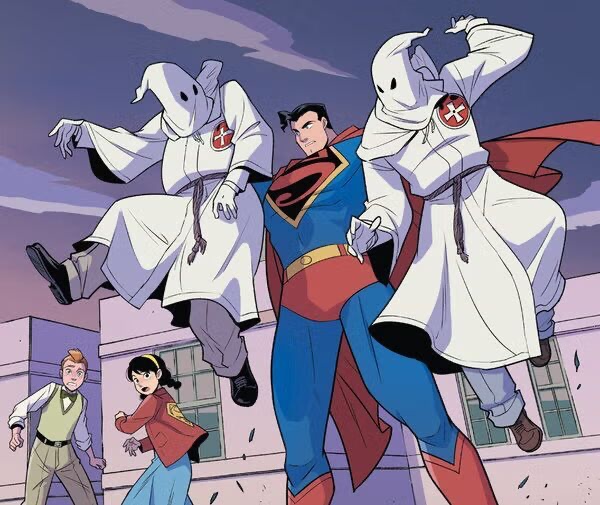
A panel from Superman Smashes the Klan, written by Gene Luen, loosely based on the radio serial
“Superman Smashes the Klan is my attempt to talk about these modern issues in an old context,” Yang said.
Despite the heavy topics it tackles, Superman Smashes the Klan is a delight.
Retelling “The Clan of the Fiery Cross” primarily from the perspective of Tommy Lee and his family—most significantly, his younger sister Roberta, a character created by Yang—Superman Smashes the Klan is full of intoxicatingly innocent “Gosh, wow!” optimism and the kind of community-based togetherness that informs It’s a Wonderful Life, the definitive film myth of the American Dream made by the immigrant filmmaker Frank Capra.
The Lee family are not merely immigrants to America; they are newcomers to postwar American prosperity, having just moved from Chinatown into a new, bigger, nicer house. They embody postwar opportunity, and the threat of Klan-based bigotry is not only a threat to the Lees—it is a threat to everyone’s American Dream.
Part and parcel of this celebration and defense of the American Dream is Superman’s embrace of his own identity as an immigrant. As he learns about his Kryptonian heritage, he gains a greater capacity to defend the American Dream for Tommy and Roberta’s family, and for all of Metropolis.
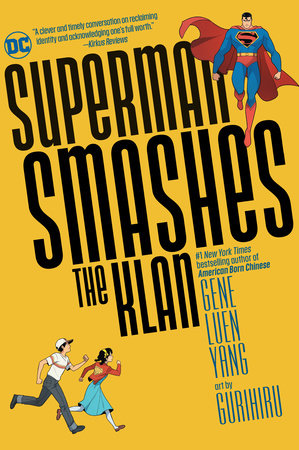 Superman and the Lees are on the same immigrant journey, and the resolution of that is the defeat of the Un-American Klan.
In this context, Yang addressed the distinctly Jewish origins of Superman that Spiegelman wrote about: “Those early Superman comics—he’s basically a golem. It comes out of Jewish tradition: the golem righting wrongs and beating up corrupt politicians, always fighting for the common man. You can’t escape that…. [H]e’s the guy. He’s the original superhero. If you’re a superhero fan, you’re, by extension, a Superman fan.”
Yang’s reinterpretation of what he sees as a foundational Jewish experience within a Chinese American context brings those traditions together. It affirms a commonality in the American experience while confronting the divisiveness of fascism. In its own way, Superman Smashes the Klan is a four-color iteration of Metropolis’s Unity House. People from different backgrounds—both on the creative teams behind the graphic novel and the original radio serial, and among the characters within the novel and serial—come together to thwart the fascist inclinations of those who would use superhero iconography to drive us apart.
“Black, white, Mexican, whatever you are, we are in this together,” Minneapolis Spider-Man Love said on the day of his arraignment for slugging Lang.
Love’s attorney, Jack Rice, said that Love acted in self-defense and, more tellingly, in defense of others, as Lang’s crew drove trucks “onto a curb toward a crowd of people.”
Superman, Spider-Man, Captain America, and so many others can call ordinary people to action and help make our communities stronger through the patriotic, wholesome, and all-American activity of slugging Nazis.
Author, critic, personal trainer, and writing instructor Michael Marano, whenever he publishes anything here that’s construed as “woke,” increases traffic to this site by as much as 100,000 hits.
Tagged: American politics, CAPTAIN AMERICA, Jewish American culture, Ku Klux Klan, Spider Man, anti-fascism, comic books, fascism, propaganda, radio history, superheroes