
Film Review: “NAZA” — A Documentary Against Willful Blindness
By Steve Erickson
Yuval Abraham and Rachel Szor’s rigorously constructed follow-up to No Other Land uses testimony from Israeli military whistleblowers to expose the systems of surveillance, dehumanization, and moral evasion that shaped Israel’s war on Gaza.
NAZA, directed by Yuval Abraham and Rachel Szor. According to Variety, screenings will begin, exclusively, at the IFC Center in New York City on September 30. Distribution of the documentary thereafter will be “spearheaded by The Guardian and mk2, who have assembled a team of U.S. and international partners and consultants to bring the film to audiences as quickly as possible.”
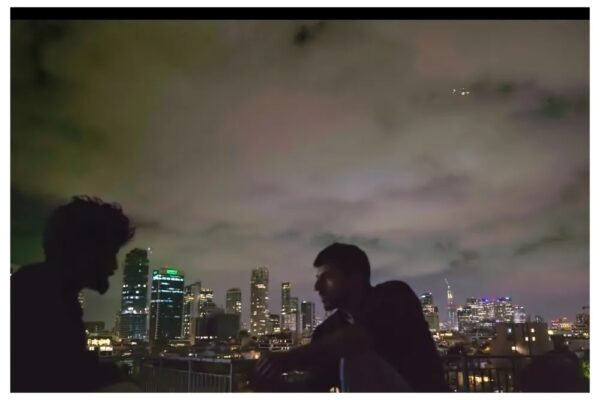
A scene from NAZA. Photo: courtesy of mk2
As a follow-up to the Oscar-winning No Other Land, NAZA’s premiere was always going to be an event. But it is a documentary about one of the key tragedies of this era, a 21st-century crime against humanity: Israel’s genocide in Gaza. So it was destined to make news outside of the film world. Israeli culture minister Miki Zohar has accused directors Yuval Abraham and Rachel Szor of treason, writing “this morning, I wrote to the director general of the Population and Immigration Authority and the director general of the interior ministry, asking them to examine the possibility of revoking the Israeli citizenship of the creators of the anti-Israel film NZA [sic] for breach of loyalty to the state and collaboration with the enemy.” Other officials, from Benjamin Netanyahu and Avigdor Liberman to Naftali Bennett, have also condemned the film and its directors in the harshest possible terms. NAZA has broken the barriers, many erected by the Israeli government, that discipline acceptable discourse in and about Israel and its actions. Rachel Szor’s parents have had to face the wrath of far-right crowds, whose members have called for the execution of the directors and the demolition of their homes.
Abraham and Szor directed 2024’s No Other Land, which follows the destruction of a town in the West Bank, and was made in collaboration with two Palestinian filmmakers, Basel Adra and Hamdan Ballal. Only Israelis could’ve gotten access to their country’s soldiers and intelligence officers to make the interviews in NAZA possible. Abraham explains why this had to be: “Imagine if a Palestinian journalist in Gaza tried to do what we did and called up senior Israeli officials. There is no comparison. They would most likely be murdered.” The directors talked to 24 whistleblowers, many in the army, who are hidden in shadows, their voices altered. Their stories are damning NAZA takes its name from the IDF’s term for collateral damage.
Before No Other Land established Abraham as a filmmaker, he wrote for +972 magazine. He still considers himself primarily an investigative journalist. (The Guardian, an English newspaper, co-produced NAZA.) This isn’t a lazy documentary, content to be a vessel for what is a damning case against mechanized barbarity. Abraham and Szor thought hard about its aesthetics. His interviews are filmed on the roof of a Tel Aviv apartment building. Drones and airplanes fly overhead. Ambient sound, along with hushed electronic music, is there to supply a steady buzz. The view allows for telling glimpses into neighboring buildings. Life in Tel Aviv appears to be proceeding relatively comfortably. Seen through their windows, its residents spend their time enjoying life, exercising, and watching TV. Because Abraham and Szor look at the city as an expanse of towering skyscrapers, their images of Tel Aviv have an icy, boxlike texture. In this sense, the documentary uses surveillance to make a moral judgment on the city’s residents. Their comfort depends on denying — or ignoring — the fact that a genocide is occurring just 60 miles away. Like The Zone of Interest (whose director, Jonathan Glazer, is one of NAZA’s producers), the vision of privileged indifference points to a willful blindness. IDF violence is tucked away in a negative space, spoken about but unseen until the film’s end.
NAZA’s interview subjects have consciences; they are guilty enough to speak about the horrors they’ve committed. But they don’t see themselves as actively racist or as bad people. They claim that Israel’s intelligence unit is made up of people who think of themselves as good liberals. In this sense, NAZA dramatizes how dehumanization is a tool that Israel uses against Arabs. For example, a soldier compares controlling bombs to playing video games. Modern technology — especially AI-guided targeting — makes the dirty work of warfare, which includes murdering women and children, easier. All the phones that belong to Palestinians in Gaza and the West Bank have been placed under surveillance, which makes tracking and killing the guilty and the innocent easier.
Under the protocol established by NAZA, the IDF has been given expansive justification for slaughtering women, children, and men who have nothing to do with Hamas. If one of the army’s targets is in a building or a home, a bomb can be dropped — regardless of how many innocent people are there. NAZA even makes the case that the IDF deliberately chooses to kill Hamas members amidst their families.
The argument that Hamas utilizes civilians as human shields — everywhere and anywhere — is deployed to justify homicidal fury against all Palestinians. The strategies used to eliminate the civilian “enemy” are sickening. One tactic is to deliberately starve the entire region of Gaza, allowing its residents to then be shot by snipers as they wait for food to be distributed. A soldier testifies that one bombing resulted in 500 civilian deaths — and that this number of casualties had been approved in advance. The testimony from members of the IDF has become NAZA’s most controversial point in terms of journalistic credibility. The IDF has questioned the film’s trustworthiness because of the anonymity of its sources. Abraham states that the film team and The Guardian have verified the claims made by the interviewees. Of course, this line of attack reveals an ongoing double standard: the American media accepts descriptions of Hamas’ violence from the Israeli government — often without requesting evidence. The whistleblowers confirm Israeli practices that are well known but not reported in our media, such as the blackmailing of queer Palestinians and the withholding of food as a military weapon.
NAZA presents a view of Israel as a country full of “good Germans,” willing to go along with myriad excuses, from the utterly flimsy to the insanely Biblical, to murder Palestinians in order to occupy their land. We see the Holocaust cynically weaponized by Netanyahu in TV clips. As bombs fall on Gaza, the Tel Aviv Cinematheque hosts a Claude Lanzmann retrospective that ignores the message of his masterpiece, Shoah: that the genocide would not have happened had ordinary Germans and Poles not been complicit in the slaughter.
Abraham and Szor don’t pretend that they can speak for Palestinians. They do what they can — offer an inside view into Israeli life, confirming the IDF’s devilish practices in the words of its own soldiers. And, of course, Americans are culpable for what has happened and is still happening — our tax dollars paid for the bombs these soldiers dropped on Gaza’s people, on their hospitals, universities, and museums. (Agencies estimate that the explosive force used is equal to six or more times the power of the atomic bomb dropped on Hiroshima during World War II. Eighty-one percent of Gaza’s buildings have been destroyed.) We sit comfortably in our own homes and are content to look away from the moral and political fallout of the heinous damage. In a move that would be hilarious if the stakes weren’t so grim, The Free Press published an attack on NAZA by Israeli journalist Haviv Rettig Gur, who admitted that he hasn’t even seen it. The film’s reception proves that many will do what they can to stop us from taking a hard look at what the U.S. and Israel have done and are doing. It will be harder for these “good Germans” to maintain an exculpatory blindness — and to hide the truth from others — after this documentary.
Steve Erickson writes about film and music for Gay City News, Slant Magazine, the Nashville Scene, Trouser Press, and other outlets. He also produces electronic music under the tag callinamagician. His latest album, Bells and Whistles, was released in January 2024, and is available to stream here. He presents a biweekly freeform radio show, Radio Not Radio, featuring an eclectic selection of music from around the world.
Tagged: "NAZA", "No Other Land", Gaza, Genocide, IDF, Israel genocide