Performing Arts Feature: Huzzah! Renaissance Faires as Immersive Theater
By Bob Abelman
Renaissance Faires and Festivals are, among many things, immersive, inclusive, and highly participatory forms of theater. King Richard’s Faire, which is New England’s largest and oldest medieval-themed entertainment venue, serves as an intriguing case study of countercultural expression and commercialized theatrical spectacle.
King Richard’s Faire, 5 Pine St., Carver, Mass. Weekends through Oct. 25, plus Labor Day and Columbus Day Mondays. $36 – $46 for adults or $22 – $26 for children ages 4-11.
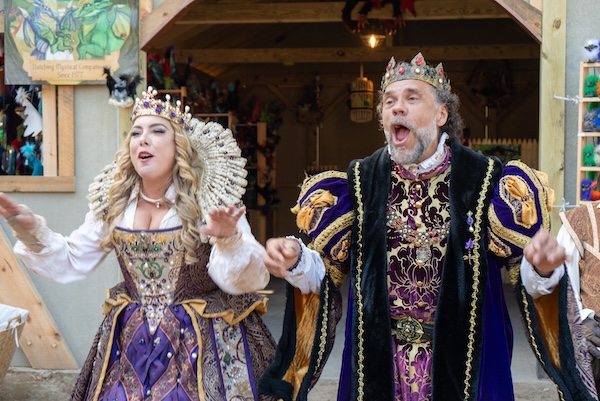
Kirk Simpson as King Richard XI and Elizabeth Crouse as Queen Anne III. Photo: Ryan Roy
Despite the growing popularity and prevalence of Renaissance faires when I was a kid, my parents never took me to one. Too many mead-impaired Maid Marians and funnel cakes for their liking. Too much jousting.
And though my later training as a theater critic exposed me to many renowned Elizabethan and Jacobean playwrights—Shakespeare, Marlowe, and Jonson among them—it was clear that faires were never the places to find their classic works.
But if you were in the market for bawdy tavern songs or mildly inappropriate limericks by period poets like John Skelton, Thomas Nashe, and Pietro Aretino, the on-site pubs and PG-rated stage shows at these faires and festivals were the places to be. There are plenty of other forms of theater as well—much of it unscripted, most of it interactive, and all of it inclusive—for the fairgrounds function as a live-action performance space.
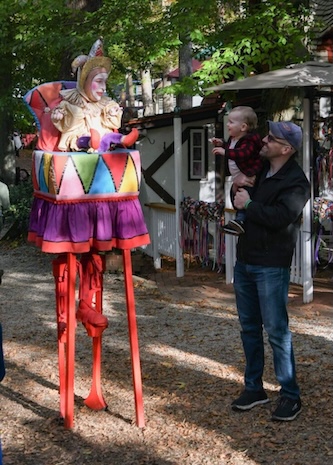
Street engagement at Maryland Renaissance Festival. Photo: Bill Englehardt
Roughly 200 Renaissance faires—immersive, pseudo-historical reenactments taking place amid romanticized, 16th-century-style architecture and wooded spaces—are held across the United States each year and draw millions of visitors. “Everything,” wrote historical reenactment scholar Sam Blazer, “is an element of the past that never was.”
Faires tend to be energized and crowded gatherings complete with Medievalesque food and drink, curio vendors, shows, rides, and marketplaces. Workers, actors, and committed patrons come dressed as courtly and corset-clad ladies, metal-laminate-layered knights, wandering wenches, assorted peasants, random nobility, fairies, and wizards. But faires are also judgment-free safe havens for creativity and countercultural self-expression, where you might find a visitor in a Deadpool, anime, or Middle-earth Hobbit costume. There’ll be no shortage of Shreks.
Psychologists—who have long noted that dressing up lets people express suppressed parts or “shadow sides” of their personalities—would have a field day at a Renaissance faire.
The overriding inclusivity and creativity of these events are grounded in their origin story. According to National Geographic—a leader in all things geographic, cartographic, and cultural—the first formally recognized faire occurred in Los Angeles in May 1963.
The Renaissance Pleasure Faire and May Market—modeled after the open-air festivals of medieval Europe—was the brainchild of a McCarthy-era theater teacher who balked at having to sign a political loyalty oath to work in California’s public schools. She sought to create a refuge from political repression and to celebrate the era’s countercultural values. The faire’s many volunteers were largely left-leaning creatives from the Hollywood Hills. Many had been blacklisted as communists, leaving them unable to find work in the film and television industries.
That faire, which served as a fund-raising event for the local listener-supported KPFK/Pacifica Radio station, presented an opportunity for these individuals to use their skills and participate in a project that celebrated free thinking. It also encouraged attendees to become active participants in the fantasy. The founders viewed it as a one-off gathering, but it attracted more than 3,000 attendees and sparked enough demand to become an annual event—and then a nationwide cultural phenomenon.
Today, Renaissance faires differ in terms of scale, quality, logistics, and accessibility. Mega-festivals like the Texas Renaissance Festival in Todd Mission, the Maryland Renaissance Festival in Annapolis, and the Bristol Renaissance Faire in Kenosha, Wisconsin, operate for months and feature sprawling villages with permanent structures. Smaller faires, like the Canterbury Renaissance Faire in Silverton, Oregon, pop up for long weekends and are typically housed in makeshift booths and tents. They vary in their desired degree of authenticity as well.
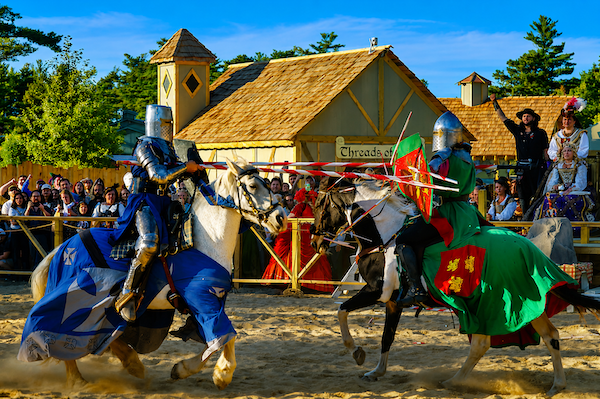
Jousting at King Richard’s Faire. Photo: Maddie Sedley
What they all have in common is a commedia dell’arte aesthetic and driving theatricality.
Unlike American Revolutionary War and Civil War reenactments, where historical accuracy is paramount and best observed from a safe distance, Renaissance faires are thriving and unpredictable ecosystems of performance art. They involve everyone who attends, and the experience typically begins the moment you step through the gates.
The best of them create an atmosphere not unlike that of the 2021 Apple TV+ series and 2026 Tony Award-winning Broadway hit Schmigadoon! There, a backpacking couple stumbles into a mysterious, magical town where life plays out entirely like a 1940s or 1950s Golden Age musical, with character archetypes breaking out in song and dance in huge production numbers.
At a faire, life plays out like a medieval celebration facilitated by a vivid, vibrant, enveloping landscape populated by people fully dedicated to their meta-immersion in this world. Ideally, the air is filled with the smell of woodsmoke, baked goods, dusty earth, and mead, as well as the sounds of the lute, dulcimer, shawm, and occasional “huzzah!”
In short, suspension of disbelief should be easy, immediate, and all-encompassing. Disney parks have had suspension of disbelief down to a science since 1955.
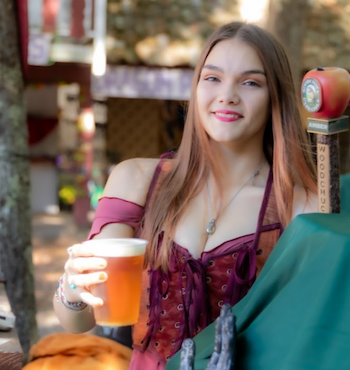
Beer wench at King Richard’s Faire. Photo: Ryan Roy
King Richard’s Faire in Carver, Mass., is New England’s largest and oldest Medieval-era festival. The faire started outside Chicago in 1972 and moved to Carver ten years later, where it has remained for 45 years. It is, in many ways, typical of most large-scale enterprises. Theatrically, it is better than most but falls short when compared with some of the best.
Until last year, King Richard’s Faire was held on the 80-acre grounds of a cranberry farm off Route 58. But according to Aimée Bialick, the faire’s general manager, organizers were unable to come to an agreement on a new lease with the landlord, and a significant amount of real-life drama ensued.
Lancelot Entertainment—a private-equity investment firm that focuses heavily on acquiring and consolidating historical theme parks and festivals across the United States—purchased the faire in late 2024 and sued then-landlord Alphonse D’Amico. It accused him of attempting to sabotage lease negotiations so that he could start a faire of his own on the property. D’Amico’s associates had, in fact, pursued festival-related entertainment and liquor licenses, registered a limited partnership named “Camelot Renaissance Village,” and met with town officials about hosting a Renaissance faire. D’Amico countersued, alleging that Lancelot Entertainment underpaid him and tried to force through a cheaper lease agreement.
King Richard’s Faire has since relocated to the former Edaville Family Theme Park, a mile down the road from its original location. The sprawling, 80-year-old, more-than-200-acre park was purchased for $8.7 million by Lancelot Entertainment. Much of the faire’s 2025 season was spent adjusting to the new property, turning an amusement park with train tracks and modern rides and attractions into a medieval village, and moving from a state of transition to one of permanence.
It received mixed reviews from patrons in this regard, but in their defense, faire organizers had only five weeks between receiving the go-ahead from the Town of Carver and opening day. As of this season’s opening, most of the telltale signs of the old amusement park are gone. In their place is a greater sense of a lived-in village with period structures and sprawling pathways.
The entrance fee, plus an optional protection plan and add-on VIP experiences, gives patrons full-day access to the grounds, all the shows taking place on its 11 open-air stages, street performances, and daily jousting tournaments. As is typical of theme, amusement, water, and adventure parks, everything else—including rides, games of skill, face painting, and a small petting zoo—comes at an additional cost. With potential earnings ranging from $7 million to $10 million per season, it’s easy to see why Lancelot Entertainment has invested in King Richard’s Faire and why the number of stages and shows is dwarfed by the number of ye olde shoppes and eateries. It is impossible not to see the commercialization of what was originally an altruistic, grassroots enterprise.
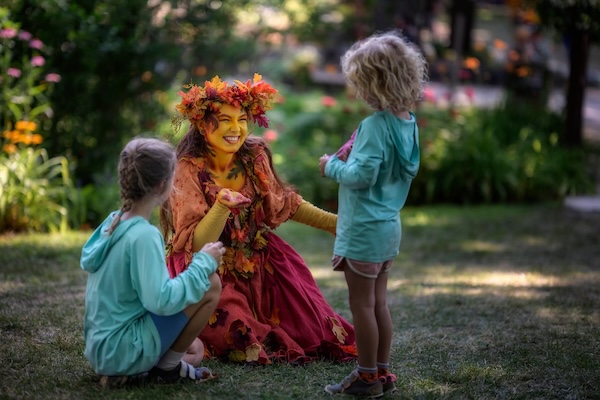
Street storytelling. Photo: Courtesy of the Bristol Renaissance Faire
Still, a sense of the theatrical plays prominently at King Richard’s Faire.
There’s a narrative that serves as a backdrop to this year’s festivities and celebrates the faire’s landmark anniversary. We are told at the start of the day that King Richard XI, Queen Anne III, and the other royals have returned to the village during harvest season, only to find themselves caught up in mysterious royal intrigue and magical mishaps. The story is played out in a two-act musical parody titled “Hell No Dolly,” staged as two short performances over the course of the day. It’s a modest enterprise—technically unsound on opening day, but earnest in its presentation and wonderfully endearing.
There’s also a lesser and less endearing theme that takes place during the second weekend of the season. “Babes & Beer” includes a pub run and a cleavage contest. To the faire’s credit and PR savvy, the event serves as a fundraiser for breast cancer awareness.
More than 70 performances occur in repeated repertory on the faire’s stages, and one of the best is “Washing Well Wenches.” Part sketch comedy and part improvisational show, its four performances per day center on two bawdy, cheeky washerwomen doing laundry while engaging in playful banter and audience interaction. The players are members of an all-female professional troupe who have been trained by acclaimed companies like The Second City, The Groundlings, and the Upright Citizens Brigade and travel the faire and festival circuit.
Also not to be missed is the husband-and-wife team behind the comedy show “Grievance by Proxy,” in which conflicts and pet peeves identified by the audience are resolved by the players through staged combat.
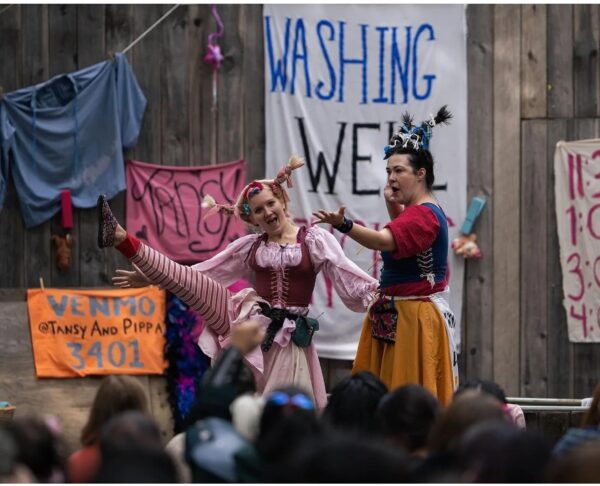
Tansy and Pippa at King Richard’s Faire. Photo: Courtesy of The Washing Well Wenches
Expect close encounters with street artisans throughout the day, ranging from the Roaming Fiddler and the Rogue Piper to the Traveling Miracle Show and Uncle Jester. But it is in this area that King Richard’s Faire falls short as a fully immersive Schmigadoon! experience, much of which can be chalked up to growing pains.
The Maryland Renaissance Festival is celebrated for filling its lanes and pub corners with an abundance of compelling acoustic musicians, minstrel groups, and novelty acts. The Bristol Renaissance Faire is renowned for its roving, captivating storytellers. These artists, whose job it is to be catalysts for imagination and play, seem fewer and farther between on King Richard’s Faire’s expansive acreage and are not nearly as engaging as they could be. The costumed employees seen circulating the premises also do little to draw patrons into the world of the Renaissance beyond being part of the scenery and offering up a “good morrow.”
Perhaps the next phase of the faire’s transition to its new home will bring greater attention to the things that make the experience more all-encompassing. After 45 years, it certainly has staged entertainment down pat. And the smoked turkey leg.
Bob Abelman is an award-winning critic who covers the Rhode Island theater scene for the Boston Globe.