
Film Review: “Bernstein’s Wall” — A Vivid Portrait of the Artist as Activist
By Jonathan Blumhofer
Douglas Tirola’s documentary draws on a remarkable archive to make Leonard Bernstein’s musical, political, and moral commitments feel urgently contemporary.
Bernstein’s Wall, directed by Douglas Tirola. Screening at Coolidge Corner Theatre, Brookline through August 13.
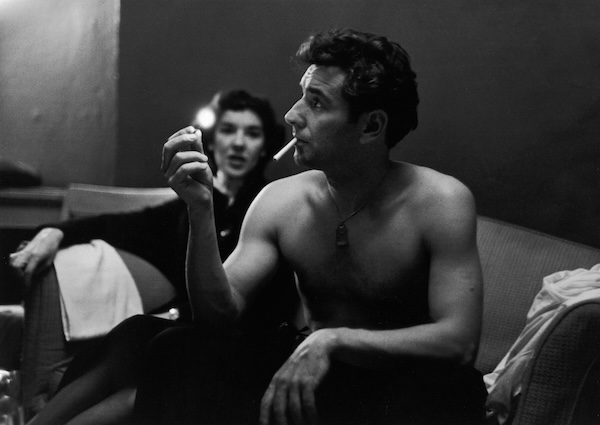
Leonard Bernstein sits shirtless next to his sister Shirley on a couch and prepares to light a cigarette with a match as she speaks to him, 1940s. Photo: Ruth Orkin
Unsurprisingly, Leonard Bernstein never got around to writing a memoir. While that omission is no doubt a loss to posterity, the composer-conductor-pianist-educator-public intellectual-activist left behind such a copious legacy on film that it was probably just a matter of time before an enterprising director saw fit to combine fragments of the footage into the next-best thing: a self-narrated audio-visual document.
Enter Douglas Tirola, whose Bernstein’s Wall presents a 105-minute snapshot of a life that remains as fascinating, dynamic, and relevant as ever. Weaving together archival footage, family movies, tape-recorded interviews, and more, the director has given us perhaps as close to a Bernstein autobiography as we can hope to expect.
As with a book, what’s made it into his film is selective. The essentials of Bernstein’s life story are present, from his childhood in Boston, studies in Philadelphia and Tanglewood, and his sensational 1943 debut with the New York Philharmonic to his directorship of that ensemble, various successes (and failures) as a composer, identity as a Jewish American, and extensive work as a teacher.
Family life, especially Bernstein’s marriage to Felicia Montealegre, features considerably, too. Tirola doesn’t shy away from the darker side of that relationship: one of the film’s most striking moments is an extended monologue from Montealegre articulating her frustrations at becoming the stay-at-home wife of a celebrity husband with a growing brood to look after (she was an accomplished actress in her own right). Bernstein’s sexuality is dealt with discreetly by way of extracts from letters between him, Aaron Copland, and Montealegre, but otherwise doesn’t dominate the storytelling.
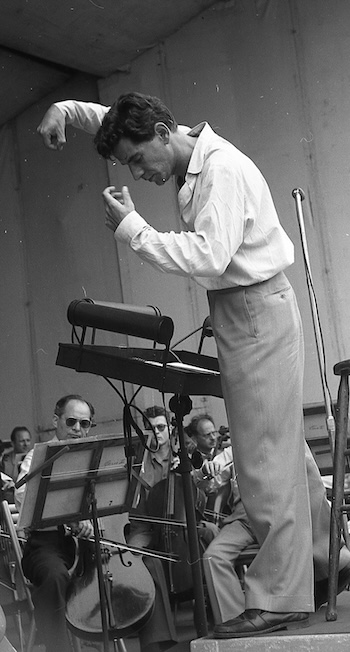
Leonard Bernstein conducting during the 1940s. Photo: Ruth Orkin
Instead, Tirola’s main focus is Bernstein’s commitment to the ideal of the artist as activist. That was a concept towards which his subject devoted much thought, time, and energy. Regardless, he was often pilloried, sometimes mercilessly, for his engagement in non-musical activities: the notorious 1970 fundraiser for the Black Panthers legal defense fund that resulted in Tom Wolfe’s “Radical Chic” gets a thorough airing here.
True, Bernstein could be naïve. His daughter, Nina, recalled being mortified at the simplistic solutions he offered to grave problems discussed one evening over dinner at the White House with Jimmy Carter. In Wall, his musings on a potential Cold War thaw following the NYPO’s 1959 tour of the Soviet Union smack a bit of giddiness and a brief mention of redistributing wealth will surely raise hackles in certain political quarters.
Despite the tortured contradictions that sometimes emerged in interviews, Bernstein’s heart was in the right place: he was, ultimately, a realist unafraid to dream big—and no intellectual pushover. “Art cannot change events,” he admits at one point in Tirola’s film. “What it can do is move people whereby they can wake up and be active.”
Accordingly, he led by example.
Tirola traces Bernstein’s engagement in the Civil Rights and anti-Vietnam War movements, as well as his efforts towards interracial and musical bridge-building: there are snippets of a performance with Louis Armstrong at Lewisohn Stadium, a chat with Duke Ellington, and part of André Watts’ brilliant Young People’s Concerts debut. Unfortunately, there seems to be no video of Bernstein’s 1986 birthday dinner with Michael Jackson, though stills from that night—Lenny with the King of Pop and Quincy Jones—appear in the film.
Of course, it helped that, during his lifetime, Bernstein occupied a perch as the country’s premiere classical musician that no longer exists. He was a celebrity who rubbed elbows with (and sometimes lit cigarettes for) Frank Sinatra, Barbra Streisand, Harry Belafonte, James Baldwin, and others. For good measure, Tirano includes a snatch of the appropriate spot in R.E.M.’s “It’s the End of the World as We Know It” and Bernstein’s ties with the Kennedy family form a central part of the film. Indeed, it is sobering to hear an excerpt of his remarks extolling the arrival of American high culture in 1962 knowing what the decades since his death have held for that very thing (and what the last couple of years, in particular, have meant for the Kennedy Center).
Nevertheless, Bernstein’s own star burned bright.
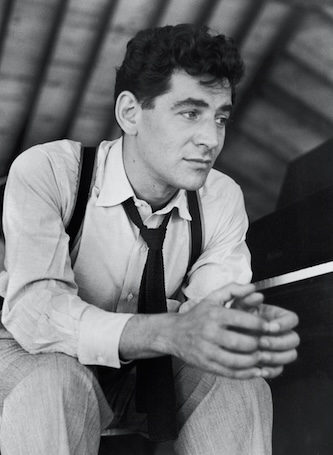
Leonard Bernstein sits with his elbows on his knees on his piano bench at Tanglewood. Photo: Ruth Orkin
Tying all of his activities together was music-making of often electrifying intensity, depth, and breadth. Tirola provides a proper focus on Mass, his most provocative and musically daring composition, but spends rather less time on other works (though the postlude from Act 1 of A Quiet Place makes a welcome, anonymous cameo late in the proceedings). Curiously, too, there’s virtually nothing on the music of Mahler, who was not just a composer Bernstein championed but a figure who functioned for him as something akin to the 20th century’s musical prophet.
There is much more, though, on Beethoven, who Bernstein described as being a composer of “struggle: struggle for peace, for fulfilment of spirit, for serenity, for triumphant joy. He achieved [that] in his music.” In the conductor’s view, it is ultimately an engagement with the art itself—“somehow it must be possible for us to learn from his music, from listening to it with all our power of attention [and] concentration”—that can show the way and lead to growth, understanding, and peace.
If such sentiments appear to our jaded eyes as hopelessly optimistic, it’s worth noting that they were formed in the crucible of an era perhaps even more volatile than our own. And, though it was often a theme of his music, Bernstein’s faith in the perfectibility of man wasn’t some blind, untested thing—“[man] can be divinely wrong” he noted, knowingly, in 1954. In that same essay, though, he offered that humanity’s “noblest endowment” is its “capacity to change.”
In a time of calcified partisanship, economic unrest, social anxiety, and so much more, that’s a valuable truth of which to be reminded again and again. So is Tirola’s larger point: that all the arts, not just music, can have a central, decisive role to play in transforming our present circumstances into something more equitable and just.
Ultimately, Bernstein’s Wall is a call to artistic action and courage. It stands as a particularly cogent response to the forces at work in public life that seek to accrue power and wealth for themselves while, in the process, diminishing the rest of us and attempting to police the arts along the way. Lenny, we can rest assured, approves its message.
Jonathan Blumhofer is a composer and violist who has been active in the greater Boston area since 2004. His music has received numerous awards and been performed by various ensembles, including the American Composers Orchestra, Kiev Philharmonic, Camerata Chicago, Xanthos Ensemble, and Juventas New Music Group. Since receiving his doctorate from Boston University in 2010, Jon has taught at Clark University, Worcester Polytechnic Institute, and online for the University of Phoenix, in addition to writing music criticism for the Worcester Telegram & Gazette.
Tagged: American music, American musician, Bernstein’s Wall, Douglas Tirola
1 Comment
Leave a Comment
A very very nice essay. I just watched the documentary and this review does it well.