
Book Review: Dennis Cooper’s “Closer” — A Mirror Held to Desire’s Dark Core
By Michael Londra
Dennis Cooper’s “transgressive” reputation obscures his deeper project: language as moral instrument, and the victim rather than the predator as the true subject.
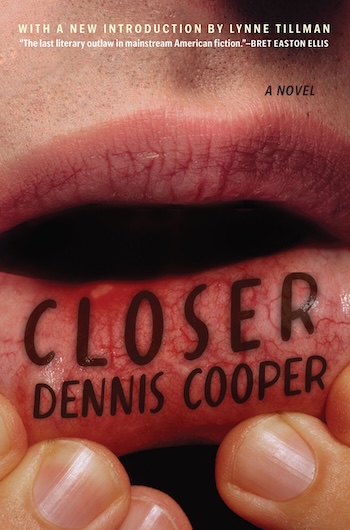
Closer by Dennis Cooper, with a new introduction by Lynne Tillman, Grove Press, 160 pp, $17.
Laurence Olivier’s voiceover to his Oscar-winning 1948 film version of Hamlet announced one of the most controversial takes on Shakespeare’s Prince of Denmark: “This is the tragedy of a man who could not make up his mind.” In other words, Hamlet doesn’t know what he wants.
What if Hamlet lived in Southern California? One possibility to consider is Dennis Cooper’s 1989 novel Closer. Now reissued with an introduction by Lynne Tillman, Closer is the first in his George Miles Cycle, which also includes Frisk (1991), Try (1994), Guide (1997), and Period (2000). As meticulously crafted as—at considerably shorter length—Proust’s À la recherche du temps perdu or Karl Ove Knausgård’s My Struggle, Cooper’s pentalogy is inspired by high school friend and muse George Miles. Interviewed by The Paris Review, Cooper noted George “was an amazing, brilliant, crazy, sweet, beautiful kid.” It was this passion that jumpstarted Closer: “George was very important to me…I wanted him…to be known…to be remembered.”
To paraphrase Olivier, Closer is a novel about a young man without desire. George is an adolescent in despair. “I don’t even think I’m alive anymore,” he tells his diary, included here in sections alternating with chapters of third and first person narration, each labeled for the different boys and men George looks to for emotional connection: “I don’t know what’s going on. I keep crying for no reason…I wish I knew what I wanted.” Allowing himself to be exploited by others, George endeavors to grasp who he is through experience: “I’m trying out all sorts of stuff and when the right thing shows up I’ll keep doing it.”
By contrast, the folks he encounters anchor their identities in artistic ambitions, even if it’s all just fantasy bullshit. First up is John, a photographer who also likes to draw. He aligns himself with punk rock: “John liked the way punk romanticized death…He dyed his hair blue-black, wore torn T-shirts, smeared his eyes with mascara.” Projecting libidinal delights onto George’s affectless demeanor, John uses him as a portrait model. A bad sitter, George “twitched and trembled like a badly tuned hologram,” which interferes with John’s creative vibe. So he is tossed aside.
Next is David. George’s doppelgänger, a mirrored twin “parallel self” who’s figured out the conundrum of desire George has yet to master. Steeped in teen idol delusions that help him cope with the abuse he endures at home, David’s musical fantasies draw on a violent masochistic dimension that is a recurring theme of Closer: “I’m daydreaming. I find myself standing on stage…From out of the shadowy sea of excitable kids climbs an older man. I think he’s planning to rush up and hug me, but he draws a knife from his pocket. Before I can step back he’s slashed at my face.” Some critics see such “sick” violence as gratuitous, but Cooper’s mingling of pain and pleasure here dramatizes resistance: it is a poetic critique of conservative hypocrisy. Bourgeois conformity denies the reality of gay desire, so David serves as an example of political repression redirected into imaginary—and therefore emancipatory—sexualized violence. On his make-believe stage, David chooses distance over intimacy — he will not suffer George’s fate.
Cliff, on the other hand, is George’s confidant. He struggles to articulate the confusion roiling inside him: “George…relied on our little talks…there was nothing between him and ‘it,’ as he called what he currently felt. ‘It’s getting worse,’ he remarked as we strolled hand in hand through a city park.” Worried that his relationship with Phillippe, an older man, is undermining his mental stability, George seeks advice. Cliff suggests eavesdropping on the couple when they have sex: “I crawled through some bushes…I found an unshuttered window…George was stumbling out of his Jockey shorts.” A voyeur fascinated by the porn his friend Alex directs, Cliff’s desire is filtered through screens and lenses: “I wished I brought my old Konica. I could have gotten some great shots of George in the nude….he was…pale and smooth and airbrushed.” What Cliff sees, though, makes him vomit. Phillippe is a death fetishist who requires that George pretend to be a corpse — and then defecate into his hands.

Writer Dennis Cooper. Photo: Christopher Ho
Closer’s pilgrim’s progress of eroticized objectification pushes George (theatrically) over the threshold of morality. Just as Hamlet had to be confronted with impending death to prod him out of a state of waking inertia, so will George. Cue Tom, a serial killer who murders kids. Since George agreed to be a cadaver for Phillippe perhaps, with Tom, he’d go all the way and accept extinction. During Tom’s assault, George cries uncontrollably. Unnerved by this gauche outburst of emotion, Tom yells, “Do you want me to kill you or not?” George finally asserts himself and screams that he does not want to die. There is a border he will not cross. By refusing to participate in Tom’s homicidal drama, George is infused with his own desire. Once George was detached and passive. Now he’s howling to live.
An oft-made comparison for Closer is Bret Easton Ellis’s Less Than Zero. Both authors share similar concerns, but the assessment is superficial. In a word, Ellis shocks, but Cooper disturbs. This difference might be explained in terms of punk rock and New Wave. Namely, Richard Hell and Elvis Costello, whose song “Less Than Zero” Ellis borrowed for his title. Hell is aggressive and intense, yet formally rigorous, sincere, and musically principled. Costello is ironic, sarcastic, sneering, and stylistically protean, reflecting his dilettantish nature. (Interestingly, Cooper accepted Hell’s novel Godlike for his boutique publishing imprint.) Renowned for its “transgressive” subject matter, Cooper’s George Miles quintet becomes increasingly outré as it progresses. Themes like ritualized murder, cannibalism, snuff films, coprophilia, and necrophilia become more pronounced. Still, like all serious writers, Cooper’s primary obsession is language. His sympathy is with society’s victims, not its predators.
Closer is Cooper’s “mirror up to nature,” a vision of an American culture oversaturated with extreme horror films and serial killer documentaries. (The kill-for-thrills gore in Apple TV’s Cape Fear reboot makes the doings in Closer look well behaved.) Cooper is a genuine artist, and Closer forces us to confront the darkness inside the human psyche. He does not wallow in it; he is part of a noble tradition of unconventional truth-tellers, Bataille, Sade, Burroughs, Genet, and Hubert Selby, Jr., among them. In fact, Selby was a favorite of Lou Reed’s, whose bleak 1973 album Berlin reflects Cooper’s rebellious sensibility. Reed’s 1967 tune “I’ll Be Your Mirror” is a sentimental love ditty: it hints at nasty depths but quickly chickens out. (Six years later, Reed jettisoned that domesticating impulse — he refused to make Berlin palatable.) That said, these edited lines from “I’ll Be Your Mirror” suggest what you will encounter when you read Closer: “I’ll be your mirror / Reflect what you are…inside you’re twisted and unkind…put down your hands / ’Cause I see you.”
Michael Londra—poet, fiction writer, critic—recently introduced the Poets Confront AI and Surveillance Capitalism event at Poets House, available on YouTube. He also talks New York writers in YouTube indie doc Only the Dead Know Brooklyn (dir. Barbara Glasser, 2022). “Time is the Fire,” the prologue to his soon-completed novel of Delmore Schwartz and Lou Reed, appears in DarkWinter Literary Magazine. His poetry was translated into Chinese by scholar-poet Yongbo Ma. Two of his Asian Review of Books contributions were named Highlights of the Year for 2024 and 2025, one of which was translated into Vietnamese. “Life in a State of Sparkle—The Writings of David Shapiro” from The Arts Fuse was selected for the Best American Poetry blog. He can also be found or is forthcoming in Lana Turner: A Journal of Poetry & Opinion, Restless Messengers, The Fortnightly Review, spoKe, Cha: An Asian Literary Journal, and The Blue Mountain Review, among others. He added six essays and the introduction to New Studies in Delmore Schwartz, coming next year. Born in New York City, he lives in Manhattan.